The Ticking Heart of the 4077th
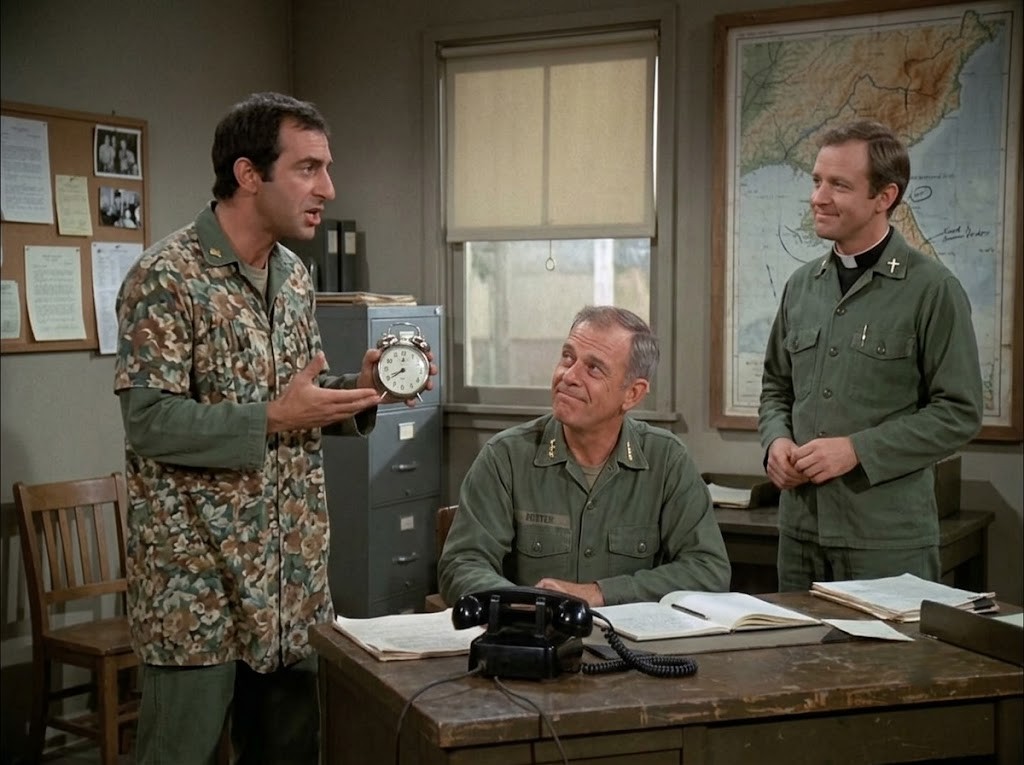
The mud in Korea had a way of slowing everything down, but inside the administrative tent of the 4077th, time was currently being cross-examined.
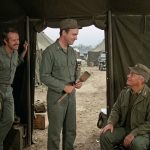
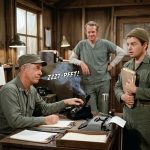
Colonel Sherman Potter sat anchored behind his desk, his expression a masterful blend of fatherly patience and old-cavalry skepticism. To his right stood Father Mulcahy, hands clasped quietly, a gentle, knowing smile gracing his face as he observed the daily theater of the camp.
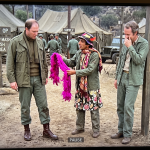
Before them stood Corporal Max Klinger, resplendent in a custom-tailored, floral-patterned camouflage smock that defied every known military regulation. In his hands, held aloft like a priceless artifact or a ticking piece of unexploded ordnance, was an old, chrome twin-bell alarm clock.
“Colonel, I’m telling you, this isn’t just about a spring and a couple of gears,” Klinger insisted, his voice rising with theatrical urgency as he gestured toward the clock face. “This is a matter of psychological survival! Look at it, sir! It’s losing exactly three minutes every single hour!”
Potter leaned back, his eyes tracking the movement of Klinger’s hands. “Klinger, it’s an alarm clock. In this army, losing three minutes an hour sounds like a promotion. Most of us are trying to lose years.”
“But you don’t understand the delicate ecosystem of the post-operative ward, Colonel,” Klinger pressed on, turning to enlist Father Mulcahy with an imploring look. “The boys look at this clock. When they see the hands moving backward relative to the rest of the world, they think they’re trapped in a twilight zone. Hawkeye told them it’s a temporal anomaly caused by the swamp juice, and now half the ward is refusing to sleep because they think tomorrow won’t happen!”
Father Mulcahy let out a soft chuckle, his eyes twinkling. “Now, Corporal, I’m sure Captain Pierce was merely trying to inject a bit of levity into a very long night shift.”
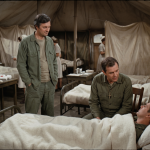
“Levity, Father? With all due respect, I’m the one who has to explain to a sergeant from Toledo why his breakfast is arriving thirty minutes before his watch says he woke up!” Klinger turned back to Potter, his face deadly serious now. “This clock belonged to Private Danny Miller. The kid from Iowa who spent three weeks in bed four before they shipped him out to Tokyo yesterday morning.”
The mood in the room shifted instantly, the light humor catching on the memory of the young private.
“He left it on his nightstand, Colonel,” Klinger said softly, his voice dropping its dramatic edge. “He told me that as long as those bells kept ringing on time, he knew the 4077th was still watching over the rest of the guys. I promised him I’d keep it wound. But it’s dying, sir. And if it stops, I feel like we’re breaking a promise.”
Potter’s face softened, the dry sarcasm melting away into the deep, tired compassion of a man who carried the weight of two hundred souls on his shoulders. He looked from Klinger’s earnest face down to the scratched chrome of the clock, the room suddenly growing so quiet that the faint, erratic *tick-tick-tick* of the dying mechanism seemed to fill the entire space.
—
Colonel Potter looked at the clock, then up at Klinger, whose eyes held none of his usual schemes for a Section 8 discharge. In this quiet corner of the office, captured so perfectly in the spirit of the 4077th, the true heart of the camp was beating—hidden behind a ridiculous floral shirt and an old piece of brass.
“Let me see the patient, Corporal,” Potter said softly, extending a hand.
Klinger carefully handed the clock over, placing it into the Colonel’s weathered palms as if it were a fragile bird. Potter turned it over, his thumb tracing the worn winding keys on the back. He gave the knob a gentle twist, but it met stiff resistance, emitting a harsh, scraping sound.
“Mainspring’s choked with Korean dust,” Potter muttered, a look of professional diagnosis on his face. “Brought a lot of it in from the road during Tuesday’s deluge, I reckon. It’s tired, Klinger. Just like the rest of us.”
Father Mulcahy stepped forward, placing a comforting hand on Klinger’s shoulder. “A promise made to a soldier is a sacred thing, Max. But sometimes, despite our best efforts, the things of this world simply wear out. The sentiment you showed Private Miller doesn’t fade just because the gears do.”
“I know, Father,” Klinger said, his shoulders slumping a bit beneath the vibrant pattern of his smock. “It’s just… when Danny was leaving, he looked so scared. He was gripping that duffel bag, and he looked back at the ward and said, ‘Keep the clock ticking, Klinger. It lets me know you’re all still here.’ I just wanted to keep it going for him. For all of them.”
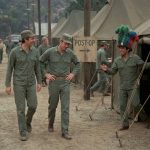
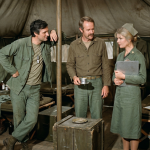
Just then, the screen door banged open, and Hawkeye Pierce slouched into the office, a half-eaten apple in one hand and a stethoscope draped around his neck like a silver tie. B.J. Hunnicutt followed a step behind, his face lined with the telltale exhaustion of a twelve-hour stint in the plaster room.
“What’s the caucus for?” Hawkeye asked, taking a bite of the apple. “Are we court-martialing Klinger for crimes against camouflage, or is the Colonel finally handing out early departures for good behavior?”
“We are dealing with a crisis of time, Pierce,” Potter said, not looking up as he tapped the side of the clock against his palm. “Danny Miller’s alarm clock is giving up the ghost.”
Hawkeye’s smirk vanished, replaced by a quiet, reflective look. He and B.J. exchanged a glance. They had both spent hours over Miller’s shattered leg, fighting the clock in a completely different way under the harsh lights of the OR.
“Ah, the Miller timekeeper,” B.J. said, stepping closer to the desk. “I remember him winding that thing at precisely 2100 hours every night. Said the sound reminded him of his father’s workshop in Cedar Rapids.”
“Exactly!” Klinger cried, his theatrical energy returning as he found his allies. “Thank you, Captain Hunnicutt! It’s a piece of home! We can’t just let it die in a filing cabinet!”
Hawkeye walked over to the desk, leaning over Potter’s shoulder to peer at the clock face. “You know, Charles Winchester claims to have a cousin who is a master horologist in Boston. Of course, Charles also claims his family invented the minute hand, but we might be able to shush him into looking at it.”
“Major Winchester wouldn’t touch a common alarm clock with a ten-foot pole, Pierce,” Potter said, a small smile returning to his lips. “He’d claim it lacked breeding.”
“Then we do surgery,” Hawkeye said simply. He reached out and tapped the glass. “Look at it. It’s not dead. It’s just bradycardic. It needs a little lubrication, a little love, and maybe a touch of Radar’s grape juice to grease the wheels.”
Father Mulcahy smiled warmly, looking around the room at the gathered staff. “It seems, Colonel, that the camp has found its new patient.”
Potter looked at the faces of his officers and his clerk. They were exhausted, filthy from the mud, and starved for sleep. Yet here they were, standing in a cramped administrative tent, deeply invested in the survival of a five-dollar piece of metal because it carried the memory of a boy who was already hundreds of miles away.
“Alright, Klinger,” Potter said, handing the clock back to the corporal. “Take it over to the Swamp. Tell Pierce and Hunnicutt they have exactly one hour to perform a miracle before the evening shift starts. If it’s still losing time by dinner, I’m donating it to Radar’s guinea pigs.”
Klinger’s face lit up, a brilliant, gap-toothed smile breaking through his anxiety. “Sir, you won’t regret this! The 4077th time standard will be preserved! Thank you, Colonel. Thank you, Father.”
As Klinger cradled the clock and hurried out of the tent, followed closely by Hawkeye and B.J. arguing over whether a clock required a local anesthetic, Father Mulcahy watched them go through the screen door.
“They’re good men, Sherman,” the priest said softly.
Potter sighed, leaning back in his chair and picking up his pen to return to the endless mountain of paperwork. The faint, distant sound of laughter drifted across the compound from the direction of the Swamp, breaking through the heavy, humid Korean air.
“The best, Father,” Potter murmured, looking out the window at the dusty tents. “The absolute best.”
In a place where tomorrow was never guaranteed, sometimes keeping a promise was the only way to make sure the world kept turning.