The Day the Papers Cried Uncle
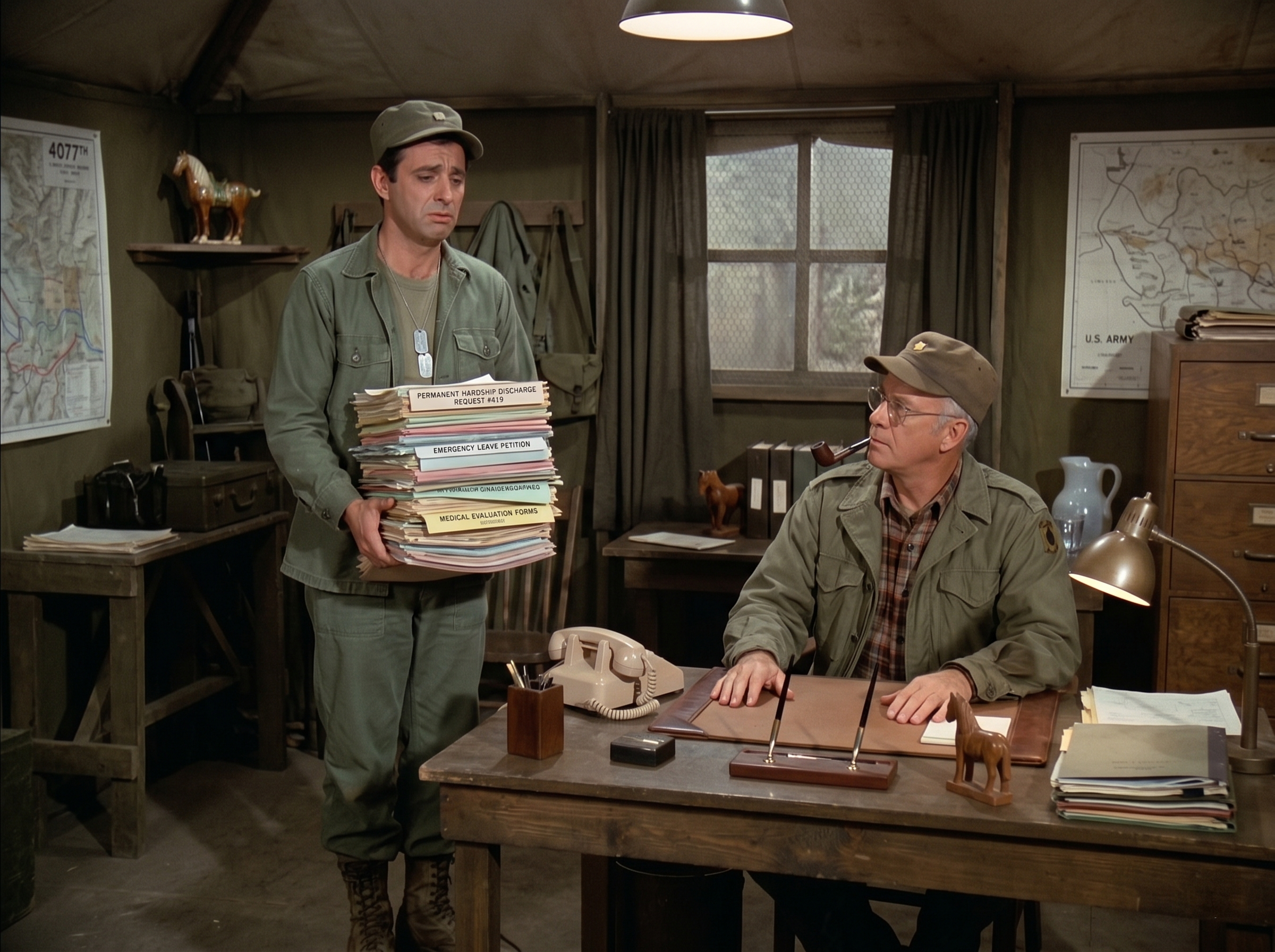
If there’s one thing you could count on at the 4077th, besides the endless supply of purple hearts and mud, it was the paper.
The relentless, indifferent bureaucracy of the United States Army churned out forms faster than we could stitch up GIs.
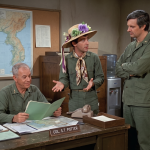
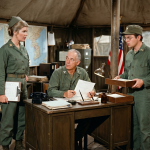
In Colonel Potter’s office, the air usually smelled faintly of Old Spice and good bourbon, a sanctuary of sanity in a mad world.
But that Tuesday, the atmosphere was different.
It felt heavy.
Klinger had walked in looking like he’d been dragged through a minefield backwards.
He was standard-issue fatigue green that day, for once, his latest request for a Section 8 seemingly abandoned in favor of sheer, exhausted duty.
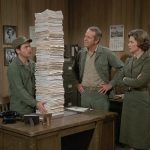
He was cradling a stack of papers that reached his nose, balanced precariously like a leaning tower of red tape.
The top layer of folders read, clearly, and heartbreakingly, “PERMANENT HARDSHIP DISCHARGE REQUESTS.”
The Colonel, pipe clamped firmly in his jaw, didn’t move a muscle as he stared at Klinger.
He looked less like a commanding officer and more like a weary father who’d just been handed a pile of unpaid bills.
Klinger’s eyes, wide and almost glassed-over with fatigue, pleaded.
He stood there, shifting slightly under the weight of the paper, the small ceramic horse on the shelf over his shoulder looking like the only thing with any structure left in the room.
“It’s not just forms, Colonel,” Klinger said, his voice unusually soft, cracked.
“They’re… they’re stories. And most of them are about moms.”
That was the high point. The moment the paperwork stopped being an abstract mountain and became a collective, documented ache.
Colonel Potter didn’t look at the papers. He continued to look at Klinger.
The quiet, almost tender connection between the regular army cavalryman and the kid from Toledo who was just trying to go home was palpable.
This wasn’t Klinger the clown, in another dress.
This was Klinger the messenger, carrying the crushing reality of hundreds of boys who just wanted to see their families again before they broke.
The silence stretched, thick enough to stir with a scalpel.
“Set ’em down, son,” Potter finally said, removing his pipe and placing it gently in the glass tray.
Klinger didn’t just drop them. He eased the stack onto the edge of the large wooden desk, making sure “PERMANENT HARDSHIP DISCHARGE” was facing the Colonel.
He exhaled, a long, shaky breath that seemed to deflate his whole tired frame.
The Colonel slowly stood up and walked around the desk.
He put a steadying hand on Klinger’s fatigued shoulder.
He didn’t say any of the standard army platitudes. He didn’t promise to process them immediately. He just acknowledged the burden.
“Some of these kids…” Klinger began again, his voice thicker now. “One boy wrote about how his father died, and his mother is running the entire farm by herself. She’s too old, Colonel. She needs him. And he’s sitting over there waiting to die because he happened to get drafted. It just… it’s not right.”
The Colonel nodded slowly. “No, Klinger. It isn’t right. Most of this war isn’t right.”
For all the cynicism and wit that flew around the camp—the Hawkeye barbs and the Trapper quips—there was a core of deep decency that kept the 4077th from being swallowed by the surrounding darkness.
This was that core.
The paperwork represented an impossible decision for the Colonel, but for Klinger, it was the raw, unedited proof that the world outside this tent was hurting just as much as the operating room.
Klinger looked at the Colonel’s desk. The neat arrangement of pen sets, the desk lamp, and that small, worn ceramic horse, a reminder of a gentler, four-legged life.
“The papers… they make you feel so small, don’t they?” Klinger said.
The Colonel chuckled dryly, a sound that held no humor. “They make you feel small so the brass can feel big. But you and me, Klinger… we’re not going to let them make us small. Not when we’re standing right here.”
Klinger stood a little straighter. The weight of the world hadn’t disappeared, but it was being shared.
“Go on and get some coffee, Klinger,” the Colonel said. “That stack is still going to be here when you get back.”
Klinger nodded, a single, firm movement, and turned towards the tent flap.
Before he left, he looked back. “Colonel? That boy’s mother… her name is Millie. Just thought you should know.”
Potter didn’t answer. He just picked up the first folder, carefully opened it, and began to read.
When Klinger stepped back out into the bright Korean sun, the sound of the base was still the same: the chopping of wood, the occasional jeep engine, the distant thunder. But the world felt, just for a moment, slightly less indifferent.
Beneath the khaki and the comedy, we were all just one big, broken family, holding each other together with red tape and raw humanity.