The Silent Inventory of Friendship
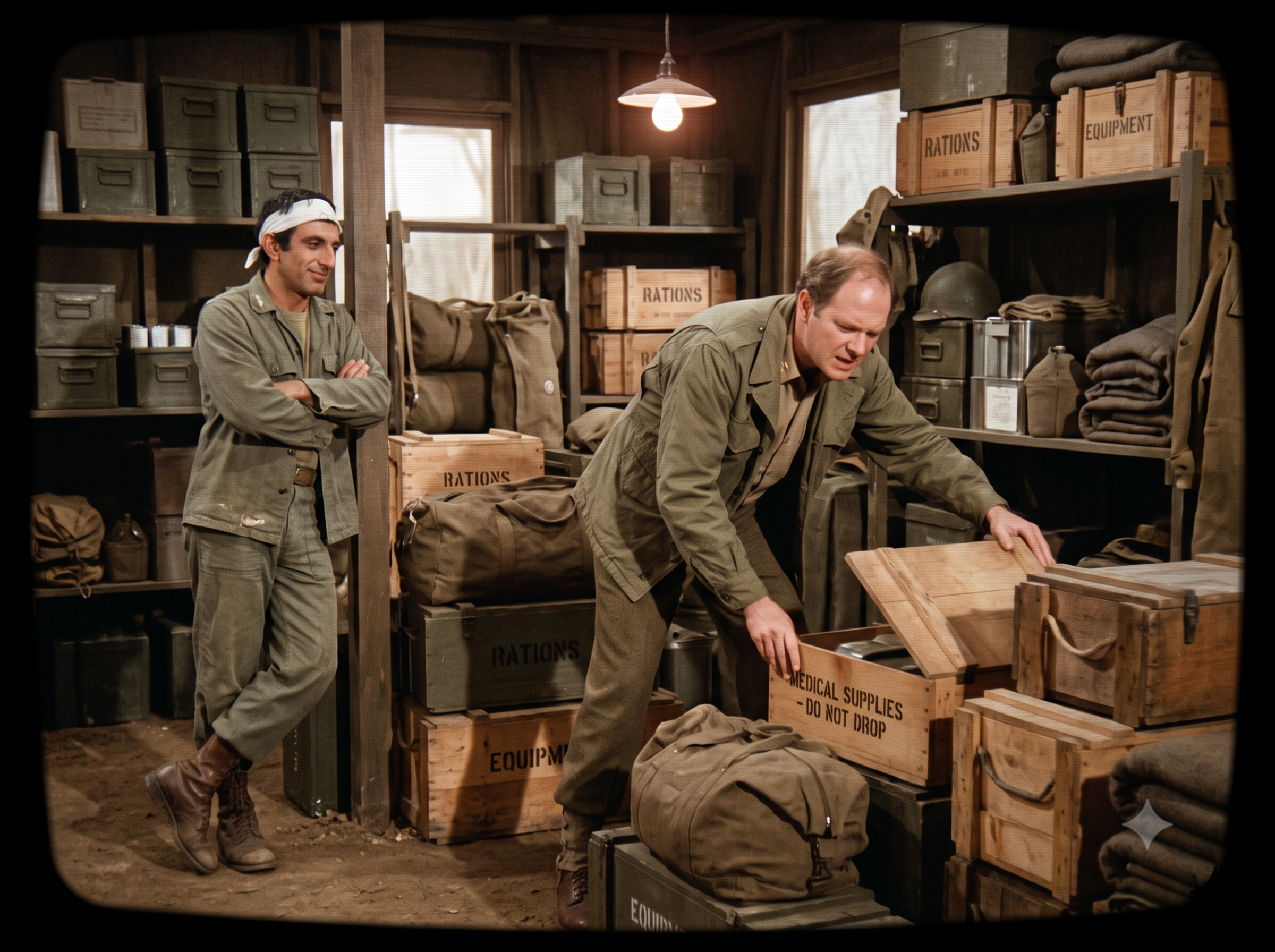
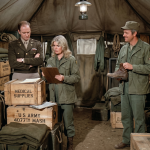
The supply tent always smelled the same—a heady, suffocating mixture of raw pine, damp canvas, and the relentless dust of Korea. It was a place where things were counted, filed, and occasionally lost to the abyss of military bureaucracy. On this particular afternoon, the air felt heavier, stagnant with the kind of fatigue that seemed to settle into the very marrow of your bones after a long, grueling stretch in the OR.
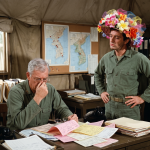
Hawkeye stood by the rough-hewn shelving, his arms crossed over his chest, a makeshift bandage wrapped around his head. He looked less like the irreverent surgeon who could crack a joke in the middle of a triage and more like a man who had seen just a little too much for one lifetime. He wasn’t doing much, just leaning, watching, his eyes tracing the shadows in the rafters with an expression that sat somewhere between exhaustion and quiet contemplation.
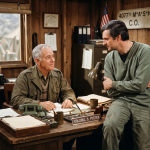
Across from him, Winchester was knee-deep in the chaotic heart of a wooden crate, his hands meticulously shifting through medical supplies as if he were sorting through a stack of fine, rare records back in Boston. His uniform was immaculate despite the dust, though his usual air of unassailable superiority had frayed at the edges. He was searching for something, his movements deliberate, his jaw set in a line of intense, singular focus.
“Charles, if you’re looking for the lost city of gold, I believe that’s in the other tent next to Klinger’s stash of silk stockings,” Hawkeye finally offered, his voice raspy, lacking its usual sharp-edged bite.
Winchester didn’t look up, his fingers brushing past gauze and vials. “Your levity is as ill-timed as it is tedious, Pierce. I am searching for a specific scalpel blade. A precise instrument, which, in this godforsaken outpost, seems to have vanished alongside our dignity.”
Hawkeye uncrossed his arms, shifting his weight. “Maybe it grew legs and walked away to a better life. I wouldn’t blame it.”
Winchester froze, his hand hovering over the wooden rim of the box. He turned slowly, his face drained of its usual color, his eyes searching Hawkeye’s with a sudden, startling vulnerability. “It’s not just a blade, Pierce. It’s for the boy. The one who came in during the night shift. If I don’t have the right equipment, the closure will be… substandard.”
The silence that followed was absolute, punctuated only by the distant, rhythmic thrum of a helicopter engine somewhere far out over the hills. Hawkeye’s breath hitched, the playful cynicism evaporating, leaving behind a stark, naked concern that hit harder than any lecture.
Hawkeye straightened up, his feet suddenly feeling firm on the dirt floor. The fatigue that had anchored him to the shelves shifted. He walked over to the crate, the space between them shrinking until they were standing side-by-side in the dimly lit tent. He didn’t offer another joke. He didn’t offer a lecture. He simply looked down into the crate, his eyes scanning the jumble of supplies with the same precision that Winchester possessed.
“It’s not here, Charles,” Hawkeye said quietly, his voice now steady and anchoring. “But I think I know where it might be.”
Winchester let out a breath he seemed to have been holding for hours, his shoulders dropping from their rigid posture. “And where, pray tell, would that be? In the Colonel’s desk? Or perhaps filed under ‘W’ for ‘waste of time’?”
“Klinger,” Hawkeye replied with a faint, tired smirk. “He was hoarding a shipment of special orders earlier this week, trying to find a better brand of moisturizer. He might have accidentally tucked the high-grade steel in with the grooming supplies.”
Winchester stared at him, then let out a short, sharp sigh that was closer to a chuckle than his usual scoff. He wiped a hand across his forehead, smearing a bit of dust, and closed the wooden crate with a gentle *thud*. “I suppose I should be horrified that our surgical inventory is governed by a man in a floral dress, yet somehow, it feels entirely appropriate.”
“We live in a world of madness,” Hawkeye whispered, placing a hand briefly, almost instinctively, on Winchester’s shoulder—a gesture that, in any other setting, would have been rebuffed, but here, in the dim light of the supply tent, felt like a bridge. “But we manage to keep the lights on, don’t we?”
They stood there for a moment longer, surrounded by the crates of rations and the heavy scent of canvas. The tension hadn’t fully vanished, but it had transformed. It was no longer the sharp, jagged friction of two opposites clashing, but a quiet, shared understanding. They were two men who disliked much about each other, yet were bound by the absolute necessity of caring for those who could not care for themselves.
As they turned to leave the tent, stepping out into the fading, amber glow of a Korean twilight, the world outside looked just as scarred and broken as before. But the weight didn’t feel quite so crushing. The supplies were there, the work was waiting, and the morning would bring its own inevitable chaos.
Yet, for a brief, fleeting moment, they had stopped counting the supplies and realized they were, in their own messy, fractured way, taking inventory of something much more important: the realization that no one here was truly doing it alone. They walked back toward the compound, two ghosts in olive drab, heading toward the next emergency, the next smile, and the next sunrise, together.
In the heart of the madness, the quietest victories are the ones that keep us human.