A Quiet Harbor in the 4077th
The generator at the 4077th had a specific hum when the camp was entirely exhausted. It was a low, mechanical growl that vibrated through the floorboards, a constant reminder that the war never really slept.
But inside Colonel Sherman Potter’s office, there was a rare, fragile quiet.
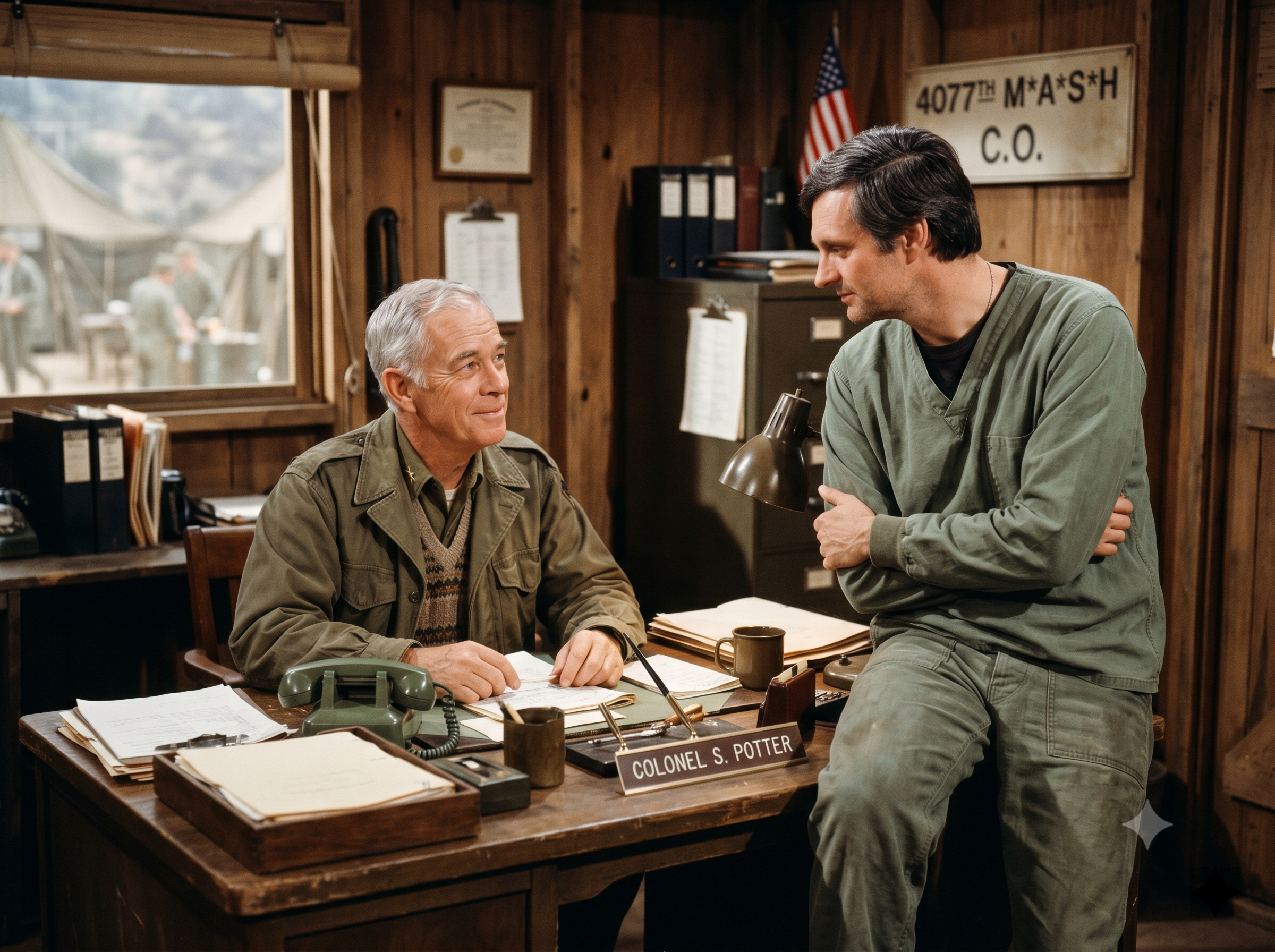
The olive-drab walls were insulated by the soft, warm glow of a practical desk lamp. The shadows were chased away by the amber light pooling across the worn wooden desk.
It felt less like a military outpost and more like a study in a Midwestern home.
Hawkeye Pierce wandered through the door without knocking. He didn’t have the energy for protocol, and he knew he didn’t need it here.
He wore his green surgical scrubs over a black cotton undershirt, the uniform of a man who had spent the last eighteen hours elbows-deep in someone else’s tragedy.
He didn’t make for the leather chair. Instead, he simply stopped at the edge of the desk and leaned his weight against it.
He folded his arms across his chest, a physical barricade against the chill of the Korean night and the lingering ghosts of the operating room.
Behind the desk sat Colonel Potter.
He was a portrait of seasoned authority wrapped in a wool sweater vest and an olive drab shirt. The brass oak leaves on his collar caught the light, but it was the deep, knowing lines around his eyes that truly commanded the room.
Potter had a stack of requisition forms in front of him, a coffee mug sitting near his elbow, and the heavy green field phone resting silently, thankfully, on its cradle.
He looked up as Hawkeye anchored himself to the desk.
“Evening, Pierce,” Potter said, his voice a low, gravelly rumble of comfort. “Or is it morning? My watch surrendered three days ago.”
Hawkeye stared down at the wooden surface. He was trying to summon a joke. It was his reflex, his armor, his only way to deflect the staggering weight of the day.
“It’s officially the hour of the wolf, Colonel,” Hawkeye said, his voice raspy. “Or maybe the hour of the ferret. Whatever animal runs entirely on stale coffee and unearned optimism.”
Potter didn’t offer a polite chuckle. He just watched his chief surgeon.
He saw the way Hawkeye’s shoulders slumped. He saw the dark, bruised exhaustion beneath his eyes.
“You look like ten miles of bad road, son,” Potter observed mildly.
“I feel like twenty,” Hawkeye replied. He shifted his weight, looking thoughtful, quietly wounded beneath the tired banter. “Tell me you have a magic wand in that middle drawer, Sherman. A one-way ticket to Maine. A sudden, miraculous end to human stupidity.”
Potter set his pen down beside his wooden nameplate. COLONEL S. POTTER. The silence stretched between them, thick and heavy with the things they didn’t want to say out loud.
Hawkeye finally looked up, meeting the older man’s gaze. The wisecracking swamp rat was gone, replaced by a doctor who had simply seen too much.
“We lost three in the last shift, Colonel,” Hawkeye’s voice cracked, just a fraction. “Three kids who shouldn’t have even been shaving yet, let alone catching shrapnel. Tell me… does it ever actually make a difference? Or are we just bailing water on a sinking ship?”
The question hung in the warm air, raw, desperate, and begging for an answer that a lesser man couldn’t give.
Colonel Potter didn’t flinch.
He had heard that question before. He had asked it himself, in muddy trenches in France and sweaty jungles in the Pacific.
He leaned back in his chair, the wood groaning softly in protest.
He looked at Hawkeye with a calm, unshakeable clarity. There was no pity in his eyes, only a deep, fatherly pride and a shared understanding of the burden.
“Bailing water, Pierce?” Potter asked gently. “Is that what you think you were doing in there today?”
Hawkeye kept his arms crossed, his jaw tight. “Felt like it. The choppers just keep coming. It’s an assembly line of misery, and I’m the guy with the wrench trying to tighten bolts on a machine that’s designed to break.”
Potter rested his hands on his desk. The warm light caught the silver in his hair.
“You’re looking at the whole ocean, Hawkeye,” Potter said, his tone steady and grounding. “You can’t do that. You look at the ocean, you drown in it. It’s too big. Too senseless.”
Hawkeye let out a shaky breath, his eyes dropping back down to the edge of the desk.
“You want to know what I see?” Potter asked.
Hawkeye didn’t answer, but he didn’t pull away. He stood there, absorbing the quiet safety of the room.
“I don’t see a sinking ship,” Potter continued. “I see a young private from Ohio waking up in post-op with two legs instead of one. I see a corporal from Detroit who gets to go home and marry his sweetheart because you spent four hours stitching his liver back together like a quilt.”
Hawkeye shifted, the praise making him uncomfortable. He deflected, true to form.
“It was more like a sloppy needlepoint, Colonel. Don’t give me too much credit.”
Potter smiled. It was a small, warm thing that reached all the way to his eyes.
“I’ll give you exactly the credit you’ve earned, Captain,” Potter said softly. “You’re not saving the world, Pierce. None of us are. That’s above our pay grade. But you saved a piece of it today. And yesterday. And you’ll do it again tomorrow.”
The quiet emotional beat settled over the room.
The tension that had been keeping Hawkeye rigid began to melt. It was slow, almost imperceptible, but the frantic, wounded energy in his chest started to quiet down.
The office felt like a sanctuary.
The smell of canvas, the muted glow of the desk lamp, the neat stacks of folders in the cabinet behind Potter. It was a tiny island of sanity in a sea of chaos, anchored entirely by the man sitting behind the desk.
Hawkeye uncrossed his arms and let his hands rest on the wood. He looked at Potter, truly looked at him, and saw the moral clarity that kept the entire 4077th from falling apart.
“You always have the right answer, don’t you, Colonel?” Hawkeye asked. The edge was completely gone from his voice.
“Not always,” Potter admitted, picking up his pen again. “But I’ve got a few more miles on my tires than you do. I’ve learned how to drive in the dark.”
Hawkeye let out a soft, genuine exhale. It was half-laugh, half-sigh.
“I’ll try to remember that next time I hit a pothole,” Hawkeye said.
“You do that,” Potter replied, his eyes dropping back to his paperwork, though the gentle pride remained on his face. “Now, get out of my office and go to sleep, Pierce. Your face is scaring the filing cabinets.”
Hawkeye pushed himself off the edge of the desk. His legs still felt like lead, and the exhaustion was still there, bone-deep and heavy.
But the despair was gone.
He felt grounded. He felt seen. Most importantly, he felt like he wasn’t carrying the weight of the war entirely by himself.
“Yes, sir,” Hawkeye said, his voice quiet and respectful. “Goodnight, Sherman.”
“Goodnight, Hawkeye.”
Hawkeye turned and walked out into the chilly Korean night, leaving the warmth of the office behind.
The war was still waiting for him outside, loud and terrible.
But as he walked back to the Swamp, the darkness didn’t seem quite so impossible to navigate.
Sometimes the greatest medicine prescribed at the 4077th wasn’t found in the OR, but across a wooden desk in the quiet company of a friend who understood.