Mail Call at The Swamp
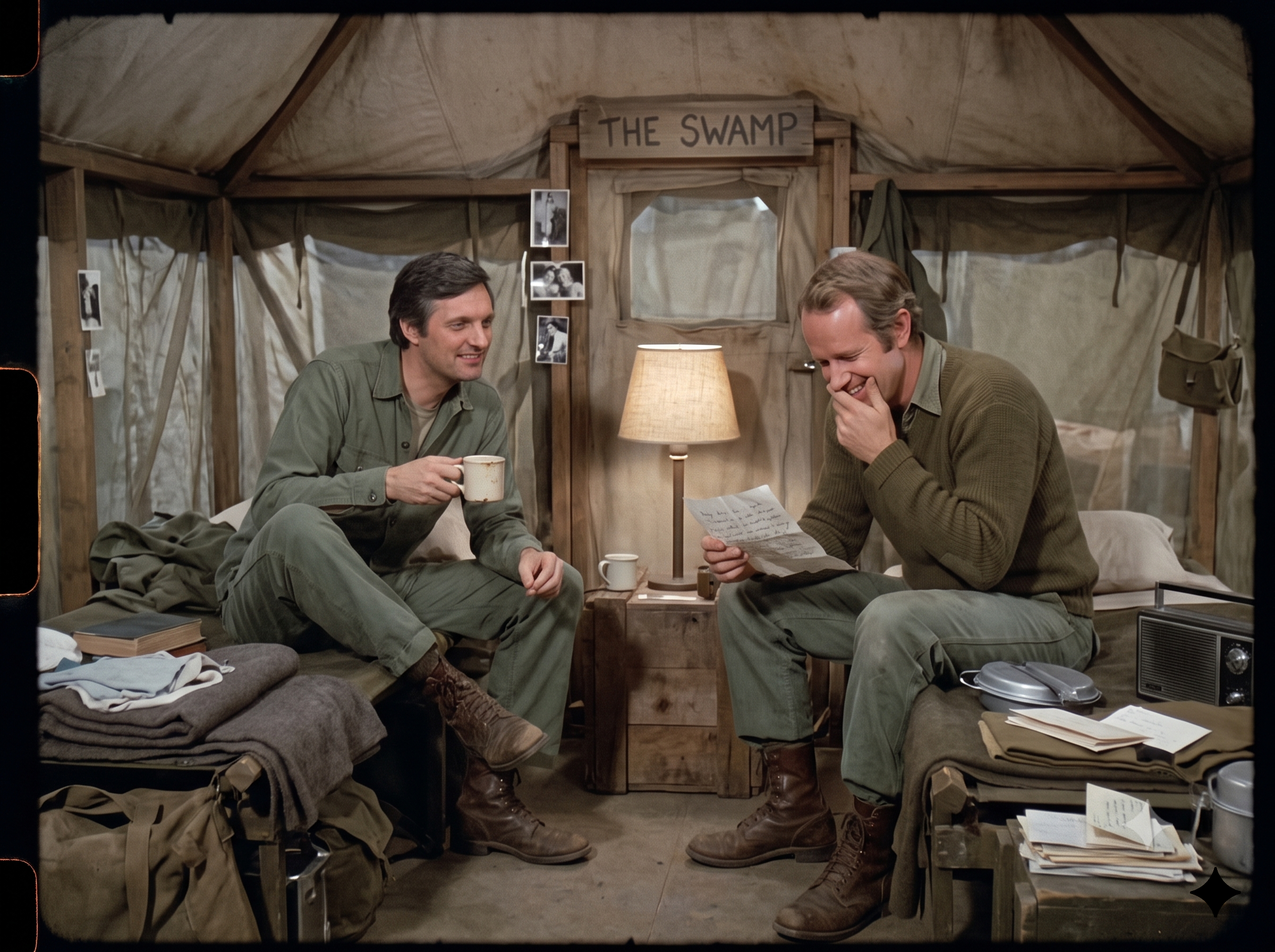
The mud outside was a given, a thick, pervasive reminder of where we were, but inside “The Swamp,” the world felt just a few degrees smaller, and perhaps, a little more human. It was one of those rare, quiet evenings where the shelling had held off, leaving us with nothing but the low hum of the generator and the clinking of cheap china.
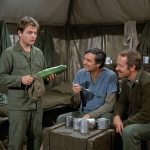
Hawkeye sat on the edge of his cot, his uniform wrinkled from a twelve-hour shift, cradling a mug of coffee that was likely more grounds than water. He looked at B.J., who was perched on the opposite bunk, his posture slightly hunched over a piece of crinkled paper.
B.J. was reading a letter from home, his thumb tracing the crease in the stationery. He started with a soft, lopsided grin, the kind he saved for the moments he felt closest to Mill Valley, but as he moved further down the page, his expression shifted. The humor in his eyes didn’t vanish, but it deepened, turning into something sharper, something that made Hawkeye stop mid-sip.
“Everything alright, Beej?” Hawkeye asked, his voice low, testing the air.
B.J. didn’t answer right away. He let out a soft, incredulous huff of laughter, but there was a tremor in his hands that betrayed the smile. He looked up, his eyes bright and glassy, holding the paper as if it were a fragile artifact from a life that felt like a dream.
“You’re not going to believe this,” B.J. started, his voice cracking just enough to turn the room electric. He held the letter up, his laughter bubbling over, but it was the kind of laughter that sat right on the edge of a sob. The tension in the small room spiked, the air suddenly thick with the weight of miles and the unbearable ache of being so far away.
Hawkeye shifted, setting his mug down on the wooden crate that served as their end table. He leaned in, bracing himself, because in the 4077th, laughter was rarely just laughter—it was usually a frantic, desperate defense mechanism against the sadness that lived in the corners of every tent.
“Well?” Hawkeye pressed, his own face softening into that familiar mask of concerned wit. “Does it involve a goat, a misplaced wedding ring, or did Peg finally decide to adopt that stray dog you wrote her about?”
B.J. wiped a hand across his face, shaking his head. “It’s Erin,” he said, his voice dropping to a whisper of pure, unadulterated joy. “She started walking. And apparently, she’s decided that the best way to travel is to mimic the way I walk, which Peg says is a ‘lumbering, seafaring gait.’”
He laughed again, a genuine, chest-shaking sound that pushed back the shadows of the surgery tent and the cold Korean night. Hawkeye joined him, the tension snapping like a rubber band. They sat there for a long moment, two tired men in olive drab, laughing at the sheer, beautiful absurdity of a toddler halfway across the globe, blissfully unaware of the war that separated her from her father.
For a few minutes, The Swamp wasn’t a tent in a demilitarized zone. It was a porch in California, it was a living room filled with warmth, and it was the center of the universe. They talked about the little things—the way the house sounded, the specific smell of the laundry, the way time felt both like a race and a prison sentence.
The lamp between their cots cast a warm, amber glow, turning the canvas walls into a sanctuary. It was a fragile peace, one built on memories and the lifeline of ink on paper, but it was enough. It had to be.
Eventually, the laughter subsided into a companionable silence. B.J. folded the letter carefully, tucking it back into his pocket like a talisman. Hawkeye picked up his coffee again, the steam rising in the quiet air. They were tired, they were miles from home, and tomorrow would almost certainly bring more of the same, but in that small, crowded tent, they were tethered to something real.
They didn’t need to say anything else. The look they shared was enough—a silent acknowledgment of the pain, the pride, and the quiet, stubborn hope that kept them going. They were just two doctors in a war zone, but for that moment, they were just men who loved their families, and that was enough to get them through the night.
In the heart of the mud, we find the people who make the distance disappear.