The Weight of the Paperwork
The 4077th was rarely quiet, but when the silence finally came, it was heavier than the noise.
It was past midnight. The distant rumble of artillery had faded into a low, dull ache somewhere over the hills. Inside the commanding officer’s office, the sputtering oil stove fought a losing battle against the biting Korean chill.
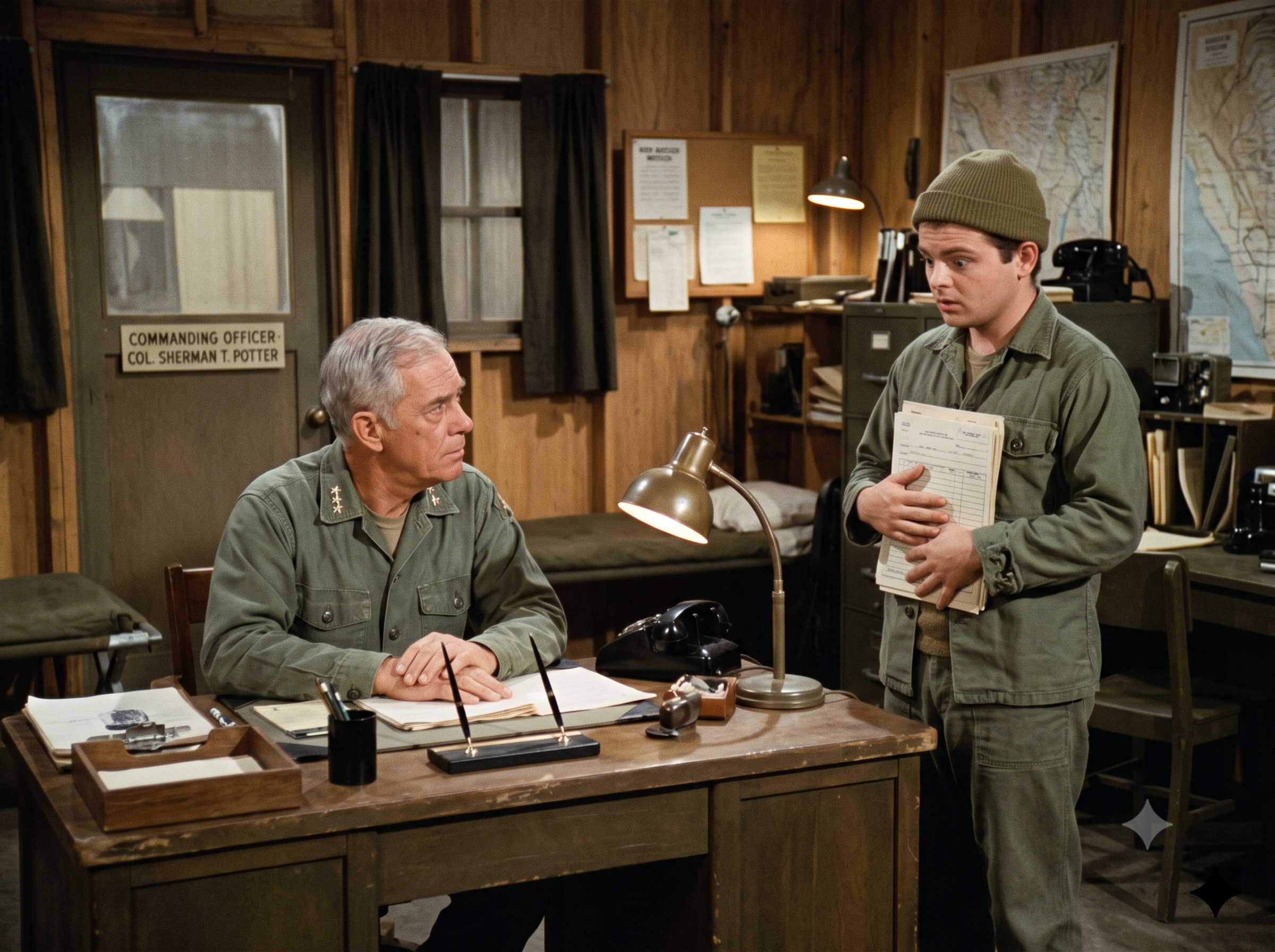
Colonel Sherman T. Potter sat behind his wooden desk, bathed in the warm, practical glow of a single desk lamp. The harsh overhead bulbs were off, leaving the fading olive walls and the scuffed wooden filing cabinets drowning in shadows.
Potter rubbed his eyes, feeling every single one of his years. He was an old cavalry man, a doctor who had seen too many wars and patched up too many boys.
He leaned forward slightly, resting his arms on the cluttered desk. He was ready to pour a small glass of something strong and call it a night, but the sudden draft from the canvas door told him his shift wasn’t quite over.
Standing just inside the doorway was Corporal Walter “Radar” O’Reilly.
Radar wasn’t speaking. He was just standing there, frozen in polite attention. He looked incredibly small in his oversized olive-drab wool shirt, clutching a thick stack of mimeographed forms directly to his chest like a handmade shield.
His posture was rigid, but his hands were trembling just enough to make the thin paper rustle.
Potter didn’t need a medical degree to diagnose the boy. Radar was terrified.
“At ease, son,” Potter said softly, his voice a low, gravelly rumble that usually calmed the camp. “If you stand any stiffer, you’re going to snap in half and I’ll have to put you in a splint.”
Radar swallowed hard, but he didn’t relax. His wide, innocent eyes darted nervously around the modest room before locking onto the Colonel.
“I can’t be at ease, sir,” Radar squeaked, his voice pitching up an octave. “If I go at ease, I might fall over, and if I fall over, I’ll drop these papers, and if I drop these papers, the whole United States Army is gonna come down here and arrest me.”
Potter sighed, a patient expression of weary wisdom settling across his lined face. He had commanded thousands of men, but this young clerk from Iowa always required a special kind of handling.
“Nobody is getting arrested tonight, Radar,” Potter said gently. “What’s in the stack?”
“Evidence, sir,” Radar said, his voice dropping to a panicked whisper.
Radar took a hesitant step forward, stopping just short of the desk. He held the forms a little tighter, his knuckles turning white.
“You see, sir, the nights are getting real cold,” Radar babbled, the words spilling out of him like water from a cracked canteen. “And post-op is freezing. The boys in there, they’re shivering so hard it’s rattling their IV stands. So, I called I-Corps to requisition fifty more wool blankets.”
Potter nodded slowly. “A reasonable request for a hospital.”
“Yes, sir. But the Quartermaster at I-Corps said blankets are restricted to combat units only until the end of the month. He said wounded men don’t need them because they’re already indoors.” Radar’s face flushed with a sudden, uncharacteristic anger. “Which is stupid, sir. Respectfully.”
“I agree, Corporal. So, what did you do?”
Radar bit his lower lip. His eyes grew even wider, filled with deep, unsure concern.
“I… I filled out Form 428-J, sir. And I reclassified fifty wool blankets as ‘Thermal Surgical Wrappings.’ And then…” Radar took a shaky breath. “Then I forged a two-star general’s authorization code to push it through.”
The quiet hum of the desk lamp suddenly felt very loud.
Potter stopped leaning forward. He sat back in his wooden chair, his face unreadable. Forging a general’s signature wasn’t a minor infraction. In a war zone, it was the kind of thing that earned a man a one-way ticket to the stockade at Leavenworth.
“Bring those here,” Potter commanded, his voice dropping its gentle tone and adopting the stern, flat authority of a regular army colonel.
Radar hesitated. He looked like a small boy being asked to hand over a broken window baseball.
Slowly, his hands shaking violently now, Radar placed the heavy stack of forms onto the wooden desk under the pool of yellow light.
Potter reached out, pulled his reading glasses down from his forehead, and looked at the top sheet. The silence in the office stretched out, thick and heavy, as the Colonel’s eyes scanned the undeniable proof of a court-martial offense.
Radar held his breath. He could hear his own heartbeat drumming in his ears.
He watched Colonel Potter’s eyes trace the lines of the forged requisition form. The old man’s face was a mask of pure military stone. Every second that ticked by felt like an hour.
“I can pack my own duffel bag, sir,” Radar blurted out, unable to handle the agonizing silence any longer.
Potter didn’t look up. He just kept reading.
“I mean, I know how to fold my socks military style, so I won’t take up too much time,” Radar rambled on, his voice trembling. “Do you think they let you keep animals in Leavenworth, sir? Because I have a pregnant guinea pig under my cot, and she’s gonna need a stable environment.”
Potter finally stopped reading. He took a slow, deep breath and removed his glasses, setting them carefully on the desk.
He looked up at the young clerk. Radar was practically vibrating with nervous energy, expecting the sky to fall.
Instead, Potter gave a soft, weary chuckle. The stern lines around his eyes softened, melting into a look of profound, fatherly tenderness.
“Corporal,” Potter said, tapping the paper with his index finger. “If you are going to commit a felony against the United States Armed Forces, you really need to learn how to spell ‘Thermal’.”
Radar blinked. “Sir?”
“You spelled it with an ‘M-U-L’. Thurmul.” Potter shook his head. “The boys down at supply aren’t the brightest bulbs on the tree, but even they know how to spot a typo. A two-star general doesn’t misspell basic medical terminology.”
Radar’s jaw dropped slightly. He stared at the Colonel, completely thrown off balance.
“I… I was typing really fast, sir,” Radar whispered. “I was nervous.”
“I can see that,” Potter said gently. “You also used the blue ink ribbon for the triplicate copy. I-Corps mandated black ink for all priority requisitions two weeks ago. You send this in, they’ll kick it back before it even hits the shipping dock.”
Radar’s shoulders slumped. The fear of prison was suddenly replaced by the crushing disappointment of failure.
“So… we aren’t getting the blankets?” Radar asked, his voice cracking. He looked down at his boots. “The guys in post-op are gonna freeze, Colonel. I just… I just wanted to keep them warm.”
Potter looked at the boy standing before him.
He saw a kid who shouldn’t be in a war zone. A kid who should be back in Iowa, worrying about crop yields and the county fair. Instead, Radar spent his days anticipating the needs of bleeding men and carrying the emotional weight of an entire surgical hospital on his small shoulders.
Radar was the heart of the 4077th, but even a heart gets tired.
Potter picked up his fountain pen. He unscrewed the cap with slow, deliberate movements.
“You’re a good boy, Walter,” Potter said quietly.
It was rare for anyone to use Radar’s real name. The sound of it made the young corporal look up, his eyes meeting the Colonel’s.
“You spend so much time looking out for everyone else in this camp,” Potter continued, his voice thick with a quiet, grounding warmth. “Hawkeye, B.J., Major Houlihan… even me. You take care of all of us.”
Potter reached out and pulled the requisition form closer to him.
“But you don’t have to carry the whole war by yourself, son. That’s what I’m here for.”
With a swift, practiced motion, Potter drew a thick line through the forged authorization code. Right beneath it, he pressed his pen to the paper and signed his own name, complete with his rank and serial number.
He authorized the theft himself.
Radar’s eyes went wider than saucers. “Colonel! You can’t do that! If they catch you, they’ll bust you down to a private!”
“Let them try,” Potter snorted, a dry, defiant twinkle returning to his eyes. “I’m an old horse cavalry man. I survived two World Wars, a depression, and Mildred’s cooking. A pencil-pusher at I-Corps doesn’t scare me.”
Potter slid the paperwork back across the desk.
“Retype this, Corporal,” Potter ordered softly. “Fix the spelling. Use the black ribbon. And send it out with the morning chopper. We’ll have those blankets by tomorrow night.”
Radar reached out and took the papers. His hands had completely stopped shaking.
The heavy, suffocating fear that had been crushing his chest was gone, replaced by a sudden, overwhelming wave of safety. He looked at Colonel Potter, really looked at him, and saw exactly what he needed to see.
A father. A protector. An anchor in a world that didn’t make any sense.
“Thank you, sir,” Radar said. It was just three words, but they carried the weight of a thousand.
“Don’t thank me, son. Just get those boys warm,” Potter said, picking up his glasses again. “And Radar?”
“Yes, sir?”
“If that guinea pig under your cot has her babies on my clean floor, you’re scrubbing the mess hall with a toothbrush.”
A small, genuine smile broke across Radar’s face. The innocent, familiar light returned to his eyes.
“Yes, sir. I’ll tell her to hold it until we find a box.”
Radar saluted—a crisp, sharp, respectful salute—and turned to leave. He stepped out of the office and back into the cold Korean night, but he didn’t feel the chill anymore.
Inside the office, Colonel Potter watched the canvas door flap shut. He smiled, turned back to his endless stack of paperwork, and let the warm light of the desk lamp guide him through the rest of the dark night.
In a place filled with so much loss, the greatest comfort was knowing you never had to carry the heavy loads alone.