The Heaviest Envelope in Korea
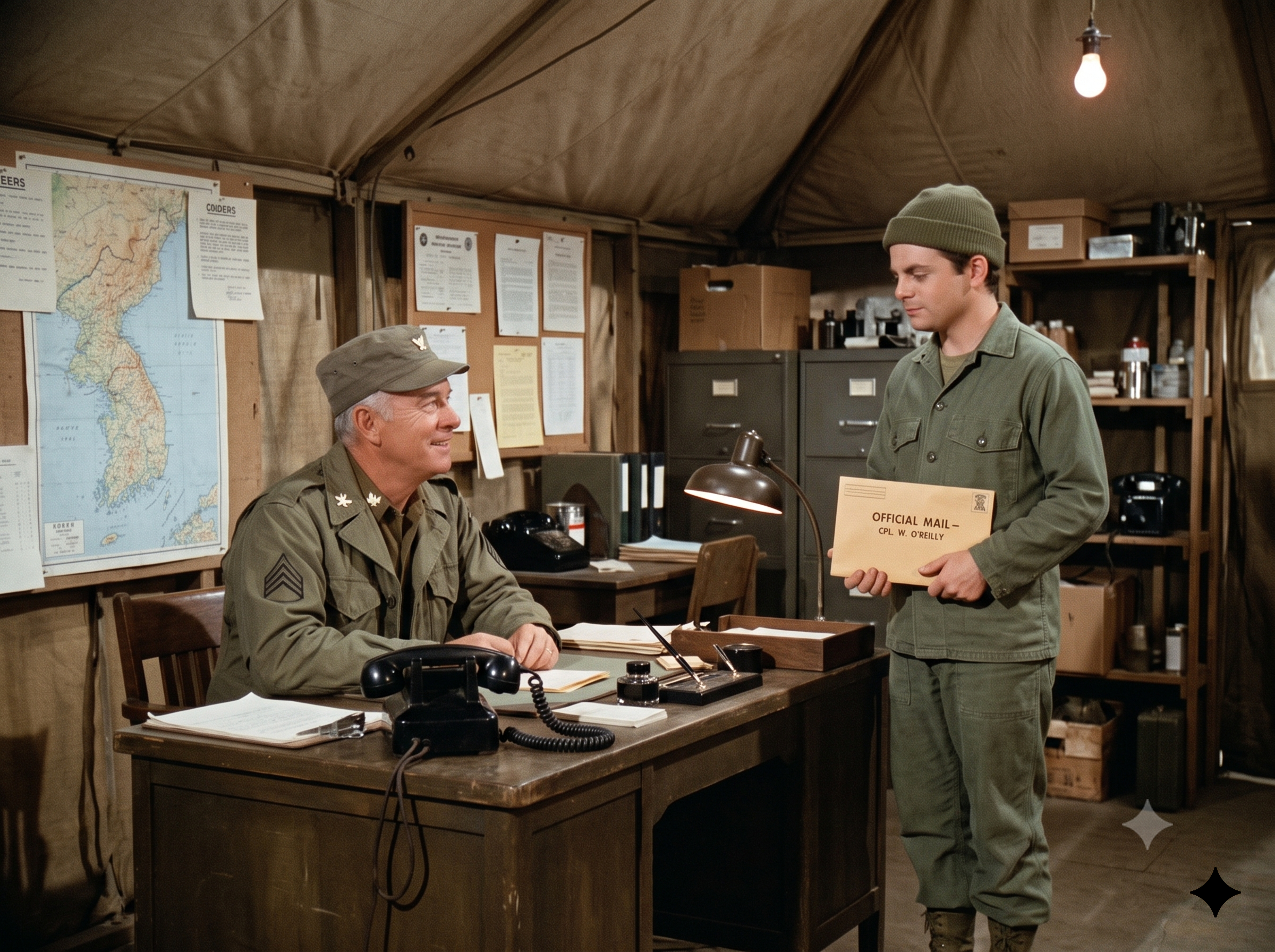
The war was always waiting just outside the canvas, but inside the commanding officer’s tent, time had a funny way of standing still.
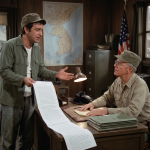
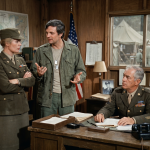
Colonel Sherman T. Potter sat behind his sturdy wooden desk, surrounded by the organized camp clutter that made the small space feel like a real office.
A lukewarm cup of coffee rested next to the heavy, olive-drab field phone. Neatly stacked personnel files sat next to a framed photograph of Mildred.
The room was bathed in soft, warm practical lighting from the desk lamp. It cast a golden hue over the tan canvas walls and highlighted the rich, warm brown wood of the desk.
It was a quiet Tuesday afternoon at the 4077th Mobile Army Surgical Hospital, a rare pocket of peace between the relentless waves of wounded.
The flap of the tent was pushed aside, and Radar O’Reilly stepped inside.
Normally, the company clerk entered the office like a startled bird, practically tripping over his own boots to deliver a frantic message from I Corps or a supply requisition that Hawkeye had forged.
Today was different.
Radar didn’t rush. He stepped dead center into the room, squared his shoulders, and stood proudly at attention.
His uniform, usually looking a little too big and rumpled, seemed to sit differently on him today. It was practical, worn, and lived-in, but his posture was perfect.
On his face was a shy, earnest smile, radiating an innocent, glowing pride that immediately caught the colonel’s attention.
Potter looked up from his paperwork, his paintbrush hovering halfway to a half-finished canvas on his easel.
He set the brush down and leaned back in his wooden chair. He projected a sense of calm control, watching the young corporal with a stern but loving, fatherly smile.
“What can I do for you, son?” Potter asked, his voice a low, gravelly rumble.
Radar didn’t speak right away. His hands were trembling just a little.
He reached forward and presented a thick, official-looking Manila envelope. It wasn’t standard Army issue. It was heavy, clean, and bore an official embossed seal in the corner.
“I, uh… I got some mail today, sir,” Radar said softly.
Potter raised an eyebrow, not reaching for it yet. “Mail from Ottumwa? How’s your mother?”
“Oh, she’s fine, Colonel. Uncle Ed’s fine, too,” Radar replied, his voice cracking slightly. “But this isn’t from home. It’s from Tokyo. And, well… I was hoping you’d be the one to open it.”
Potter looked at the envelope, then back at Radar. The boy’s eyes were wide, filled with a mixture of desperate hope and nervous energy.
Slowly, Potter reached across the desk and took the envelope. It felt surprisingly heavy in his weathered hands.
He slid his thumb under the flap, the sound of tearing paper seeming unnaturally loud in the quiet tent.
He pulled out a single, thick sheet of folded parchment.
Potter unfolded it. His eyes scanned the formal, heavy black lettering printed across the page.
The camp outside was completely silent, save for the distant, lonely hum of the motor pool generator.
The colonel stopped reading.
His face went entirely still. The familiar, deep lines around his eyes tightened, and his jaw set firmly.
He slowly lowered the paper to the desk, took off his wire-rimmed spectacles, and looked up at the young corporal.
The silence stretched on, thick and heavy. For a terrifying, heart-stopping second, Radar’s proud smile faltered, terrified he had made a terrible mistake.
For a long, agonizing moment, the air in the small office felt as heavy as a wet wool blanket.
Then, the corners of Potter’s mustache began to twitch.
The sternness in his face melted away, replaced by a smile so wide and genuinely warm that it completely transformed his tired features.
“Well, I’ll be dipped in apple butter,” Potter whispered, his voice thick with emotion.
He picked his glasses back up, put them on, and looked at the paper again, as if to make sure his eyes weren’t playing tricks on him.
“Walter Eugene O’Reilly,” Potter read aloud, letting the syllables roll around the quiet room. “General Equivalency Diploma. State of Iowa.”
Radar’s shoulders finally dropped from their rigid attention. His shy smile returned, spreading from ear to ear until his cheeks flushed pink.
“I passed, sir,” Radar said, his voice barely above a whisper. “I actually passed.”
Potter stood up from his chair. He didn’t just lean over the desk; he walked all the way around it to stand directly in front of the young clerk.
“Passed? Son, looking at these scores, you didn’t just pass. You took this test out to the woodshed.”
Radar rubbed the back of his neck, suddenly looking down at his boots. “It took a long time, Colonel. I’ve been taking the correspondence classes for over a year.”
“A year?” Potter asked, crossing his arms. “How the devil did you find the time to study while running this entire camp behind my back?”
“Well,” Radar started, looking up with that familiar innocent earnestness. “I didn’t do it alone, sir.”
He explained how it had been a quiet, camp-wide conspiracy.
Hawkeye and B.J. had spent countless nights in the Swamp, using playing cards and tongue depressors to help him understand algebra and fractions.
Major Winchester, though he complained bitterly about the “assault on the English language,” had meticulously corrected Radar’s grammar essays, refusing to accept anything less than perfection.
Even Major Houlihan had quietly slipped him her old nursing manuals when he needed to study biology.
“And Klinger?” Potter asked, an amused glint in his eye. “What was his academic contribution?”
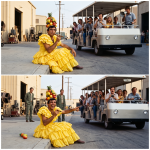
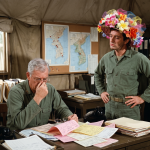
“Oh, Klinger stood guard outside the mess tent while I took the final exam, sir,” Radar grinned. “He wore his best Carmen Miranda fruit hat to distract anyone who tried to come in.”
Potter let out a sudden, barking laugh. It was a rich, deep sound that chased away the lingering shadows of the war outside.
He looked back down at the diploma. The crisp paper was a stark contrast to the mud, the canvas, and the blood that defined their daily lives.
Here was a boy who slept with a teddy bear, who could hear helicopters before the radar spun, who had seen more death before his twenty-first birthday than most men saw in a lifetime.
And yet, surrounded by all of this destruction, he had been quietly building a future for himself.
“You asked me to open it, Radar,” Potter said softly. “Why me?”
Radar shifted his weight, suddenly looking very young. “Because… well, my dad passed away a long time ago, sir. And Uncle Ed is great, but he’s in Ottumwa.”
He looked directly at Potter, his eyes shining in the warm light of the desk lamp.
“You’re the closest thing to a father I have out here, Colonel. I wanted you to be proud of me.”
Potter’s throat clicked tight. He felt a sudden, fierce stinging behind his eyes.
He had commanded thousands of men in three different wars. He had handed out medals for bravery, purple hearts for sacrifice, and folded flags for the fallen.
But right now, holding this simple piece of paper, he had never felt more honored.
“Radar,” Potter said, his voice rough with unshed emotion. “I couldn’t be prouder of you if my own name was on this paper.”
He didn’t salute. A salute was for the Army.
Instead, Potter reached out and placed a heavy, reassuring hand on Radar’s shoulder, giving it a firm, fatherly squeeze.
Radar beamed, standing a little taller, his chest swelling with a quiet, undeniable dignity.
“Now,” Potter said, clearing his throat and stepping back to his desk to mask his emotion. “I suggest you take this over to the Swamp. I believe Pierce and Hunnicutt still owe you a graduation party. And tell them to keep the still turned down, or I’ll bust you all down to buck private.”
“Yes, sir!” Radar said. He carefully took the diploma back, holding it like it was made of fragile glass.
He turned to leave, but paused at the tent flap.
“Colonel?”
“Yes, son?”
“Thanks. For everything.”
“Dismissed, Corporal,” Potter said softly, with a warm nod.
Radar slipped out into the dusty compound, leaving the commanding officer alone once again in his quiet, cluttered sanctuary.
Potter sat back down in his wooden chair. He picked up his paintbrush, looked at the empty space where Radar had just stood, and smiled a quiet, bittersweet smile.
The war would be waiting for them tomorrow, but today, they had won a small, beautiful victory.
In a place dedicated to putting broken pieces back together, someone was finally building something whole.