The Unspoken Symphony of Post-Op
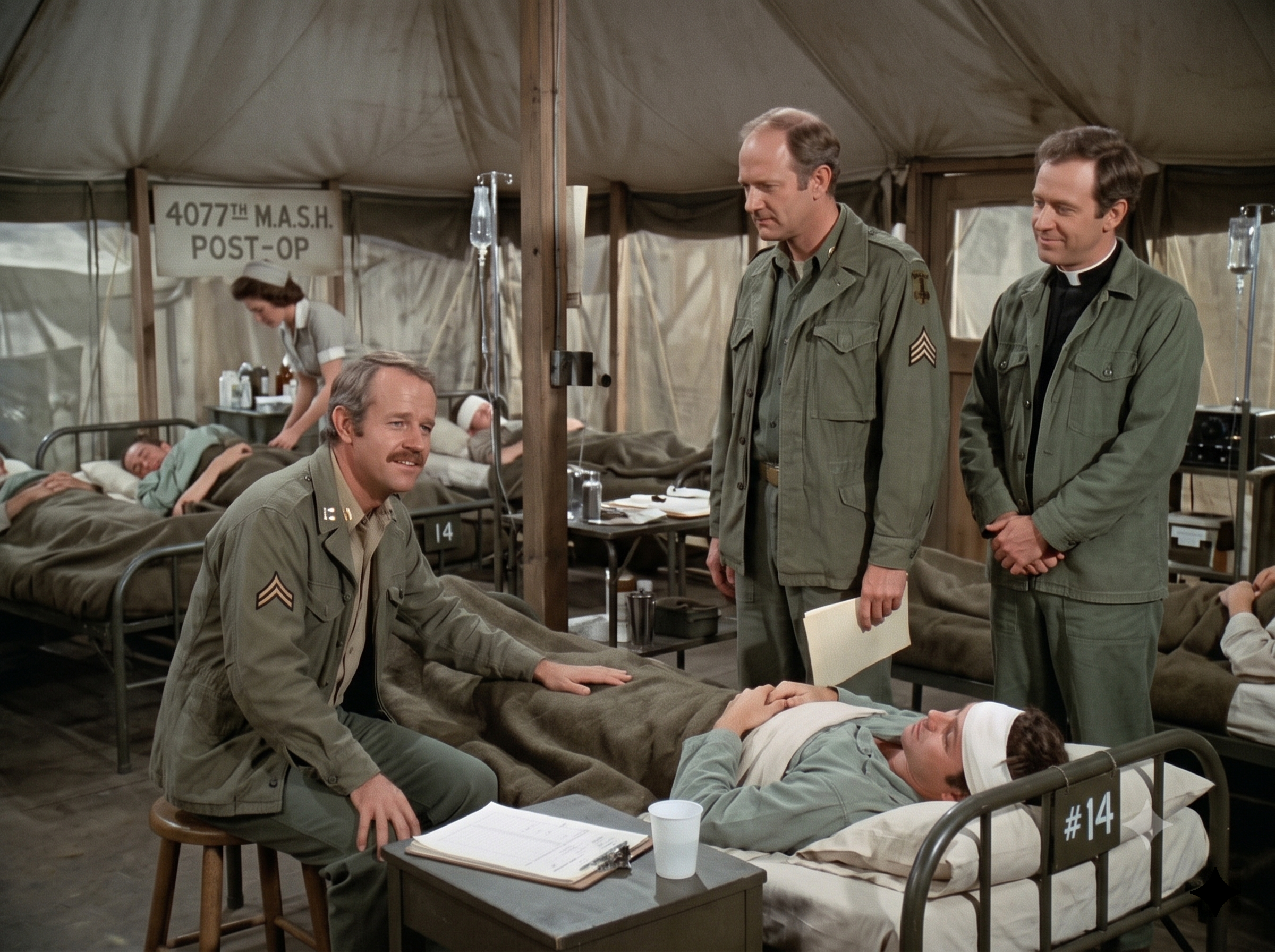
Post-Op at the 4077th was usually a symphony of restless sounds. It was the rattle of metal chart clipboards, the slow drip of IV bags, and the quiet, delirious murmurs of boys who had been forced to grow up entirely too fast.
But sometimes, in the very early hours of the morning, it fell into a deep, heavy silence.
The air always smelled of damp canvas, iodine, and stale coffee. The lighting was consistently poor, casting a soft, pale green hue over the rows of cots that made everything look like a faded photograph.
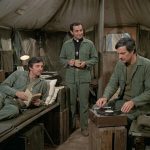
B.J. Hunnicutt was sitting on a wobbly wooden stool beside one of those cots. He was leaning forward, his forearms resting on his knees.
He was exhausted in that bone-deep way that only meatball surgery could produce. His pink scrub shirt was heavily wrinkled, and his shoulders slumped under the invisible weight of a twelve-hour shift in the OR.
He was keeping watch over a young private, a kid who looked barely old enough to possess a driver’s license, let alone wear dog tags.
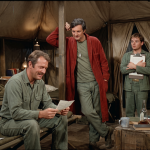
Across the aisle, standing near another bed, was Major Charles Emerson Winchester III.
Charles was, as always, a picture of defensive dignity. Even in a dusty, freezing tent in the middle of a war zone, he stood with his spine perfectly straight. He wore his standard issue robe over his clothes, looking down at a chart with an expression of mild, aristocratic distaste.
Usually, Charles preferred to keep his interactions in Post-Op strictly clinical. He was a brilliant surgeon, but he built a fortress of arrogance to protect himself from the messy, agonizing reality of the young lives broken around him.
Standing slightly behind Charles, observing the room, was Father Mulcahy.
The priest had his hands folded neatly in front of him. He wore a soft, knowing smile, bringing a quiet, hopeful warmth into the sterile and frightened space. He didn’t speak. He just offered his presence, a gentle guardian looking over his weary flock.
Suddenly, the silence in the tent shattered.
The young private in the cot between B.J. and Charles began to thrash. It wasn’t a physical pain, but the terror of a vivid, lingering nightmare from the front lines.
The boy cried out, his voice cracking with sheer panic. He reached out blindly, his hands desperately grasping at the empty air.
B.J. started to rise from his stool, ready to offer a soothing word or a hand to hold.
But Charles was closer.
Before Charles could step back, the terrified kid’s hand found the fabric of the Major’s robe. The boy clamped onto Charles’s sleeve with a desperate, iron grip, pulling the towering Bostonian off balance.
“Don’t leave me,” the boy sobbed, his eyes wide but unseeing, lost somewhere in a trench miles away. “Please, Dad, don’t leave.”
Charles froze completely.
The clipboard in his hand trembled slightly. His aristocratic shield cracked right down the middle, leaving him exposed in the dim, green light of the tent.
He looked down at the boy, and then he looked up, his eyes darting frantically toward B.J. and Father Mulcahy.
It was a look of pure, trapped panic.
Charles Emerson Winchester III was brilliant with a scalpel, but he was completely terrified of a broken heart.
B.J. stopped in his tracks, holding his breath, waiting to see if the proud Major would pull away.
For a long, agonizing second, B.J. thought Charles was going to shout for a nurse.
He fully expected the Major to pry the boy’s fingers loose, deliver a cutting remark about protocol, and march swiftly out into the freezing Korean night.
But Charles didn’t move away.
B.J. watched from his stool, leaning in, completely captivated by the silent drama unfolding in the muted light.
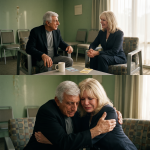
Charles swallowed hard. The rigid line of his shoulders slowly lowered. The haughty, defensive posture he wore like armor simply melted away, revealing the profoundly tired, deeply human man underneath.
With a slowness that felt incredibly fragile, Charles reached out his free hand.
He didn’t pry the boy’s fingers off his robe. Instead, he placed his large, steady surgeon’s hand gently over the boy’s trembling knuckles.
“I am right here,” Charles said.
His voice was astonishingly soft. The usual booming, pompous baritone was gone, replaced by a low, rhythmic murmur. It was a tone completely devoid of sarcasm.
“You are safe now, young man,” Charles continued, his voice a steady anchor in the boy’s turbulent sea of panic. “The worst of it is over. You are perfectly safe.”
The boy’s frantic thrashing began to slow.
He blinked, his feverish eyes trying to focus on the tall figure standing over him. He didn’t let go of Charles’s sleeve, and Charles made no effort to rush him.
“Dad?” the boy whispered, the word hanging heavy and heartbreaking in the damp air.
Charles closed his eyes for a fraction of a second. The reluctant compassion on his face was so thick it was almost palpable.
“Rest now,” Charles murmured, leaning down just a fraction closer. “Just rest. I will remain right here.”
B.J. felt a lump form in his own throat. He remained perfectly still on his stool, offering a quiet, unspoken empathy, determined not to ruin the sanctity of the moment by making a sound.
He had known Charles was a great doctor. But right now, in the dim light of Post-Op, he was witnessing a great man.
A few feet away, Father Mulcahy’s soft smile deepened.
The priest hadn’t moved to intervene. He knew that God often did His best work through the most unlikely vessels. Mulcahy just stood with his hands folded, his eyes shining with a quiet, joyful validation.
He was watching a man who claimed to be above it all finally allowing himself to be down in the mud with the rest of them.
Slowly, the young private’s breathing began to even out. The desperate tension left his body. His grip on Charles’s robe relaxed, his hand falling limply back onto the stark white blanket.
The boy was asleep again, finally at peace.
Charles stood there for a long time, watching the gentle rise and fall of the boy’s chest.
Then, very carefully, he reached down and pulled the thin white blanket up over the boy’s shoulders. He tucked the corner in with a swift, precise motion, ensuring the draft wouldn’t reach him.
When Charles finally straightened up, he cleared his throat loudly.
He adjusted the lapels of his robe, picking up his clipboard with a sudden, jerky movement. The walls of the Boston Brahmin were swiftly being rebuilt, brick by brick.
Charles turned toward the door, deliberately avoiding B.J.’s gaze.
“The, ah… the lack of adequate sedation in this camp is a scandal,” Charles muttered stiffly to the air, his nose lifting slightly. “A complete and utter scandal.”
B.J. allowed a slow, warm smile to spread across his tired face. He leaned back on his stool.
“Sure thing, Charles,” B.J. said softly. “A scandal.”
Charles paused for just a second near the tent flaps. He didn’t turn around, but the rigid set of his shoulders seemed just a little bit softer.
As Charles exited into the cold night, Father Mulcahy stepped up softly beside B.J.
“It is a remarkable thing, isn’t it, Captain?” Mulcahy whispered, looking at the sleeping boy.
“What’s that, Father?” B.J. asked, his voice rough with fatigue but lightened by the moment.
“How a place with so much pain,” Mulcahy said gently, “can stubbornly produce so much grace.”
B.J. looked around the pale, quiet tent, feeling the profound, found-family warmth that somehow kept them all from falling apart. He nodded slowly.
“Yeah, Father,” B.J. smiled. “It really is.”
They were far from home, but in the quietest moments of the war, they were exactly where they needed to be.