The Toledo Illusion
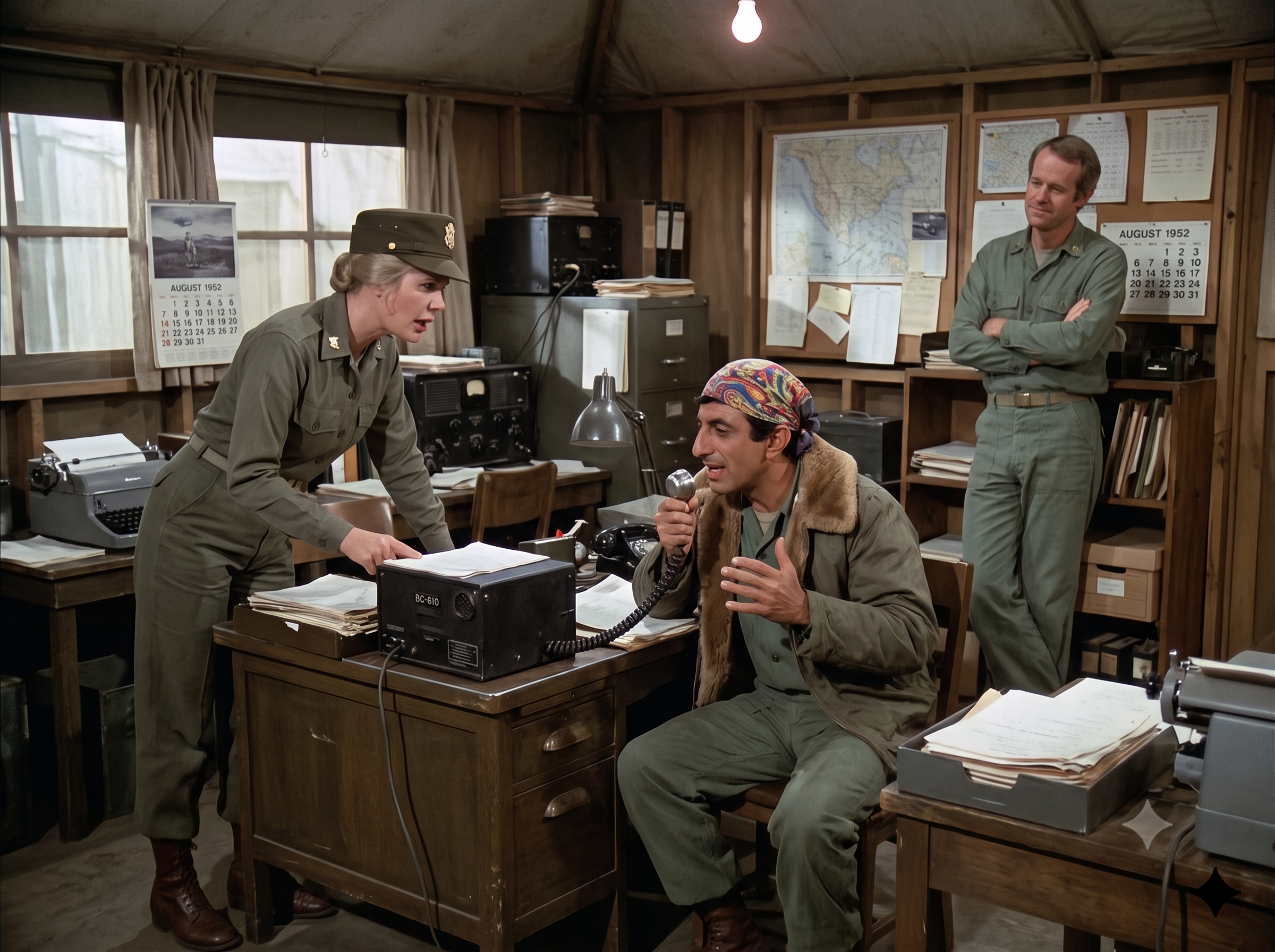
There were days at the 4077th when the war seemed to take a brief, exhausted breath, leaving the camp to its own peculiar brand of localized insanity. The heat of a Korean August hung heavy in the air, turning the clerk’s office into a stifling box of olive drab and stale coffee.
Captain B.J. Hunnicutt stood quietly in the corner, his arms crossed and a knowing, quiet smile playing on his lips. He had only come in to check for mail, but he had stayed for the matinee.
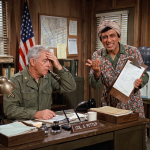
In the center of the room, surrounded by beige paperwork, file trays, and the muted gray metal of army communication equipment, sat Corporal Maxwell Q. Klinger. Despite the suffocating temperature, Klinger was bundled in a heavy, fleece-lined winter bomber jacket. A brightly patterned floral babushka was tied securely under his chin.
He held the radio microphone with the delicate, dramatic flair of a tragic stage actress. His free hand was raised, fingers spread in a gesture of sly hope and desperate persuasion.
“I assure you, Sergeant,” Klinger cooed into the microphone, pitching his voice to a remarkably convincing alto. “This is Madame Zoltana. I am a stranded civilian dignitary, and my immediate transport to a secure facility in Toledo, Ohio, is a matter of international spiritual security.”
B.J. chuckled softly from the shadows. It was a terrible plan, even by Klinger’s prolific standards, but the sheer, earnest theatricality of it was a masterpiece to behold.
Then, the flimsy screen door flew open. Major Margaret Houlihan marched into the office, carrying a clipboard and an aura of absolute, uncompromising authority.
She stopped dead in her tracks. Her eyes darted from Klinger’s floral headscarf to the microphone in his hand. Her professional posture stiffened, her jaw setting into a familiar line of sharp indignation.
“Corporal,” Margaret hissed, stepping up to the desk. She leaned over the scattered papers, her presence suddenly filling the small room.
Klinger’s eyes widened, but he didn’t drop character. He frantically waved his hand at her, a desperate plea for silence, while maintaining his high-pitched purr into the radio. “Just a moment, Sergeant, my… my handmaiden has arrived with my tea.”
Margaret’s eyes practically threw sparks. She planted her hands on the desk, leaning in so close that Klinger had to lean back into his chair.
She raised one perfectly manicured finger, pointing it directly at his nose. The air in the office crackled with tension, the collision of Klinger’s desperate bureaucratic scheme and Margaret’s unyielding military discipline.
“You listen to me, you fuzzy-headed lunatic,” Margaret began, her voice a low, dangerous rumble that promised absolute destruction.
On the other end of the radio line, the distant supply sergeant paused, his voice crackling through the small speaker. “Madame Zoltana? Is everything alright over there? Who is that?”
Klinger swallowed hard, caught between the wrath of Hot Lips Houlihan and his crumbling ticket to freedom. He gripped the microphone, his theatrical hand trembling, as Margaret took a deep breath, preparing to blow his Toledo illusion to kingdom come.
“This is Major Margaret Houlihan, Head Nurse of the 4077th MAS*H!” Margaret barked, leaning in so her voice carried perfectly over the radio’s frequency. “And the only thing ‘Madame Zoltana’ is going to receive is a court-martial for unauthorized use of military communications!”
The radio emitted a sharp click, followed immediately by the steady, hollow hiss of dead static. The supply sergeant in Seoul had hung up.
Klinger stared at the microphone for a long second. Slowly, the dramatic tension drained out of his shoulders. His raised hand fell limply to the desk, knocking against a stack of requisition forms.
The flamboyant charade evaporated, leaving behind nothing but a tired, homesick kid from Ohio sweating in a winter coat.
“He was on the hook, Major,” Klinger said quietly, his natural, gravelly voice returning. “He was looking up flight schedules. I could practically smell the muddy water of the Maumee River.”
Margaret remained leaning over the desk, her finger still hovering in the air. She looked at Klinger’s defeated posture, taking in the ridiculous babushka and the heavy coat.
For a brief second, the sharp, indignant retort died in her throat. The rigid lines of her posture softened, just a fraction.
She was a regular army officer, bound by rules and protocol, but she also knew the crushing weight of the war that sat on all their shoulders. She saw the desperation behind the joke.
From the corner of the room, B.J. finally spoke, his tone gentle and grounded. “It was a valiant effort, Klinger. I think Madame Zoltana’s accent was your best yet. Very cosmopolitan.”
Klinger looked up, managing a weak, grateful half-smile. “Thanks, Captain. I was going for mysterious yet vulnerable.”
Margaret stood up straight, clearing her throat to re-establish her professional boundary. She adjusted her clipboard, her face returning to its usual composed mask, but the fiery anger had burned itself out.
“You’re a fool, Klinger,” she said, her voice surprisingly quiet. “And if I ever catch you tying up an emergency frequency with this nonsense again, I will personally see that you peel potatoes until the end of this war.”
“Yes, Major,” Klinger sighed, reaching up to untie the knot of his headscarf.
“Now,” Margaret continued, tapping her pen against the clipboard. “I need the updated inventory forms for the surgical ward. And I need them right now.”
Klinger opened the bottom drawer of his desk, pulling out a crisp beige folder. He handed it across the desk without a word.
Margaret took it, flipping it open to check the contents. She looked back down at the clerk. “And take that ridiculous coat off, Corporal. It’s a hundred degrees in here. You’re going to give yourself heatstroke.”
It wasn’t an order. It was a scolding, wrapped in a thin layer of genuine, almost motherly concern.
“Yes, Major,” Klinger said softly.
Margaret turned on her heel and walked out of the office, the screen door slapping shut behind her. The room fell quiet again, save for the hum of the radio and the distant drone of a jeep engine.
B.J. walked over to the desk, picking up a chipped mug and pouring a fresh cup of terrible camp coffee from the hotplate. He set it gently down in front of Klinger.
“Drink up, Madame Zoltana,” B.J. smiled, a warm, reassuring look in his eyes. “Toledo is just going to have to wait a little while longer.”
Klinger pulled off the winter coat, letting the stifling heat of the tent wash over him. He took a sip of the bitter coffee, looking around the cluttered, worn-in office that had become his entire world.
He wasn’t going home today. But as he looked at B.J., and thought of Margaret’s gruff mercy, he realized that, for now, this strange, loud, exhausting place was its own kind of home.
In a place defined by mud, blood, and broken things, the greatest medicine they had was simply each other.