The Blue Plate Special at the End of the World
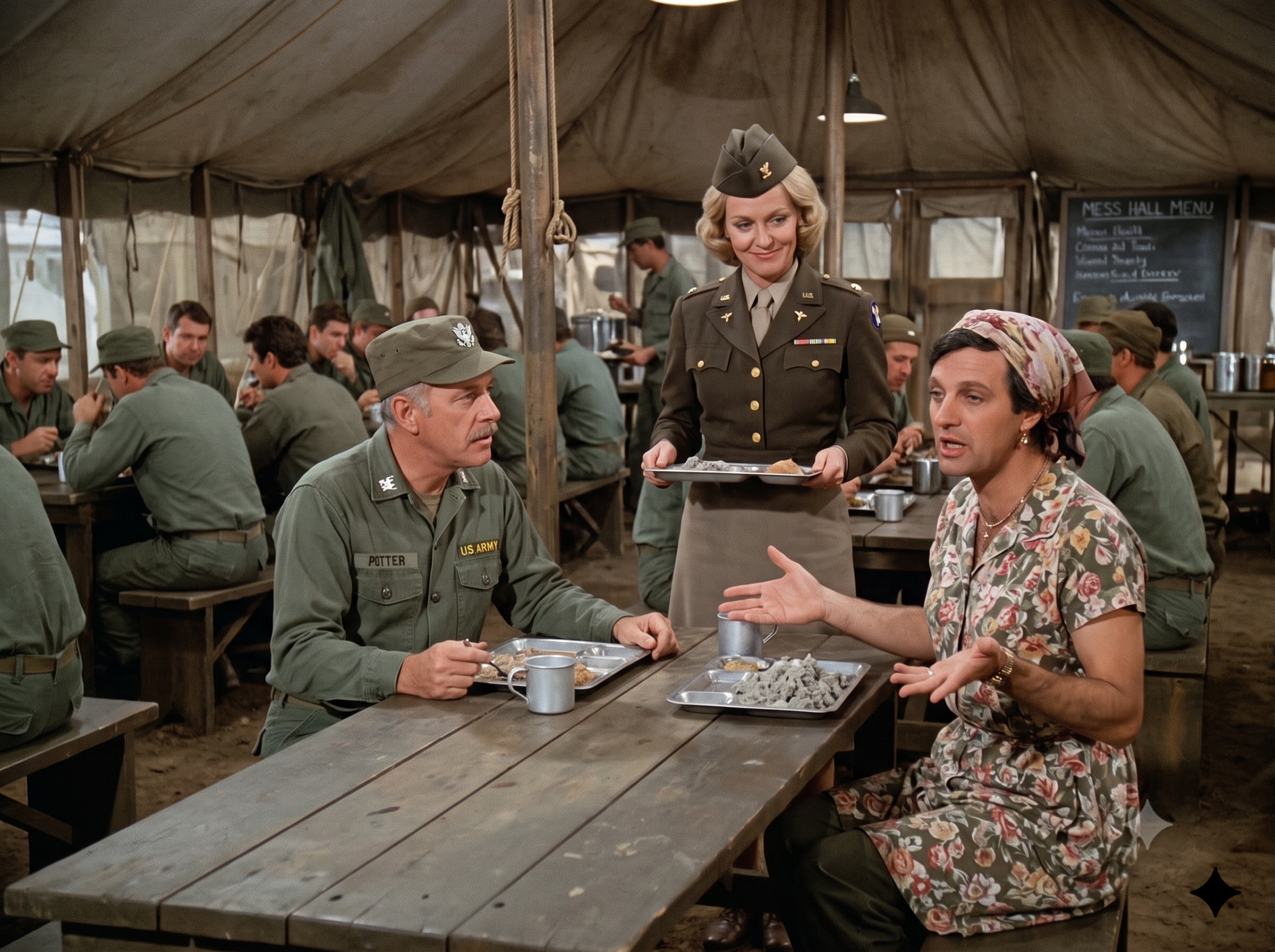
There were exactly three certainties to be found at the 4077th: the incoming choppers would always break your heart, the coffee would always taste like boiled boots, and the mess tent would always serve something that actively defied the laws of nature.
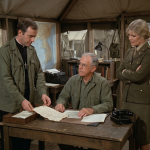
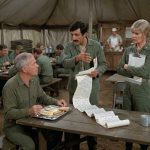
Colonel Sherman T. Potter sat at the weathered pine table, staring down at the dull metal tray in front of him. He leaned forward slightly, resting his heavy arms against the wood.
After eighteen straight hours of meatball surgery, his bones felt like lead. The fading brown and olive tones of the canvas tent seemed to press in on him, thick with the smell of damp earth and boiled cabbage.
Potter held his fork with a tight grip. He looked perfectly ready to use it as a weapon.
On the tray sat a pile of gray, lumpy substance. It didn’t look like meat. It didn’t look like a vegetable. It looked like something that had surrendered unconditionally to the Geneva Convention.
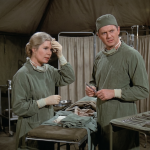
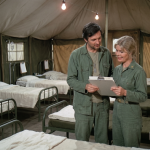
Standing just behind his shoulder, Major Margaret Houlihan held her own metal tray.
Her uniform was crisp, her posture rigidly professional, but the deep fatigue around her eyes betrayed the grueling reality of the long shift they had all just survived. She looked down at Potter, then across the table, her lips pressed tightly together.
Margaret was fighting a very un-military, very warm smile.
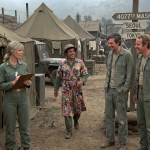
Because standing at the end of the table was Corporal Maxwell Q. Klinger.
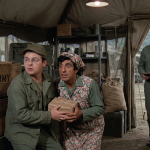
Klinger was draped in a cheerful, floral-print summer dress, complete with a matching patterned headscarf tied neatly beneath his chin. He had his hands thrown wide in a grand, theatrical gesture, hovering over a tray of the exact same gray mush.
His face was a portrait of wounded comic pride.
“I assure you, Colonel,” Klinger declared, his voice carrying over the dull roar of the crowded tent. “This is a culinary masterpiece! A secret recipe handed down through generations of the finest, most exclusive chefs in downtown Toledo.”
Potter blinked slowly. He looked from the gray lump to Klinger’s wildly earnest face.
“Klinger,” Potter rumbled, his voice as dry as a Texas creek bed. “If this is a masterpiece, then I’m the Queen of Sheba. And my crown is giving me a migraine.”
“But sir!” Klinger pleaded, leaning in closer, refusing to drop the act. “It’s all in the presentation! You have to look past the… the overwhelming grayness. It’s a delicacy. A morale booster! If a man can’t appreciate a fine mock-veal surprise, then surely he must be driven entirely mad by the horrors of war. Mad enough for, say, an immediate Section Eight discharge?”
Potter tightened his grip on the fork.
The background noise of the mess tent seemed to suddenly fade out. The bone-deep exhaustion from the operating room caught up with the Colonel all at once, a heavy wave of frustration rising hot in his chest.
He took a sharp breath, his jaw setting hard, ready to deliver a blistering dressing-down that would echo all the way down to Seoul.
Potter opened his mouth, the command ready to fire.
Klinger froze, his hands still suspended over the tray, bracing for the inevitable explosion. Even Margaret tensed slightly, her professional composure tightening as she waited for the Old Man to blow his top.
But the explosion never came.
Potter looked at Klinger. He really looked at him.
He saw the ridiculous floral dress, the desperate, comical gleam in the Corporal’s eyes, and beneath it all, the shared, crushing exhaustion that haunted every single soul in the camp.
Klinger wasn’t just trying to get out of the Army. He was putting on a show. It was a little piece of canvas vaudeville, a desperate attempt to distract his commanding officer from the blood and the noise of the last eighteen hours.
Potter’s tense shoulders dropped, just a fraction.
The fatherly exasperation returned to his face, melting away the sharp, dangerous edge of his anger.
Behind him, Margaret let out a soft, barely audible breath. The tight line of her mouth finally softened into a genuine, affectionate smile. She knew the Old Man’s tells better than anyone.
“A Toledo masterpiece, you say?” Potter asked softly, his tone shifting into dry, weary amusement.
“The absolute pride of the Ohio valley, sir,” Klinger replied. His voice lost a bit of its theatrical volume, replaced by a quiet, hopeful sincerity.
“Well,” Potter sighed, picking up his metal mug of lukewarm coffee. “I suppose my palate just isn’t sophisticated enough for the finer things in life, Corporal.”
“It takes a great deal of time to develop an appreciation for the exotic, sir,” Klinger offered generously, lowering his hands and adjusting his dress.
Margaret shifted her tray, her voice dropping its usual strict cadence.
“I think it looks… highly nutritious, Colonel,” she offered quietly. “In a purely theoretical sense.”
Potter glanced up at his head nurse. A shared, silent understanding passed between them in an instant.
They were all a million miles from home, eating terrible food in a canvas tent, surrounded by the mud and the madness of a war that made no sense.
“Nutritious,” Potter muttered. “That’s a real comfort, Major. I feel healthier already just looking at the damn stuff.”
He looked back down at the gray lump. With a slow, deliberate motion, Potter scooped a tiny fraction onto his fork.
Klinger leaned forward, breathless.
Potter chewed. His face remained completely impassive. He swallowed hard, immediately chasing it with a large, desperate gulp of the terrible coffee.
“You know, Klinger,” Potter said, setting the metal mug down with a clunk.
“Yes, Colonel?” Klinger asked, his eyes wide with anticipation.
“It tastes exactly like despair,” Potter deadpanned. “But the texture is surprisingly resilient.”
Klinger beamed, taking it as the absolute highest compliment. “I’ll be sure to tell the cooks to keep up the good work, sir! And if this fine dining experience has proven that my mind is hopelessly detached from reality…”
“Nice try, son,” Potter interrupted, a faint, fond smile touching the corners of his mustache. “But you’re as sane as I am. Which, given what we do for a living, really isn’t saying much.”
Klinger sighed, a sound of exaggerated defeat, but the nervous tension had completely left his shoulders. He adjusted his headscarf with quiet dignity. “Can’t blame a girl for trying, sir.”
“No, you can’t,” Potter agreed softly.
He picked up his fork again, not to eat, but just to hold onto something familiar.
The noise of the mess tent swelled back around them—the clatter of metal trays, the low hum of tired voices, the occasional burst of laughter breaking through the heavy fatigue.
Margaret took a seat opposite the Colonel, carefully arranging her own unrecognizable meal. She didn’t complain about the food or the dirt or the noise. She just sat with them.
In the dim, faded light of the canvas room, the terrible food really didn’t matter. The unending war waiting just outside the flaps didn’t matter.
For a few quiet minutes, they were just a family, sharing a terrible dinner together, kept alive by dry jokes and the unspoken promise that they would all endure it together.
Sometimes, the only thing that saves you from the madness outside the tent is the beautiful, ridiculous humanity inside it.