The Fruit of Frustration and the Weight of Home
The office of the 4077th’s Commanding Officer was always a place of uneasy calm, a thin veneer of order stretched over the chaos of a war that refused to end.
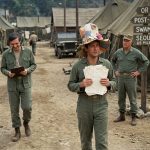
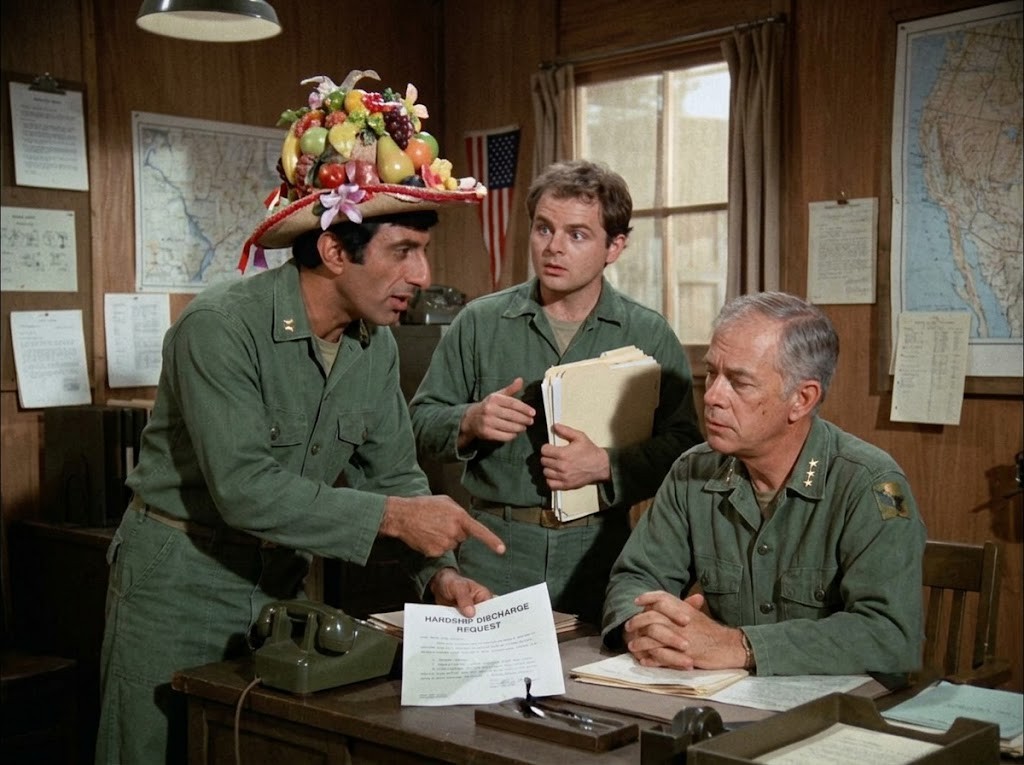
Colonel Sherman Potter sat behind his desk, his posture a masterclass in controlled exhaustion. Across from him, Maxwell Q. Klinger stood in full, flamboyant glory, his head topped by a fruit-laden hat that defied both gravity and the Geneva Convention.
Radar O’Reilly stood between them, clutching a thick stack of files like a shield, his eyes darting between the Colonel’s weary frown and Klinger’s desperate, neon-bright conviction.
“It’s a hardship discharge request, Colonel,” Klinger insisted, his voice rising with that familiar, theatrical tremor. He jabbed a manicured finger toward the paper on the desk. “My dear Aunt Sarah has been beset by the most unusual case of… persistent, localized gravity.”
Potter didn’t move. He simply stared at the plastic grapes resting precariously near his own stern visage. The silence in the room was heavy, thick with the smell of old paper, stagnant air, and the unspoken fatigue of men who had seen too much.
“Klinger,” Potter sighed, his voice like gravel grinding under a jeep tire. “This is the third time this week you’ve brought me a request involving a relative’s botanical misfortune. My patience is a finite resource, and you are currently overdrawing your account.”
“But Colonel,” Klinger pleaded, his expression shifting from frantic to wounded, “look at the documentation! It’s all there. The drought in Toledo, the wilting of the petunias—it’s a family catastrophe!”
The tension snapped when Potter suddenly slammed his hand flat on the desk, the sound echoing like a gunshot. He leaned forward, his face inches from the plastic bananas, and his eyes weren’t angry—they were tired. Deeply, profoundly tired.
“Stop it, Klinger,” Potter growled, his voice cracking just slightly. “Just stop. Don’t make me look at another one of these today. I can’t send you home, and I can’t pretend this is a joke anymore. Get out of here before I have you scrubbing the latrines until the turn of the century.”
Klinger froze, his theatrical mask slipping for the first time in months. The bravado, the costume, the absurdity—it all seemed to sag under the weight of the Colonel’s genuine heartbreak. Radar, usually the first to interject with a helpful suggestion or a stuttered defense, remained frozen, clutching his files, his own young face reflecting a sudden, sharp clarity.
The room went deathly quiet. Even the distant hum of the generators seemed to fade, leaving only the sound of three men breathing in the small, wooden office.
Klinger looked down at his own hands, then slowly back at Potter. He reached up, his fingers brushing the brim of the ridiculous hat. For a moment, it looked as if he might finally drop the act, as if he might just say, *I just want to go home, sir.*
Instead, his shoulders slumped. He didn’t leave. He stood there, a man dressed for a parade in a place that only knew funerals.
“I know, sir,” Klinger said, his voice dropping to a low, human register that didn’t sound like a radio broadcast. “I know it’s a long shot. I know it’s crazy. It’s just… it’s been a very long war, Colonel.”
Potter looked up, his gaze softening. He looked at Klinger—not as a headache, not as a nuisance, but as one of his boys. One of the many kids he had to watch over in a place that didn’t care much for children.
“I know it has, son,” Potter murmured. He shifted in his chair and gestured toward the desk. “But that doesn’t mean you have to wear the entire produce section of a grocery store to make me see it. Put the papers down. Take the hat off. Let’s just sit for a minute.”
Klinger hesitated, then slowly reached up and took off the hat, setting it gently on the corner of the desk like a fragile, colorful artifact. His hair was disheveled, and he looked smaller without the plumage. Radar stepped forward, placing the files down, his nervous energy replaced by a quiet, supportive presence.
He didn’t offer a joke. He just stood by his friend.
They didn’t talk about discharge papers. They didn’t talk about Toledo. For a few minutes, they just existed in the space between duty and humanity. It was the way the 4077th worked—when the war tried to strip them of their sense of self, they found pieces of each other to hold onto.
Klinger eventually turned toward the door, leaving the hat on the desk. He didn’t look back, but there was a different kind of steadiness in his step as he walked out into the bright, harsh Korean sunlight.
Potter watched him go, then looked at the hat. He let out a long, slow breath, reached out, and straightened the plastic fruit, his touch almost paternal. He knew he’d see Klinger back here tomorrow, probably with a new scheme, and he knew he’d still have to say no.
But for today, the war had been held at bay, just for a moment, by the shared, weary understanding that they were all, in their own ways, just trying to survive until the mail call brought them home.
In a place where everything was temporary, the only thing that lasted was the quiet grace of looking after one another.