The Quiet Victories of the Night Watch
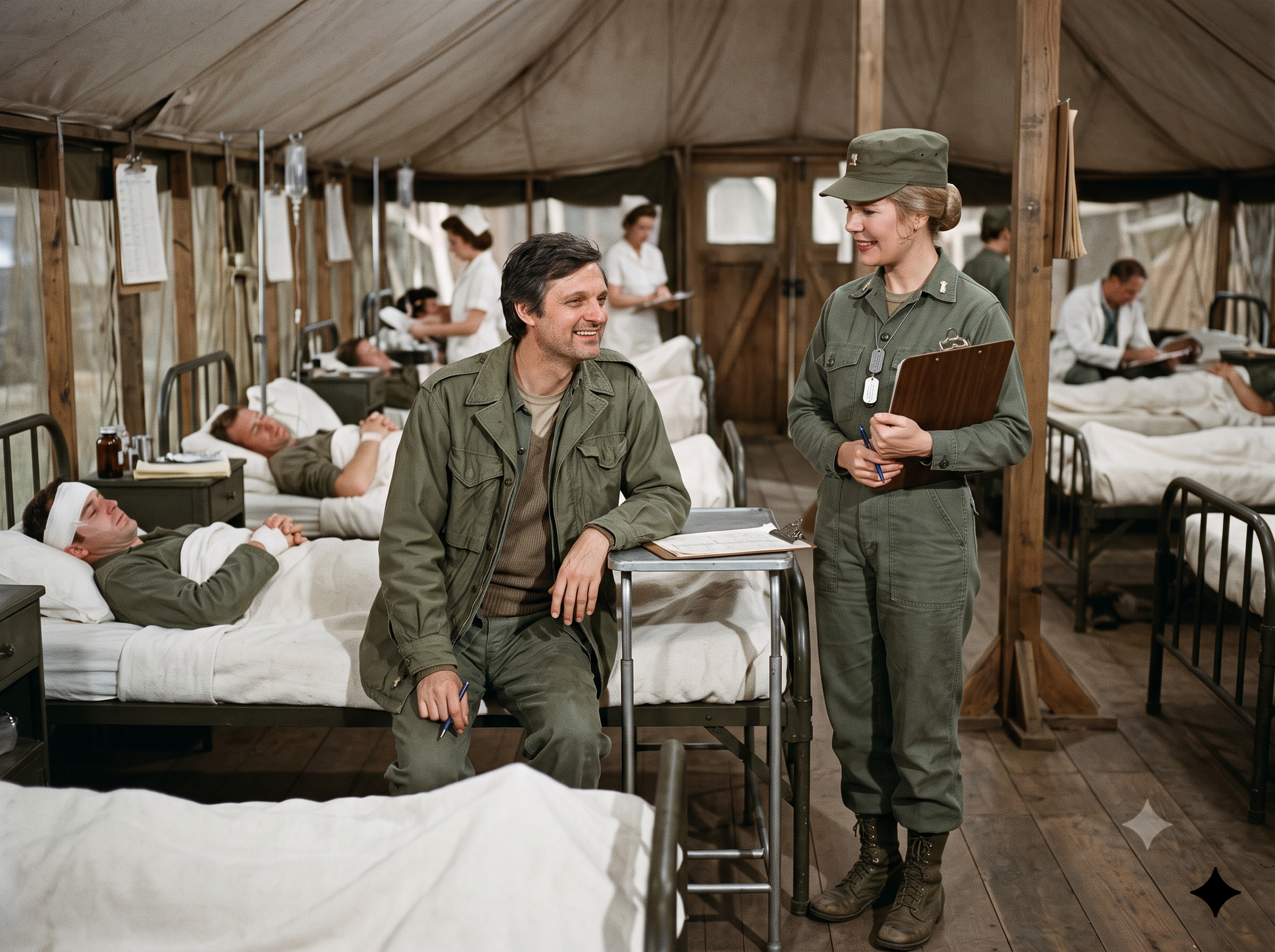
The hardest part of the 4077th wasn’t the chaotic, blood-soaked noise of the operating room.
It was the heavy, suffocating silence of the Post-Op ward.
After the helicopters stopped their rhythmic, terrifying thumping and the scrub brushes were tossed exhausted into the sink, the doctors and nurses were left with the waiting.
And waiting, Hawkeye Pierce often thought, was a far deadlier disease than anything you could catch in the damp hills of Korea.
It was nearly three in the morning, and the canvas walls of the ward breathed gently with the cold autumn wind.
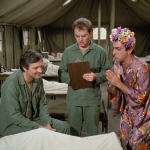
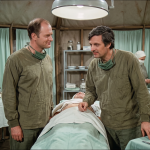
Rows of simple iron cots stretched down the length of the tent, each holding a heavily bandaged boy tucked beneath a plain white Army-issue blanket.
The lighting was low and humane, casting long, soft shadows across the wooden floorboards.
The air smelled faintly of iodine, damp wool, and the metallic tang of fear that never fully washed out of the canvas.
Hawkeye sat perched on the edge of a metal bedside table, his long legs stretched out in front of him.
He was running on forty hours of no sleep and a diet consisting entirely of stale coffee and black humor.
He wore his olive drab field jacket over a worn sweater, the heavy material feeling like it weighed fifty pounds on his aching shoulders.
In his right hand, he absentmindedly clicked a blue ballpoint pen, though he couldn’t remember what he had originally intended to write.
Next to him lay Private Miller, a kid from Ohio who looked barely old enough to shave.
Miller had taken a nasty piece of shrapnel near the artery, and Hawkeye had spent three agonizing hours piecing his leg back together with freezing fingers.
Now, the boy’s chest was rising and falling in shallow, fragile breaths.
Hawkeye refused to go back to the Swamp. He refused to close his eyes until he knew if his stitch work was going to hold.
Footsteps echoed softly on the wooden floorboards, deliberate and precise.
Major Margaret Houlihan stepped into the aisle between the cots.
Even after a grueling marathon session in the OR, she was remarkably put together.
Her patrol cap sat neatly on her blonde hair, and her silver dog tags rested perfectly against the collar of her green fatigues.
She carried her wooden wooden clipboard against her side like a shield, her posture stiff and unyielding.
She was the Head Nurse, the unbending spine of the unit, and she never allowed the fatigue to show in her posture.
“You should be in your tent, Pierce,” Margaret whispered, her voice low to avoid waking the sleeping ward.
Hawkeye didn’t move. He just stared at the sleeping boy.
“I’m auditioning for a role as a cot, Margaret,” Hawkeye replied, his voice raspy and devoid of its usual bounce. “I figure if I stay still enough, the Army will eventually issue me a blanket and a serial number.”
Margaret stepped closer, her blue eyes dropping to the pale, sleeping soldier in the bed.
She knew exactly why Hawkeye was sitting there. She had handed him the instruments during the worst of the bleeding.
She clicked her pen and lifted the boy’s medical chart off the end of the bed.
As she read the latest vitals scrawled by the night nurse, her face fell into the guarded, fiercely professional mask she wore to survive this awful place.
Hawkeye watched her face, the cynical jokes completely dissolving in the dry, tense air of the tent.
His heart began to hammer a frantic rhythm against his ribs.
“Well, Major?” Hawkeye asked, his voice suddenly stripped of all its protective armor.
He leaned forward, his tired eyes pleading for an answer.
“Did we put him back together again, or are we just delaying the inevitable?”
Margaret stood perfectly still, her eyes locked on the numbers on the page.
The silence between them stretched out, tight and terrible, pulling the air right out of the room.
Margaret’s eyes scanned the messy, hurried handwriting on the chart a second time.
For a breathless moment, the entire ward seemed to stand still, the only sound the collective, ragged breathing of thirty wounded boys.
Then, the rigid, defensive set of Margaret’s shoulders softened.
It was a microscopic movement, a fractional release of tension.
But to Hawkeye, who had spent years reading this woman’s posture like a medical textbook across the OR table, it was everything.
“His pressure is holding, Captain,” Margaret said, her voice dropping into a register of quiet relief.
She looked up from the clipboard, her eyes meeting his.
“His heart rate is steadying. His color is significantly better than it was an hour ago.”
She lowered the chart slightly. “He’s stabilizing, Hawk. He’s going to make it.”
Hawkeye let out a long, shaky breath, a sound that seemed to carry the weight of the entire war.
He slumped a little further against the table, the frantic adrenaline that had been keeping him upright suddenly evaporating.
It left behind a profound, bone-deep exhaustion that settled into his very marrow.
He looked down at the pen in his hand, gave a small, weary shake of his head, and sighed.
“Good,” Hawkeye murmured, scrubbing a hand over his face. “That’s good. I promised this kid he’d live long enough to experience the terrible powdered eggs in the mess tent. I’d hate to be a liar.”
Margaret pressed the clipboard gently against her chest, holding it like a protective barrier.
She knew she should tell him to go to bed.
She knew she should cite section four, paragraph twelve of the Army field manual regarding mandatory officer rest periods.
Instead, she just looked at him.
She saw the dark, bruised circles under his eyes, the heavy stubble on his jaw, and the slight, telltale tremor of exhaustion in his hands.
He was maddening, insubordinate, and utterly impossible.
But he was also the finest, most desperately caring surgeon she had ever known.
“You did good work today, Pierce,” Margaret said softly, the words slipping out before her brain could stop them.
Hawkeye looked up, clearly caught off guard.
The utter sincerity in her voice was startling. It was an unprotected moment, raw and unpolished, right here in the middle of a war zone.
And for Hawkeye Pierce, vulnerability was just a little too bright to look at directly. He had to deflect.
A slow, tired smile began to pull at the corners of Hawkeye’s mouth.
He tilted his head, leaning back against the metal framing, the familiar, dry spark returning to his bloodshot eyes.
“Major Houlihan,” Hawkeye said, feigning a look of absolute shock. “Are you complimenting me? Because if you are, I need you to sign a sworn affidavit. Frank will never believe it.”
Margaret tried to maintain her stoic glare.
She tightened her grip on the clipboard, lifting her chin to look down her nose at him.
“I am merely acknowledging a satisfactory surgical outcome, Captain,” she said, her tone attempting to sound crisp. “Don’t let it go to your head.”
“Too late,” Hawkeye grinned, the smile fully reaching his eyes now. “I’ve already mentally promoted myself to Surgeon General. You’ll have to salute me at breakfast.”
Margaret opened her mouth to fire back a sharp, military-issue retort.
She wanted to be annoyed. She wanted to be the fiercely disciplined Regular Army officer she had been trained to be.
But looking at Hawkeye—disheveled, completely exhausted, and desperately trying to keep the darkness at bay with a flimsy joke—she found she simply didn’t have the energy to fight him.
The corners of her mouth twitched.
She bit her lower lip, desperately trying to suppress it, but the relief of the successful surgery and the sheer, absurd exhaustion of their shared reality finally won out.
Margaret Houlihan’s proud, guarded professional demeanor cracked right down the middle.
A warm, reluctant, incredibly genuine smile spread across her face.
It softened her sharp features, melting away the strict military persona and revealing the deeply compassionate, quietly vulnerable woman beneath.
In this small, quiet aisle between the rows of white blankets, the war outside ceased to exist.
They weren’t a rebellious, wisecracking draftee and an uncompromising Army lifer.
They were just two incredibly tired people, standing in a drafty canvas tent, sharing the profound, quiet victory of keeping one more kid alive.
Hawkeye looked at her smiling, and his own grin softened into something wonderfully tender and true.
He didn’t make another joke. He didn’t push the punchline.
He just let the moment hang there, warm and suspended in the cool, antiseptic air of the ward.
There was a whole lifetime of language spoken in that one shared glance.
It spoke of endless nights, of blood-stained gloves, of the terror they constantly hid from the patients, and the desperate strength they somehow found in each other.
They drove each other crazy, but they were family. They were all they had.
“Go get some sleep, Hawkeye,” Margaret said gently, her voice completely stripped of its usual commanding bark. “I’ll keep an eye on him for the rest of the shift.”
Hawkeye nodded slowly. He pushed himself off the table, his knees popping, his joints protesting every single movement.
“Save a dance for me, Major,” he whispered, slipping the blue pen into the pocket of his heavy green jacket.
Margaret watched him walk away down the long row of cots, her warm smile lingering in the dim, humane light of the recovery ward.
Tomorrow, the choppers would inevitably come again, bringing more noise, more fear, and more broken pieces for them to frantically put back together.
But for tonight, the ward was quiet, the boy was breathing, and they were okay.
In the darkest hours of the 4077th, it wasn’t the medicine that kept them alive; it was each other.