The Quiet Watch in Post-Op
There was a very specific kind of silence in the Post-Op ward at the 4077th. It wasn’t the peaceful quiet of a Sunday morning back in the States, and it certainly wasn’t the heavy, terrified silence that fell over the camp just before the choppers arrived.
It was a tired, breathing silence. It was the sound of thirty cots holding thirty young men who had somehow made it through the worst day of their lives.
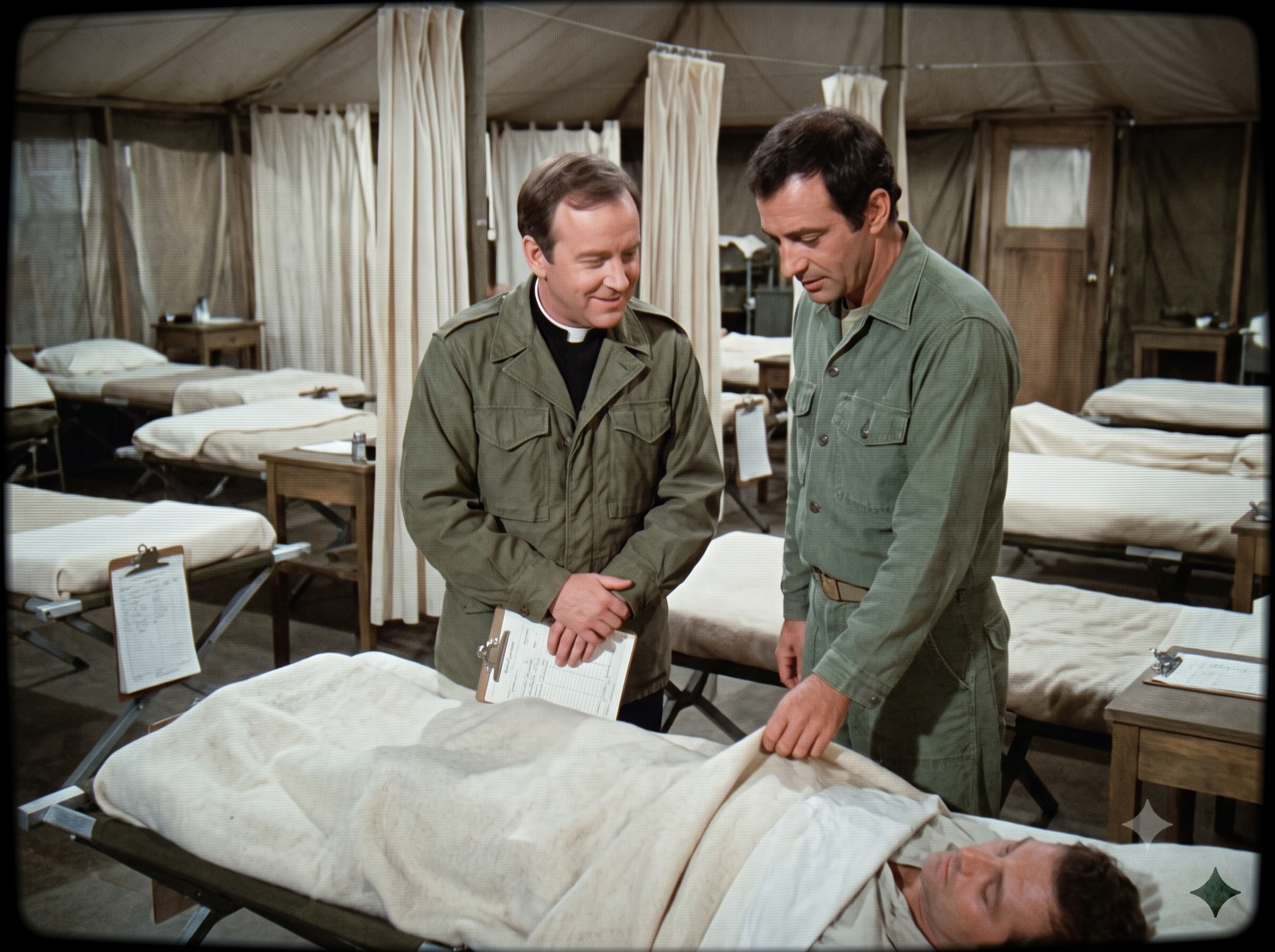
The canvas walls of the ward breathed in and out with the evening wind, casting long, soft shadows across the rows of simple wooden beds. The lighting was even and dim, offering a gentle, muted glow that turned the harsh white blankets into a soft, pale cream.
Corporal Maxwell Klinger stood near the middle of the ward, looking down at a sleeping patient.
Tonight, there was no taffeta. There was no crushed velvet, no feathered boa, and no elaborate tragic backstory about a dying uncle in Toledo. Klinger was just wearing his standard, worn olive-drab fatigues.
He looked smaller without his theatrical armor, his shoulders a little stooped under the invisible weight that everyone in the camp carried.
Father John Mulcahy stepped softly down the aisle, his boots making almost no sound against the dirt floor. He held a wooden clipboard in his hands, performing his usual evening rounds to offer a prayer, a smile, or just a listening ear.
When the priest saw Klinger standing so still, he paused. He didn’t want to interrupt.
Mulcahy stepped up beside him, leaning in compassionately. He folded his hands near the edge of the clipboard, a soft, familiar smile resting on his face.
They both looked down at the boy in the bed. He couldn’t have been more than nineteen. His face was pale, his breathing shallow but steady.
“He had a rough time in OR,” Mulcahy whispered gently, his voice barely rising above the hum of the camp’s distant generators. “Hawkeye said it was a near thing.”
“He looks like a kid who used to deliver papers on my block,” Klinger replied, his voice stripped of its usual loud, fast-talking bravado. “Name was Petey. Used to throw the Sunday edition right into my mother’s rose bushes.”
The boy on the cot suddenly shifted, a low groan escaping his lips. His brow furrowed in pain, and a tremor ran through his shoulders as the cool Korean draft swept through the tent.
Klinger didn’t hesitate. He reached out with a quiet, grounded tenderness, taking hold of the rough wool blanket to pull it higher over the boy’s shoulders.
But as Klinger’s hand brushed the cot, the young soldier’s eyes flew open. They were wide, unfocused, and filled with sudden, blind panic.
Before Klinger could step back, the boy’s hand shot out from under the blanket. He grabbed Klinger’s wrist with a grip born of pure desperation.
“Tommy?” the boy gasped, his voice cracking as he stared right through Klinger. “Tommy, they said you were gone. Don’t leave me here. Please, Tommy, don’t leave me.”
Klinger froze, his eyes widening. He looked over at Father Mulcahy, panic flashing across his face as the boy’s grip tightened until Klinger’s knuckles turned white.
The silence in the ward suddenly felt incredibly heavy.
Klinger stood practically paralyzed, his hand still caught in the terrified grip of the wounded soldier. He was a corporal from Toledo, a man who spent his days trying to convince the United States Army that he was crazy. He didn’t know how to be the ghost of a lost brother.
Father Mulcahy didn’t intervene. He stood close, his hands still resting on the clipboard, his kind eyes watching Klinger. The priest knew that some moments required a doctor, some required a chaplain, and some just required a fellow human being.
Mulcahy gave Klinger a slow, subtle nod of encouragement.
Klinger swallowed hard. He let go of the blanket and lowered his posture, bringing himself closer to the boy’s eye level. He set aside every ounce of his usual dramatic flair.
“I’m right here, kid,” Klinger said softly, his voice remarkably steady and warm. “I’m right here. I ain’t going anywhere.”
The boy stared at him, his fevered eyes searching Klinger’s face in the dim, pale green light of the ward.
“You promise?” the boy whispered, a tear slipping down his cheek and catching in the grime on his face. “It’s so cold, Tommy.”
“I promise,” Klinger said, his tone thick with a quiet sincerity that rarely surfaced in the mess tent. With his free hand, he gently pulled the white blanket up to the boy’s chin, tucking it in with the careful precision of a mother back home. “You just close your eyes now. You’re safe. We’re gonna get out of here.”
The boy let out a long, shaky breath. The desperate tension drained from his body, and his grip on Klinger’s wrist finally went slack. Within seconds, the heavy pull of the morphine took over again, and his eyes fluttered shut.
He was asleep, his breathing settling into a slow, peaceful rhythm.
Klinger stood there for a long moment, staring at his own wrist where the boy had held him. He carefully placed the boy’s hand back under the warmth of the blanket.
He let out a breath he felt like he’d been holding since he arrived in Korea.
“That was a very fine thing you did, Maxwell,” Father Mulcahy said quietly, his soft smile returning as he looked at the sleeping soldier’s chart.
Klinger rubbed the back of his neck, suddenly looking a little embarrassed by his own profound decency. He kept his eyes on the blanket, smoothing out a small wrinkle in the wool.
“I don’t know about that, Father,” Klinger murmured. “I’m just a guy who usually wears a floral print to try and get a ticket back to Ohio. I ain’t exactly a hero.”
Mulcahy chuckled softly, a warm, affectionate sound that belonged perfectly in the quiet of the ward.
“Maxwell, heroism comes in many forms,” the priest replied, his voice full of gentle wisdom. “Sometimes it’s a surgeon working through the night. And sometimes, it’s simply allowing a frightened young man to believe that he isn’t alone in the dark.”
Klinger looked up at Mulcahy, the fatigue of the war etched deeply into the lines around his eyes. For a moment, the two men just stood there in the quiet fellowship of the 4077th.
They were thousands of miles from anything that made sense, surrounded by mud, blood, and the endless roar of choppers. Yet, in this small canvas room, surrounded by pale canvas and sleeping kids, they had managed to build a strange, enduring family.
“You think he’s gonna make it, Father?” Klinger asked, his voice returning to its normal, slightly raspy pitch, though the tenderness remained.
“I believe he will,” Mulcahy said, tapping the clipboard gently against his leg. “He has an excellent medical staff looking after his body. And it seems he has a very capable guardian angel looking after his spirit, even if that angel normally prefers to wear chiffon.”
A small, genuine smile finally broke through Klinger’s tired expression. He looked back down at the sleeping boy, giving the blanket one last, gentle pat.
“Sleep tight, kid,” Klinger whispered. “Toledo’s watching out for you tonight.”
Father Mulcahy simply nodded, stepping back to continue his rounds, leaving Klinger to stand his quiet watch in the comforting, analog warmth of the ward.
In a place built on patching up broken bodies, it was the quiet mending of the soul that somehow kept them all alive.