The Quiet Victories of the Afternoon
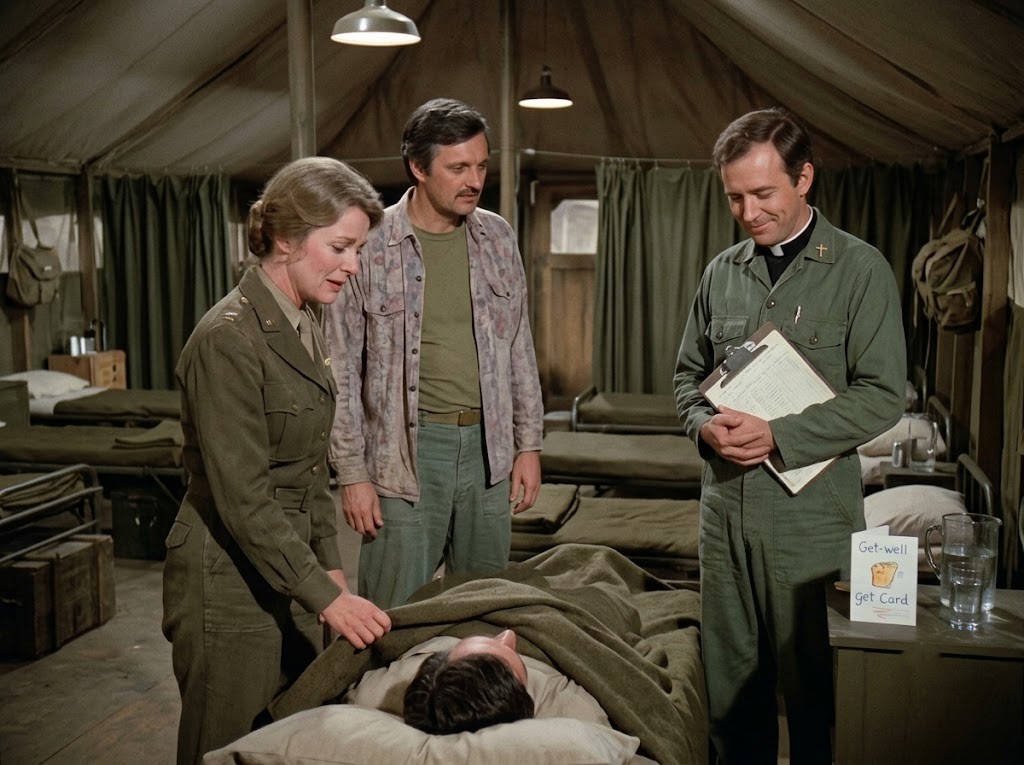
The loudest sound in the Post-Op ward wasn’t the distant, muffled thud of artillery, but the steady, rhythmic breathing of a nineteen-year-old kid who had almost stopped breathing entirely the night before.
It was mid-afternoon, the strange, suspended hour when the 4077th finally caught its breath. The dusty canvas of the tent glowed with a soft, muted light, filtering the harsh Korean sun into something almost peaceful.
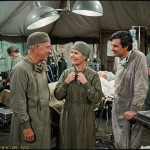
Major Margaret Houlihan stood near the head of the cot, her uniform immaculate as always, though the dark circles under her eyes betrayed a grueling forty-eight-hour shift. She reached out, her fingers gently grasping the rough wool of the olive-drab blanket. With a slow, deliberate motion, she pulled it up just an inch, tucking it closer to the sleeping soldier’s shoulders. It wasn’t a medical necessity. It was a purely human one.
Beside her, Captain Benjamin Franklin Pierce stood completely still, a rare state of being for the camp’s most restless surgeon. He wore his faded, purple-patterned button-down shirt open over a green t-shirt, his shoulders slumped with a bone-deep fatigue that no amount of bad gin could cure. He didn’t have a quip loaded. He didn’t have a witty remark about the army or the food. He just stared at the boy’s chest, watching it rise and fall, silently counting the breaths as if his own lungs depended on the rhythm.
At the foot of the bed, Father John Mulcahy completed the quiet trio. He held his familiar wooden clipboard clasped loosely in his hands, his green utility shirt neatly buttoned to the collar. A gentle, knowing smile touched the corners of the chaplain’s mouth. He wasn’t looking at the patient. He was looking at Hawkeye and Margaret.
“His fever broke an hour ago,” Margaret said, her voice dropping to a whisper that barely carried over the hum of the camp. “Pulse is strong. He’s going to make it.”
“I know,” Hawkeye replied, his voice raspy and devoid of its usual sarcastic bite. “I told him yesterday he wasn’t allowed to die on my shift. It’s bad for my complexion.”
Despite the joke, his eyes remained locked on the sleeping boy, dark with lingering anxiety. Last night, Hawkeye had spent three hours up to his elbows in this kid’s chest, trading frantic orders with Margaret while the world outside the O.R. threatened to cave in. Now, the boy was just a kid again, resting peacefully under the tin-shaded lamps of the ward.
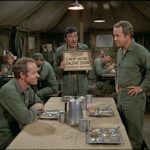
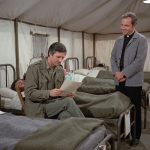
On the small, makeshift wooden nightstand next to the bed, a hand-drawn piece of paper leaned against a water pitcher. It was a crude, well-meaning gesture, decorated with a drawing of a smiling bedpan and bearing the inexplicably misspelled message: “Get-well Get Card.”
Hawkeye finally tore his eyes away from the patient and looked down at the handmade card. A small, tired smile flickered across his face, but the heavy silence in the tent suddenly felt too thick to breathe. The adrenaline of the long night was entirely gone, leaving behind a profound, terrifying vulnerability that threatened to pull him under.
“Who is the master wordsmith?” Hawkeye asked, nodding toward the nightstand. “I haven’t seen prose like that since Frank tried to write a requisition form for more tongue depressors.”
Father Mulcahy stepped forward, his smile widening slightly as he looked down at the paper. “That would be Corporal O’Reilly, I believe. Radar was quite concerned when the helicopters arrived last night. He asked me if he should draft a letter to the boy’s parents. I suggested he make a card instead. I think the sentiment outshines the syntax.”
Margaret’s hand lingered on the edge of the blanket for a second longer before she withdrew it, folding her hands neatly in front of her. The strict, unyielding head nurse of the 4077th was back, but the softness in her eyes remained.
“It’s sweet,” she said quietly, surprising both of the men. She didn’t offer a critique of military protocol or complain about unauthorized paper usage in the ward. She just looked at the card, then back at the sleeping soldier. “He looks so young when he sleeps. They all do. You forget they aren’t much older than high school kids until the mud washes off.”
“He told me he was a mechanic,” Hawkeye said, his voice finding a little more of its usual footing. “Said he could fix a tractor blindfolded. I told him if he pulled through, I’d let him take a look at the Swamp’s still. It’s been making a noise like a dying goose lately.”
Mulcahy chuckled softly, the sound warm and comforting in the drafty tent. “I’m sure he’ll appreciate the mechanical challenge, Pierce. Though I might have to intercede on behalf of his moral development before you introduce him to your… homemade spirits.”
Hawkeye shifted his weight, crossing his arms over his chest to ward off the chill that always seemed to settle in the camp by late afternoon. The crushing weight of the war, the endless line of choppers, the blood, and the dirt—it all felt a little lighter in this one specific corner of the room.
They had lost too many that week. The O.R. floor had been a slick, unforgiving battlefield of its own. But not this one. This mechanic from somewhere in the Midwest was going to wake up, read a poorly spelled card from a radar operator, and eventually go home.
Margaret reached into her pocket and pulled out a small, folded piece of gauze, meticulously wiping a smudge of dirt off the boy’s cheek. It was a motherly gesture, executed with clinical precision. Hawkeye watched her, feeling a familiar surge of deep, unspoken affection for the woman who infuriated him, challenged him, and understood this bizarre life better than anyone else in the world.
“You did good work last night, Major,” Hawkeye said softly, offering the compliment without a trace of a punchline.
Margaret looked up, her blue eyes meeting his. For a moment, the rank, the rules, and the constant bickering dissolved completely. There was only mutual respect and the shared, exhausted relief of a battle won.
“So did you, Captain,” she replied, her voice thick with quiet emotion.
Mulcahy looked down at his clipboard, making a small, satisfying checkmark next to the boy’s name. It wasn’t just a medical record; to the Father, it was a ledger of miracles, however small and fleeting they might be in the grand scheme of the conflict.
“Well,” Mulcahy said, stepping back and gesturing gently toward the door. “I suppose we should let him rest. The Lord does his best healing when the doctors finally stop poking around.”
Hawkeye uncrossed his arms and let out a long, slow breath. He reached out and lightly tapped the handmade “Get-well Get Card” with his index finger, ensuring it was perfectly centered next to the water glass.
“Yeah, let’s get out of here before he wakes up and realizes he’s still in Korea,” Hawkeye said. “I’d hate to be the one to break the news.”
Margaret turned on her heel, her professional posture returning, while Mulcahy tucked the clipboard under his arm. They walked out of the ward together, leaving the quiet hum of the sleeping tent behind. The war was still waiting for them outside, loud and unbroken, but for just one afternoon, it had been held successfully at bay.
In a place defined by what was lost, the greatest comfort always came from the ones they managed to keep.