The Endless Paper Trail of the 4077th
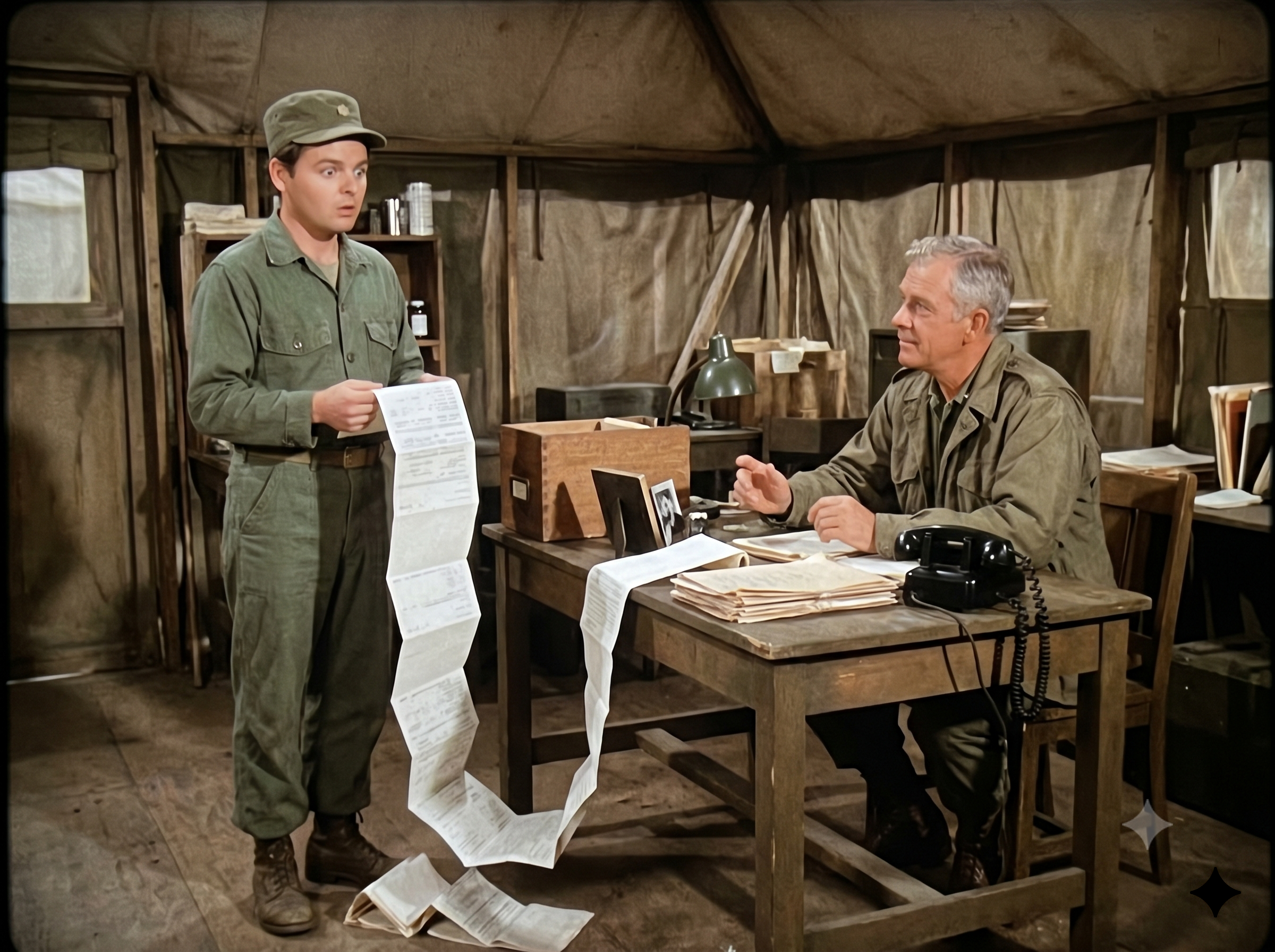
The war in Korea was fought with two things: bullets and paperwork. At the 4077th Mobile Army Surgical Hospital, it was often a toss-up as to which was a bigger threat to a man’s sanity.
Colonel Sherman T. Potter sat behind his small wooden desk, trying to find a rare moment of peace. The camp was quiet for once. No choppers. No wounded. Just the low, steady hum of the mess tent generator and the afternoon sun baking the olive-drab canvas of his office.
He was just about to open a letter from his beloved Mildred when the screen door squeaked.
It wasn’t a confident entrance. It was a slow, agonizing shuffle.
Corporal Walter “Radar” O’Reilly stood in the doorway. He looked like a boy who had just been asked to explain a broken window to the police. His olive fatigues looked a little too big for him today. His garrison cap was pulled low, and his eyes behind his round glasses were wide with unadulterated terror.
But it was what Radar was holding that caught Potter’s attention.
Clutched in the young clerk’s hands was a continuous sheet of teletype paper. It was impossibly long. It draped over Radar’s arms, cascaded down his uniform, pooled onto the wooden floorboards, and trailed out the door like the tail of a very bureaucratic kite.
Potter lowered his reading glasses. He leaned slightly forward, resting his hand near the heavy black field phone. He didn’t yell. He didn’t bark. He just let out a long, slow sigh born of thirty years in the United States Army.
“Great Caesar’s Ghost, Radar,” Potter said, his voice a mixture of fatherly exasperation and dry amusement. “Did you print out the entire Old Testament, or did Tokyo finally send us the list of MacArthur’s grievances?”
“N-no, sir,” Radar stammered, his voice cracking. He tried to gather the endless folds of paper, but it only made a louder crinkling sound. “It’s… it’s a message from I Corps, Colonel. It just kept coming out of the machine. I thought it was broken. I hit it with a clipboard, but it just got angrier.”
Potter took a sip of his lukewarm coffee. “Well, spit it out, son. What does the brain trust in Seoul want now? Are we out of regulation paperclips? Did Hawkeye insult a brigadier general’s dog?”
Radar swallowed hard. His hands shook as he held up the top section of the endless scroll. “It’s about the requisition form I sent last week, sir. The one for the extra wool blankets and the new sterilizer valves.”
“A perfectly reasonable request for a hospital in a combat zone,” Potter said calmly. “I assume they approved it?”
“No, sir.” Radar looked down at the paper, his chin trembling. “They didn’t approve it. They… they analyzed it.”
Radar took a deep breath, scanning the dense blocks of typed ink. “Sir, they say my request violates Section 4, Paragraph 12 of the Quartermaster’s Directive on strategic asset allocation. They say the 4077th is currently exceeding our textile quota by twelve percent.”
Potter stared at him. “Textile quota? We’re using those blankets to keep boys in shock from freezing to death.”
“I know, sir,” Radar whispered, looking completely defeated. He nervously pulled another three feet of paper from the pile on the floor. “But there’s more, Colonel. A lot more. It goes all the way to the bottom.”
Radar looked up, his eyes shining with unshed tears. “Sir… because I bypassed the regional depot to ask for the valves directly… I Corps says I’ve committed ‘willful sabotage of the quartermaster’s strategic reserves.'”
Radar clutched the paper to his chest like a shield. “Colonel… they’re bringing me up on charges. They’re going to send me to Leavenworth.”
The young corporal stood frozen, anchored to the floor by the impossible weight of the military machine, waiting for the sky to fall.
The silence in the small tent stretched out for a long, heavy moment. Outside, a jeep rumbled past, kicking up dust that danced in the shafts of sunlight.
Potter didn’t move. He sat perfectly still, looking at the boy standing before him.
He saw the genuine panic in Radar’s eyes. He saw a kid from Ottumwa, Iowa, who still slept with a teddy bear, currently convinced he was going to spend the rest of his life breaking rocks in a military prison.
Slowly, a warm, sad smile touched the corners of Colonel Potter’s mouth. The exasperation faded, replaced by the deep, quiet tenderness of a man who had seen too many boys asked to carry too much weight.
“Bring that monstrosity over here, son,” Potter said gently.
Radar shuffled forward. The paper dragged across the floor behind him like a bridal train made of red tape. He handed the top edge to the Colonel, his hands still trembling.
Potter took the paper. He didn’t bother putting his reading glasses back on. He just felt the cheap, stiff texture of it between his fingers.
“Sabotage,” Potter muttered, shaking his head. “Well, fan my brow. You’re a regular public enemy number one, Corporal.”
“I didn’t mean to, sir,” Radar pleaded, leaning over the desk. “I just knew we needed the blankets. Captain Pierce said the post-op ward was getting too drafty. You know how Captain Pierce gets when he’s cold, he starts singing show tunes, and nobody wants that. So I just… I just finessed the paperwork a little.”
“Finessed,” Potter repeated, chuckling softly. “Radar, sit down before you faint.”
Radar practically collapsed onto the small wooden chair beside the filing box, though he kept a death grip on his section of the teletype paper.
Potter tossed the endless document onto his desk. It spilled over the edge, resting against his landline phone. He folded his hands and looked Radar right in the eye.
“Let me tell you something about the United States Army, Walter,” Potter said, his voice low and steady. It was the voice of a father explaining how the world worked. “When a man sits behind a mahogany desk three thousand miles away from a bleeding soldier, he starts to lose his perspective.”
Potter pointed a weathered finger at the paper. “He starts to think his filing cabinet is the front line. He thinks ink is blood.”
Radar blinked, listening intently. The panic in his chest began to slow, grounded by the calm authority radiating from the man across the desk.
“The brass in Tokyo and Seoul, they get bored,” Potter continued. “They don’t have shrapnel to deal with. They don’t have boys crying out for their mothers in the middle of the night. So, they invent enemies.”
Potter leaned back in his creaky chair. “Today, their enemy is a corporal in Korea who had the audacity to want shivering kids to have a warm blanket.”
Potter picked up his favorite fountain pen. He uncapped it with a deliberate, practiced motion.
“They aren’t going to send you to Leavenworth, son,” Potter said warmly. “They don’t have enough paper to charge you with half the things you’ve pulled off to keep this camp running. And if they ever try, they’ll have to go through me first.”
Radar’s shoulders dropped. A massive, shuddering breath escaped his lungs. The color slowly started returning to his pale face. “You mean it, Colonel?”
“I mean it,” Potter smiled. He pulled the top of the teletype sheet toward him. “Now, as for this ‘willful sabotage’…”
Potter pressed the pen to the paper. In large, bold cursive, he wrote a single word across the dense block of military jargon: BULLHOCKEY.
Beneath it, he signed his name with a flourish: Sherman T. Potter, Colonel, Commanding. “There,” Potter said, capping his pen. “That ought to give the boys in the typing pool something to scratch their heads over.”
Radar looked at the bold signature. A small, relieved smile finally broke across his face. “Are you sure you can do that, sir?”
“I’m a Colonel, Radar. I can do any damn fool thing I please, as long as it confuses a General.” Potter winked. “Now, bundle up this mess and throw it in the incinerator. We need to clear some space. I’m expecting a very important letter from Mildred, and I don’t want it getting lost in your paper factory.”
“Yes, sir!” Radar jumped up. The boyish energy returned to his limbs in an instant. He began frantically gathering the paper in his arms, turning it into a massive, crinkling snowball of bureaucracy.
He paused at the door, peering over the top of the white paper mountain. He looked at Potter, his eyes filled with quiet, fierce loyalty.
“Colonel?”
“Yes, Radar?”
“Thanks.”
Potter just smiled, offering a slight nod. “Dismissed, son.”
Radar hurried out of the tent, the screen door slamming behind him with a familiar, comforting sound.
Colonel Potter sat back. He looked at his neat, practical desk. The war was still raging just over the hills. The casualties would come again. The mud and the blood and the fatigue were waiting.
But for just a moment, the world felt a little softer. Potter picked up his cold coffee, took a sip, and smiled to himself in the quiet tent.
In a place filled with so much madness, the finest medicine they had was usually just each other.