Tolido or Bust: The Hand-Drawn Escape of the 4077th
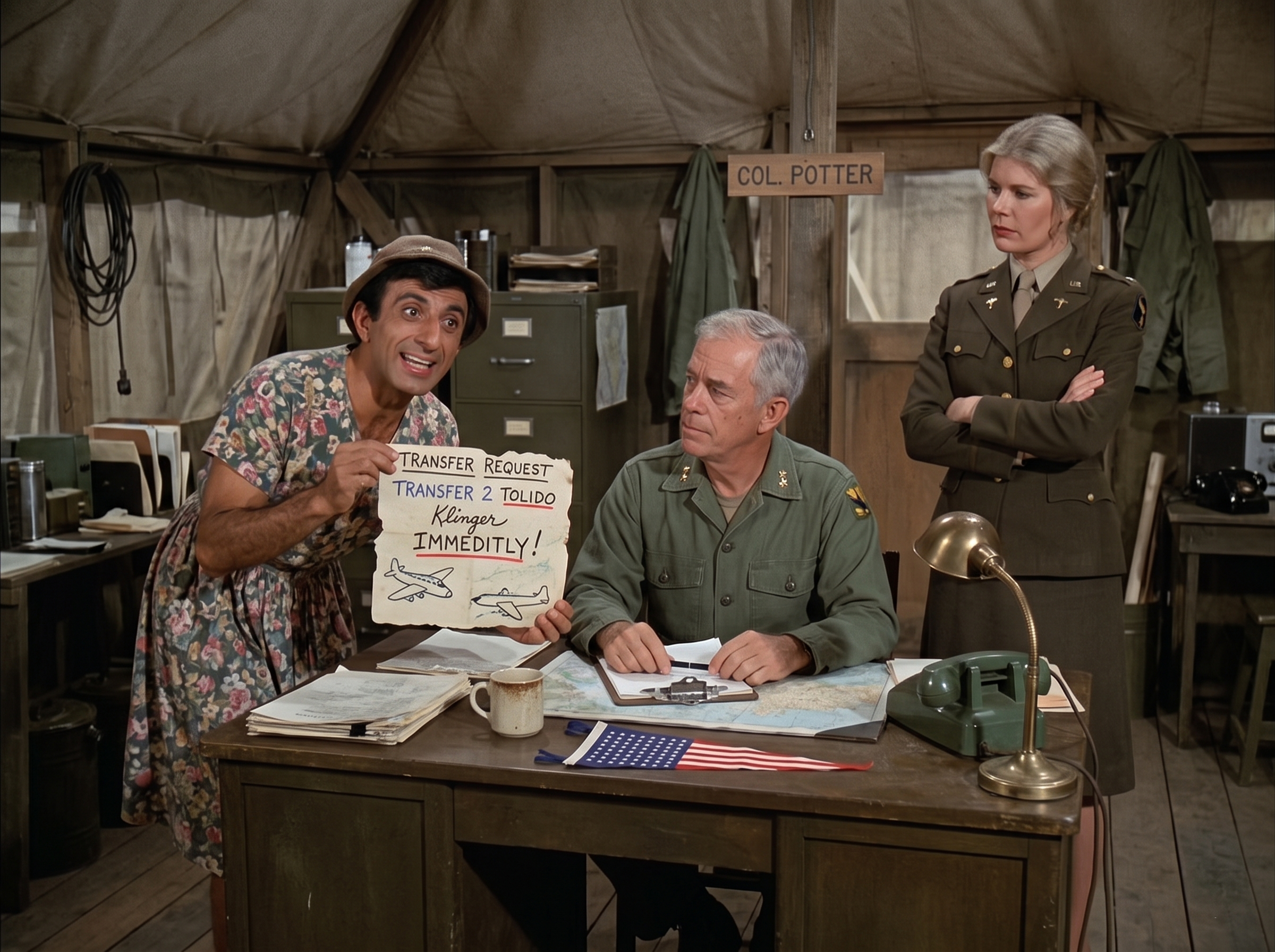
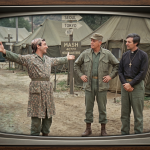
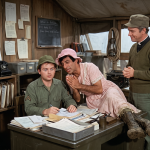
The canvas of Colonel Potter’s tent flap whipped open like a theater curtain, admitting a bright burst of floral pattern into the room’s tired olive drab. Corporal Klinger didn’t just enter; he arrived, presenting himself like an earnest, desperate contestant waiting for the grand prize. He clutched a large, hand-drawn sign, holding it with all the hopeful reverence of a sacred artifact. His expression was a manic blend of theatrical pleading and unwavering hope, his eyes fixated on the Colonel as if he might just grant his wish by sheer force of performance. Potter, seated at his heavy wooden desk amidst maps, field phones, and a small American flag pennant, didn’t even look up at first. He simply sighed, a deep, weary ventilation that spoke of thousands of casualties and only slightly fewer transfer requests. He rubbed his face, his fatherly wisdom momentarily obscured by simple exhaustion. He was tracing his fingers over a map, a reminder of the long, painful terrain they were still stuck on.
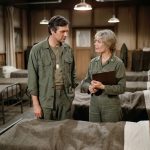
Standing stiffly by his desk was Major Margaret Houlihan, her arms crossed tight against her chest like protective armor. She’d just briefed Potter on nursing schedules and was clearly unimpressed by this fresh interruption. Her expression was a controlled, professional frustration, watching Klinger’s latest attempt to outsmart the system with a guarded disapproval. She saw efficiency being threatened, even as a small part of her surely understood the desperate need for escape that drove him. Klinger held the sign directly towards Potter, leaning slightly over the edge of the desk. The cardboard was rough-cut, covered in bold crayon and ink. “TRANSFER REQUEST,” it shouted. And then, “TRANSFER 2 TOLIDO.” The typo was brilliant, a window into his rushed, unpolished hope. And beneath it, “KLINGER IMMEDITLY!” The text was a chaotic mix of all caps and rushed script, a frantic appeal to anyone who would listen. Two crude drawings of airplanes, pointing in opposite directions, frame the text, showing his dream of flight, of just being away. Potter finally looked up, his face a perfect canvas of tired, patient acceptance. He knew this dance by heart, but it never got any easier to watch. Before either officer could say a word, Klinger spoke, his voice dropping the usual theatrical pitch for a moment of quiet, pleading earnestness. “Toledo, Colonel. My home. My grandmother… the recipe book… she needs me. And you can see, I’ve got two planes figured out for the journey. Just one, small signature.” He held the sign even higher, waiting, the entire chaotic world of the 4077th compressed into that single sheet of cardboard and the desperate hope in his eyes.
Colonel Potter didn’t take the sign immediately. He stared at it, his eyes softening as they traced the crude drawings of the airplanes. They were the most human part of the whole request, a simple, childlike longing for flight, for a swift and easy escape from the mud and pain. He looked past the colorful dress, the theatrical pleading, and the ridiculous typos. He didn’t see a prank; he saw a man trying to find a way to survive the crushing weight of a war that had dragged on far longer than anyone expected. He didn’t see a lack of discipline; he saw a resilient spirit refusing to be broken.
Margaret shifted, her crossed arms creating a small friction sound in the quiet tent. “Procedure, Corporal,” she said, her voice tight with professional duty. “Standard request forms. Proper chain of command. Correct. Spelling. Of major U.S. cities.” She pointedly avoided looking at Klinger in the dress, focusing only on the cardboard sign. Her need for order was her own survival mechanism, and Klinger’s constant disruption was a personal offense.
Potter took the sign. He held it gently, tracing the word ‘TOLIDO’ with his thumb. “Klinger,” he said, his voice quiet, fatherly, and infinitely steady. He didn’t mock the dress. He didn’t criticize the spelling. He focused on the human need. “Tell me something about Toledo. When you get back there, what’s the first thing you’re going to do?” He was inviting Klinger to dream, to share the real hope beneath the performance.
Klinger’s eyes, previously filled with theatrical hope, widened with genuine surprise. He didn’t launch into another wild story. He thought for a long moment, the layers of character dropping away. “Colonel,” he said softly, “there’s a small riverside park. I just want to sit on a bench. Watch the ducks. Smell the mud and the grass without smelling the hospital. Just… quiet.” His voice was a bare whisper, a moment of profound, simple human desire.
Potter nodded, his own memories of Missouri rising to meet Klinger’s Toledo. He knew that bench. He knew that quiet. He understood the ache to simply be useful and peaceful. “Margaret,” he said, turning to his head nurse, “the Air Force doesn’t fly to ‘Tolido’.” He used the typo, not to mock, but as a bridge to connection.
Potter returned to Klinger. He didn’t crumple the sign. He didn’t give a harsh ‘no’. ” Corporal, your request is noted. But right now, we need you here. Not the actor. Not the dress. But the heart. The spirit. We need you to keep us going.” He reached out and touched Klinger’s shoulder, a simple gesture of shared burden. “I can’t send you to Tolido today, son. But I can give you a task. Father Mulcahy needs some help organizing the children’s clothing drive. Something… useful. Something that gets you a small break.“
Potter turned back to Margaret. “Margaret, please make sure the typo is corrected on the official Toledo request that goes into his file. Procedural efficiency is important.” It was a gentle corrective that validated her desire for order, while also allowing Klinger’s dream to remain, if only on paper.
The tension in the room evaporated, replaced by a quiet, shared understanding. Klinger didn’t feel defeated. He felt seen. His dream of escape was honored, even if the logistics were impossible. His spirit was validated. He gave a quiet, simplified salute, took his sign back, and left the tent, his floral dress a vibrant, bizarre reminder of resilience. Margaret took a quiet breath, her crossed arms softening ever so slightly, and turned to check the next set of schedules. Colonel Potter picked up his pencil and returned to the map, his gaze lingering for a moment on the small American flag, a quiet reminder of what they were fighting for, and what they had just found right here in his tent: simple, enduring humanity.
In the heart of the madness, they always found small ways to care for each other.