A Fleeting Feather in the Dark
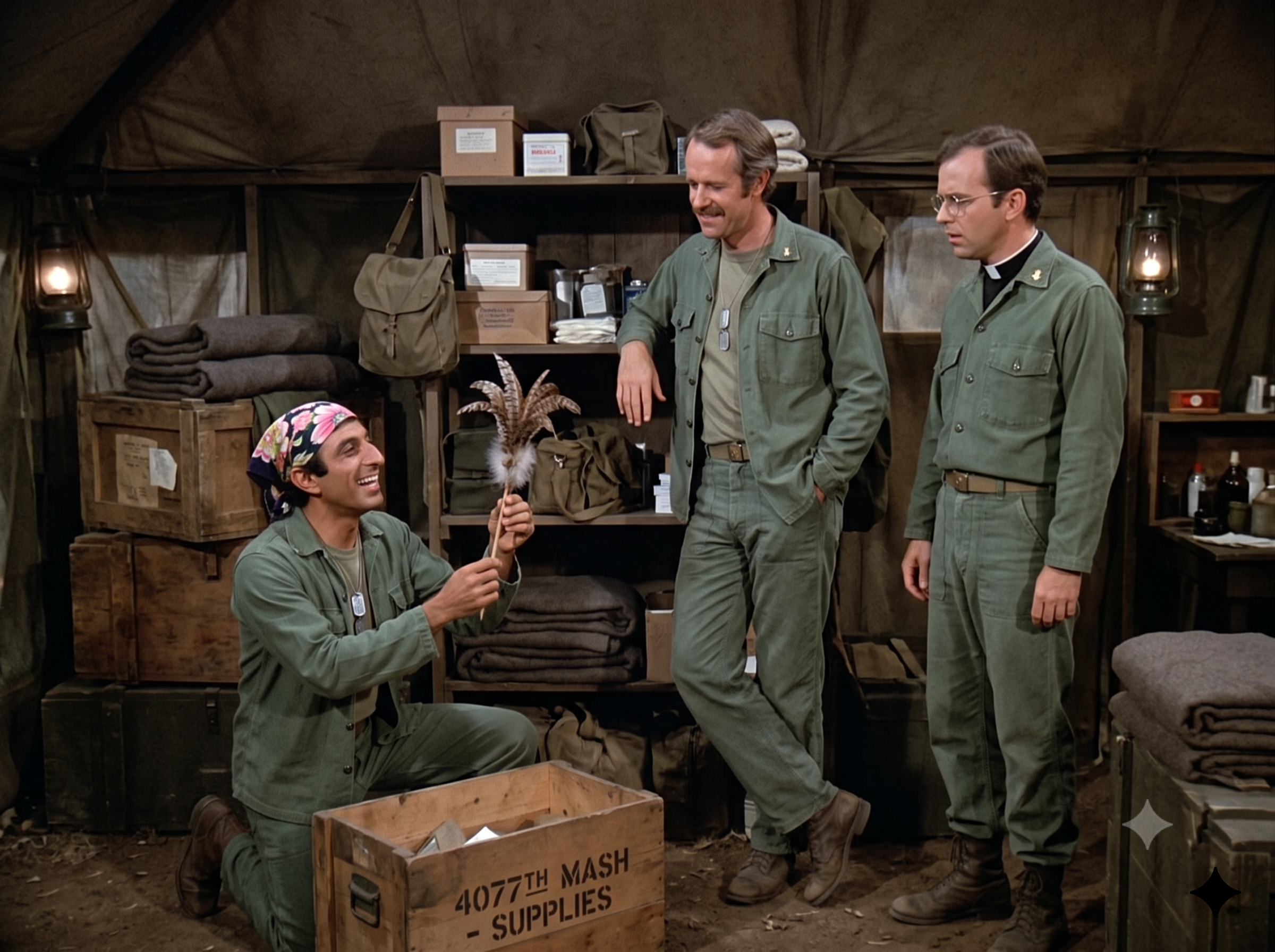
In the 4077th, salvation rarely came from heaven. Most of the time, it arrived packed in a wooden crate from Quartermaster.
The supply tent was quiet that afternoon, a rare sanctuary away from the grinding noise of the motor pool and the lingering ghosts of the operating room. The air was thick with the scent of canvas, mothballs, and the dry, dusty earth of South Korea. Dust motes danced lazily in the soft, dim light of the kerosene lanterns hanging from the wooden support beams.
For Captain B.J. Hunnicutt, the clutter of folded blankets and canvas bags offered the perfect hiding spot. He was deliberately avoiding a mountain of post-op paperwork and the endless complaints of Major Winchester.
Standing relaxed against a wooden shelf, B.J. wore his fatigue shirt casually open at the collar, his silver dog tags resting against his plain green undershirt. He had his hands tucked into his pockets, his posture easy and perfectly still. He was perfectly content to just exist in the quiet for a few minutes.
Father Francis Mulcahy had wandered in a few moments later. The gentle priest was on a much more earnest mission, searching the shelves for a spare box of communion wafers or, failing that, some decent writing paper for the orphans.
But neither the surgeon nor the priest expected the sudden, theatrical arrival of Corporal Maxwell Klinger.
Klinger had burst into the tent with the desperate energy of a man who smelled a loophole. He was dressed in standard olive drab fatigues, but his head was adorned with a brightly colored, floral bandana. It was a modest compromise of his usual wardrobe, but it still added a splash of absurd color to the drab military olive.
Without a word of greeting, Klinger had immediately dropped to his knees in the dirt. He began prying open a freshly delivered wooden crate stenciled with the words: “4077TH MASH – SUPPLIES.”
“Corporal,” Mulcahy had asked mildly, “is there something specific you are hoping to find? I was under the impression this shipment was strictly surgical dressing.”
“Padre, the army works in mysterious ways,” Klinger muttered, his hands flying as he tossed aside packing paper and cardboard boxes. “Sometimes they send bandages. Sometimes they make a glorious, glorious clerical error.”
For ten minutes, Klinger dug through the crate like a dog searching for a buried bone. B.J. simply watched from his spot against the shelves, a dry, easygoing smile playing on his lips. He loved a good Klinger scheme, especially when it delayed his return to the Swamp.
Then, Klinger froze. His hands stopped moving.
A look of sheer, unadulterated joy washed over his face. His dark eyes widened, and a sly, triumphant grin stretched from ear to ear.
Slowly, with the reverence of a man pulling the sword from the stone, Klinger lifted his prize from the wooden crate.
It was not a ticket home. It was not a misplaced set of discharge papers.
It was a bizarre, completely useless prop. It appeared to be a thin wooden stick topped with a cluster of stiff, brown pheasant feathers and a small tuft of white down. It looked like a cross between a cheap feather duster and an exotic fan from a forgotten vaudeville act.
Klinger held it aloft, the lantern light catching the absurd plumage. He looked up at the two officers, his face radiating pure, manic hope.
“Gentlemen,” Klinger announced, his voice trembling with manufactured awe. “Behold the instrument of my deliverance.”
B.J. leaned a little heavier against the shelf, his smile widening into a look of absolute, amused delight. He crossed his ankles, settling in for the performance.
Father Mulcahy, however, stood perfectly still. He pushed his wire-rimmed glasses up his nose, his gentle face settling into an expression of profound, innocent confusion.
“Maxwell,” Mulcahy asked softly, his brows furrowing as he stared at the feathers. “What on earth is that?”
Klinger scrambled slightly, still kneeling beside the crate, and turned his sly, hopeful eyes directly onto the priest.
“Father,” Klinger said breathlessly, holding the feathered stick out like a sacred relic. “I need you to perform an emergency conversion. Right now. I am officially renouncing my citizenship to become the High Shaman of the Toledo Ostrich Worshippers, and this… this is my sacred staff. Colonel Potter has to discharge me on religious grounds!”
The supply tent fell dead silent, save for the faint, distant rumble of a jeep shifting gears somewhere out in the compound.
B.J. couldn’t hold it in anymore. A low, warm chuckle rumbled in his chest. He didn’t move from his relaxed lean against the wooden shelf, but his eyes crinkled with genuine mirth.
“I don’t know, Father,” B.J. drawled, his voice thick with dry, affectionate sarcasm. “You have to admit, the plumage really complements his bandana. The Army might just have to recognize the sheer aesthetic value of his new faith.”
Father Mulcahy blinked, looking from Klinger’s beaming, expectant face to the ridiculous cluster of brown feathers trembling in the dim light. The priest tilted his head slightly, his gentle confusion slowly giving way to a soft, weary amusement.
“An ostrich worshipper, Maxwell?” Mulcahy asked, his tone remarkably even. “In Toledo? I must confess, my seminary training heavily neglected the avian deities of the American Midwest.”
“It’s a very exclusive sect, Padre,” Klinger insisted, refusing to break character. He gave the feather stick a dramatic little wave. “We are pacifists. We bury our heads in the sand at the first sign of conflict. It’s a core tenet of our belief system! I cannot possibly be expected to remain in a combat zone. It goes against everything these feathers stand for.”
“And the Army packed your sacred staff in a crate of surgical gauze?” B.J. asked, raising a single eyebrow.
“The Lord works in mysterious ways, Captain,” Klinger shot back without missing a beat. “You said it yourself, Father. A glorious clerical error!”
Mulcahy let out a soft sigh, resting his hands gently at his sides. “I believe you said that, Maxwell. And I am fairly certain that object is meant to be a bore cleaner for the artillery boys, or perhaps a rather flamboyant duster meant for the general’s tent.”
Klinger’s theatrical smile faltered, just for a fraction of a second. He looked at the bizarre, feathered object in his hand. The manic, sly hope in his eyes dimmed, replaced by a fleeting shadow of the profound exhaustion that lived in the bones of every person in the camp.
He slowly lowered the stick. The joke had run its course, as they always did. The adrenaline of the performance faded, leaving behind the damp, dusty reality of the canvas walls.
“A duster,” Klinger muttered, his voice dropping its vaudeville pitch. He slumped back slightly on his heels, resting his arm on the edge of the wooden crate. “A lousy feather duster. Just once, I’d like to reach into one of these boxes and pull out a miracle. A boat ticket. A bus pass. A map showing me the walking route to Ohio.”
The silence that followed was different from the comedic pause before. It was heavy, filled with the unspoken, shared heartache of the 4077th.
They were all so terribly far from home. They were surrounded by mud, blood, and the constant, dull ache of missing the lives they had been pulled away from. Klinger’s crazy schemes, his dresses, his bandanas, his wild stories—they weren’t just jokes. They were armor. They were a desperate, creative rebellion against the madness of the war.
B.J. lost his easy, amused smile. The surgeon pushed himself off the wooden shelf, his boots scuffing softly against the dirt floor. He walked over and crouched down next to the open supply crate, bringing himself level with the disappointed corporal.
B.J. reached out and gave Klinger’s shoulder a firm, reassuring squeeze. The gesture was incredibly grounding, a quiet anchor in the dim light.
“Hey,” B.J. said softly, his voice rich with warmth and quiet solidarity. “We’re all looking for that map, Max. Every single one of us.”
Klinger looked at B.J., the flamboyant persona completely stripped away. For a moment, he was just a tired kid from Toledo, missing his hometown and his family. He gave a small, weary nod.
Father Mulcahy stepped closer, his boots silent on the packed earth. He looked down at Klinger, his eyes full of that boundless, quiet compassion that made him the moral compass of the camp.
“You know, Maxwell,” the priest said gently, a small, tender smile touching his lips. “I may not be able to officially convert you to an ostrich sect today. The paperwork alone would be a nightmare for the poor Colonel.”
Klinger let out a short, breathy laugh, looking down at the dirt.
“However,” Mulcahy continued, his voice taking on a soft, rhythmic cadence. “I do believe that hope takes many forms. Sometimes it is a letter from home. Sometimes it is a quiet moment in a dusty tent. And sometimes, it is the remarkable ability to look at a box of military supplies and find a reason to smile.”
The priest reached out and lightly tapped the tuft of feathers Klinger was still holding.
“You have a gift for keeping our spirits aloft, Corporal,” Mulcahy said softly. “And in a place like this, that is a miracle all its own. You don’t need a conversion to be a healer here.”
Klinger looked up at the priest, and then over at B.J. The heavy, oppressive weight of the war seemed to lift, just a few inches, from his shoulders. He looked back at the bizarre feathered stick in his hand.
Slowly, the sly, theatrical grin began to creep back onto his face. He adjusted the floral bandana on his head and sat up a little straighter.
“You know, Padre,” Klinger said, twirling the feathers between his fingers. “You make a fair point. But I still say if I stick these behind my ears and start clucking during inspection, Major Winchester might just have a stroke. And frankly, that’s a miracle I’m willing to work for.”
B.J. laughed aloud, a genuine, hearty sound that filled the small canvas space. He clapped Klinger on the back and stood up, the easygoing posture returning.
“I’ll patch the Major up when you’re done, Klinger,” B.J. smiled, walking back toward the tent flap. “Just make sure you save some feathers for the rest of us.”
Father Mulcahy shook his head, his innocent bewilderment returning in full force as Klinger began to meticulously stroke the feathers.
“I shall pray for us all,” the priest murmured, turning to resume his search for writing paper.
Klinger remained kneeling by the box for a moment longer. The dim, practical light of the lantern cast a warm glow over the clutter of the supply tent. He held the ridiculous prop in his hands, no longer a ticket home, but a small, absurd trophy of survival.
He wasn’t in Toledo. But as long as he had an audience willing to smile with him in the dark, he knew he was going to make it through another day.
In a place defined by what was broken, the greatest medicine was often found in the quiet, absurd moments of standing together.