The Standard We Keep
There was a very specific kind of quiet that fell over the 4077th just before sunset.
It wasn’t peace. It was simply the sound of an entire camp holding its collective breath between the last incoming chopper and the next.
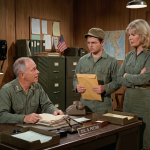
Inside Colonel Sherman Potter’s office, the late afternoon light cut through the window in long, dusty ribbons of pale amber. It caught the worn edge of the wooden desk, the tangle of the black field phone, and the stubborn map of the Korean peninsula pinned to the wall like a bad joke nobody had the energy to laugh at.
Standing dead-center on the faded rug was Major Charles Emerson Winchester III.
He stood with the rigid, unbreakable posture of a man who believed that if he slouched even a fraction of an inch, the entire Commonwealth of Massachusetts might slide into the sea. His chin was held high. His tailored olive wool was impeccably pressed, though a faint, telltale ring of salt sweat stained the inner rim of his collar.
“Colonel,” Charles began, his voice a rich, baritone cello of pure indignation. “I am a man of infinite, monumental forbearance. But I am not a medieval serf.”
Behind the desk, Sherman Potter didn’t look up immediately.
He sat with his reading glasses resting near the tip of his nose, his fountain pen hovering over a stack of triplicate transfer orders. His face bore the gentle, deeply carved map of forty years in Uncle Sam’s army.
“Nobody called you a serf, Winchester,” Potter said softly, his voice like dry gravel rolling over old wood. “Though if the shoe fits, I’m sure Klinger can requisition you a pair in a size eleven.”
To the side of the desk stood Major Margaret Houlihan.
Her arms were crossed tightly over her chest, her shoulders set like a stone rampart. She had been on her feet since four in the morning, and the sharp, composed set of her jaw suggested she was approximately three seconds away from putting a clipboard through the screen door.
“He’s been at this since breakfast, Colonel,” Margaret said, her tone clipped and dangerous. “First it was the starch in the surgical towels. Now it’s the draft in the Pre-Op tent.”
“It is not a draft, Major,” Charles snapped, turning his head just enough to register her presence without granting her the dignity of his full profile. “It is a gale-force arctic system blowing directly through the western seams! My fingers were so numb during the second bowel resection today that I felt less like a surgeon and more like a man attempting to thread a needle while wearing catcher’s mitts.”
Potter finally laid his pen down.
He took off his glasses, pinched the bridge of his nose, and let out a long, slow sigh that seemed to carry the weight of three different wars.
“Charles,” Potter said, his voice dropping into that quiet, dangerous register of a father whose patience was running on fumes. “We are three miles from the main supply route. The wind blows. The canvas flaps. The war goes on.”
“Then the war will simply have to wait!” Charles declared.
With a sharp, theatrical flick of his wrist, he reached into his jacket pocket and produced a single, neatly folded sheet of white paper. He stepped forward and laid it precisely in the center of Potter’s desk, right over the morning’s casualty log.
“I demand you sign this clearance authorization immediately,” Charles said, his voice hardening into something stubborn and entirely unyielding.
Potter looked down at the paper. Then, slowly, his tired eyes traveled up to Charles’s face.
The room went dead silent.
Even Margaret didn’t unfold her arms. Because sitting right at the bottom of that typed form wasn’t an official army stock number—it was a personal check drawn on the Boston Safe Deposit & Trust Company, written out for the staggering sum of four hundred and fifty dollars.
Potter stared at the neat, blue fountain-pen script on the check.
He reached out, his thumb brushing over the crisp, high-grade linen paper that had somehow survived a journey across the Pacific Ocean without getting smeared in mud or diesel grease.
“Four hundred and fifty dollars,” Potter read aloud, his voice barely above a whisper. “Charles… what in the name of Sam Hill is this for?”
“Three commercial, kerosene-fueled radiant space heaters,” Charles said stiffly. His chin remained high, but the fingers resting against the seam of his trousers twitched just once. “To be purchased through a private merchant in Tokyo and flown in via civilian freight.”
Margaret let out a short, incredulous breath. “Winchester, you can’t buy private heating for the Swamp just because your aristocratic toes get chilly—”
“They are not for my quarters!” Charles barked.
The sheer volume of his voice cracked the quiet of the office.
He caught himself instantly, his jaw tightening as he fought to pull the heavy, velvet curtain of his Boston manners back over his face. He swallowed hard. His gaze dropped from the ceiling to the map on the wall, refusing to meet Potter’s eyes.
“They are for Post-Op,” Charles said quietly.
The silence that followed was different from the one before. It was heavier. It smelled of floor wax, old paper, and the damp wool of tired people.
“Bed number four,” Charles continued, his voice dropping into a flat, clinical cadence. “Private First Class Thomas Gable. Nineteen years old. Shrapnel to the left thorax. We spent four hours repairing the pulmonary artery. He survived the table.”
Charles paused. A tiny, imperceptible tremor caught the corner of his mouth.
“He survived the table, Colonel. But at three o’clock this morning, his core temperature dropped to ninety-four degrees. The blankets in that tent are thinner than the coffee in the mess hall. I stood over that boy for forty-five minutes rubbing his wrists just to keep his pulse from slipping through my fingers like sand.”
Charles took a slow, deep breath, squaring his massive shoulders.
“I will not spend six hours pulling a child out of the grave, Colonel Potter, only to watch the United States Army freeze him to death in the recovery room. Sign the clearance.”
Margaret’s folded arms slowly uncrossed.
Her hands dropped to her sides. The sharp, defensive posture in her frame melted away, leaving behind the exhausted, fiercely protective Head Nurse of the 4077th. She looked at Charles—really looked at him—at the dark, bruised half-circles beneath his eyes, and the faint trace of dried yellow iodine still stuck to the cuticle of his right thumb.
“The Tokyo distributor won’t deliver to a combat zone, Major,” Margaret said. Her voice wasn’t loud anymore. It was soft, practical, and laced with a quiet, profound solidarity. “The MPs at Kimpo will impound the crates as non-essential civilian cargo before they ever touch a truck.”
Charles’s face fell. For a fraction of a second, the great Charles Emerson Winchester looked remarkably small.
“Then… then we bribe the MPs,” he said stubbornly. “I have a cousin in the State Department—”
“Put your checkbook away, Son,” Potter said gently.
The old man stood up. His knees gave a familiar, dry pop in the quiet room.
He walked around the side of the wooden desk, stepping past the field phone, and picked up the piece of paper. He didn’t tear it up. He just folded it neatly in half and slipped it into the breast pocket of Charles’s uniform, giving the heavy wool a single, firm pat.
“Army regulations say we can’t accept private hardware,” Potter said, looking Charles dead in the eye. “However… Army regulations also state that the unit Commander has the authority to declare an emergency thermal deficit in a critical recovery sector.”
Potter turned his head toward the door. “Major Houlihan.”
“Sir,” Margaret said instantly, her spine straightening.
“Take a walk over to Supply. You tell Sergeant Klinger that I want every spare sheepskin vest, every wool vehicle blanket, and every heavy-duty generator tarp moved into Post-Op before that sun goes behind the ridge.”
“Klinger told me yesterday Supply was entirely out of winter stock, Colonel,” Margaret noted, though a warm, knowing spark had already returned to her eyes.
“You tell him,” Potter said quietly, “that if he finds those blankets, I will personally sign his next weekend pass to Seoul. And if he doesn’t, I will personally assign him to check the temperatures of the camp mules for the next month.”
Margaret allowed the faintest, beautiful ghost of a smile to touch her lips. “Yes, Colonel.”
She turned toward the door, but paused with her hand on the latch. She looked back at Charles, her voice dropping into something entirely sincere.
“Good catch on bed four, Doctor.”
Charles gave a single, stiff, slightly awkward nod of his head. “Protocol, Major. Purely protocol.”
When the screen door clicked shut behind her, the office fell quiet again.
Potter walked over to the small wooden shelf beside his map. He reached behind a box of paper clips and pulled out a squat, dusty bottle of amber liquid that carried no label whatsoever. He poured two modest fingers into a pair of battered tin cups.
He walked back and held one out.
Charles stared at the metal cup. In Boston, a man would rather be caught dead than drink sour mash out of camping tin.
Slowly, Charles reached out and took it.
“To the Boston Safe Deposit and Trust,” Potter offered softly, raising his cup.
Charles looked down at the cheap whiskey, then looked at the tired old man who carried the weight of this godforsaken valley on his shoulders every single day.
“To Private Gable,” Charles corrected quietly.
They clinked the tin cups together. The sound was flat, dull, and entirely un-musical.
Outside the window, the Korean wind began to kick up against the canvas, cold and indifferent as ever. But inside the modest wooden office, for just a little while longer, the warmth held steady.
They came from different worlds to sit in the same mud, proving every day that the greatest medicine the 4077th ever carried wasn’t in the supply tent—it was in each other.