The Softer Side of the Canvas
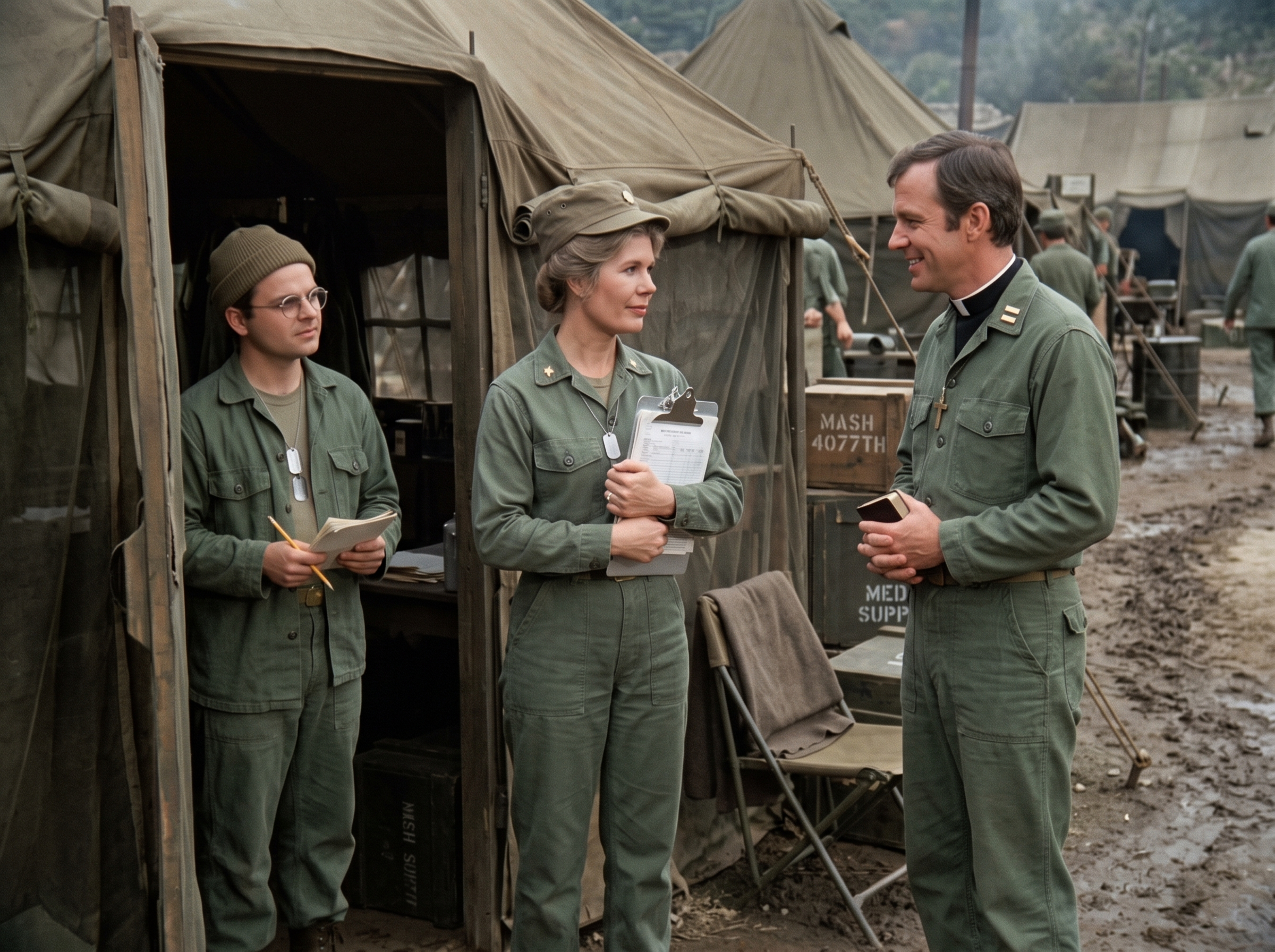
The Korean dust had a way of settling over everything at the 4077th, coating the olive drab canvas, the wooden supply crates, and the exhausted souls of the people living there.
It was mid-afternoon, the quiet hour between the roar of the incoming choppers and the chaotic scramble of the operating room.
The camp was resting, catching its breath in the stifling heat.
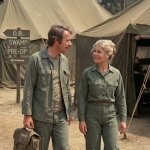
Outside the nurses’ tent, the dirt path was baked dry by the sun.
A lone wooden folding chair sat abandoned near a stack of supply crates, casting a long, lazy shadow across the ground.
Inside the tent, Major Margaret Houlihan was strictly business, as usual.
She stood just inside the doorway, the canvas flap pulled back to let in whatever meager breeze was brave enough to wander through the camp.
Her uniform was as crisp as the harsh laundry conditions allowed, her posture perfectly rigid.
In her hands, she clutched her wooden clipboard like a soldier holding a shield.
She was reviewing the duty rosters, her eyes scanning the columns of names with military precision.
Standing a few feet behind her in the shadows of the tent was Corporal Walter “Radar” O’Reilly.
He had just delivered a stack of newly mimeographed requisition forms.
Usually, Radar would drop his paperwork and scurry out before the Major could find a reason to bark at him.
But today, he lingered, clutching his own clipboard to his chest, his oversized glasses slipping slightly down his nose.
He was watching the tent doorway with a quiet, earnest anticipation.
He knew something the Major didn’t know he knew.
Footsteps crunched softly on the gravel outside.
Margaret didn’t look up from her clipboard at first.
She just tightened her grip, ready to dress down whatever enlisted man was loitering near her quarters.
“If that is you, Corporal Klinger, I am in no mood to discuss your latest velvet ensemble,” she said sharply, her eyes still glued to the paper.
“Actually, Major, it’s just me,” came a gentle, reassuring voice.
Margaret stopped reading.
She lowered the clipboard just a fraction and looked up.
Standing on the dirt path, bathed in the soft, dusty sunlight of the afternoon, was Father Mulcahy.
He wasn’t wearing his helmet or his heavy jacket.
He looked tired, the deep lines around his eyes a testament to the endless stream of wounded boys he comforted day after day.
Yet, despite the fatigue, there was a profound lightness to him today.
His hands were folded gently together in front of his waist.
He wore a soft, sincere smile that reached all the way to his eyes.
It was a look of pure, hopeful warmth, radiating a quiet moral clarity that could disarm a general.
“Father,” Margaret said, immediately adjusting her posture, trying to maintain her authoritative air. “Is there something you need? The medical supplies inventory isn’t finished yet, if that’s what you’re looking for.”
“No, Margaret,” the priest said softly, using her first name, something he only did when the conversation was not about army business.
He took a half-step closer to the canvas doorway, his smile never wavering.
“I actually just returned from the orphanage in Uijeongbu.”
Margaret froze.
Her knuckles turned instantly white against the edge of her clipboard.
Behind her, Radar shifted his weight, his eyes wide and bright beneath his cap.
The ironclad head nurse of the 4077th, the woman who took pride in her unyielding military discipline, was suddenly completely exposed.
For a long, agonizing second, Margaret didn’t say a word.
She stared at the priest, her mind racing for a way to rebuild the wall that had just crumbled.
“I see,” she finally managed, her voice slightly higher than usual. “Well. I’m sure the sisters are doing their best. Now, if you’ll excuse me, Father, I have…”
“I saw the delivery, Margaret,” Mulcahy interrupted gently.
He didn’t push, he didn’t raise his voice.
He just offered the truth with the kind of gentle grace that made it impossible to run away from.
“Two crates of winter coats, heavy wool blankets, and several tins of powdered milk. Arrived completely anonymously on the morning supply truck.”
Margaret swallowed hard. She looked away, staring intensely at a wooden crate next to the folding chair outside.
“An anonymous donation,” she said stiffly. “How fortunate for them. Some generous soul back in the States, no doubt.”
“The manifest had a very familiar signature at the bottom,” Mulcahy continued, his voice barely above a whisper. “It seems a certain chief nurse used her own back-pay to order them through a private supplier in Tokyo.”
“That’s a clerical error,” Margaret snapped, though there was no real fire in it. “The quartermaster is notoriously sloppy. I’ll have him reprimanded.”
“It wasn’t an error, Major.”
The voice came from inside the tent.
Margaret jumped slightly and spun around.
She had almost forgotten Radar was there.
The young corporal stood just a few feet away.
He wasn’t shrinking back or apologizing.
Instead, he was looking up at her with a sweet, earnest expression of absolute, innocent pride.
“I processed the telegraph wire for you last week, Major,” Radar said softly. “I had to use the special routing codes to get it to the supplier in Tokyo fast enough before the cold weather hits.”
Margaret stared at the boy.
She opened her mouth to scold him, to order him to forget what he saw, to remind him of the chain of command and the regulations regarding private telegraphs.
But looking at Radar’s bright, shining face, the words completely died in her throat.
Radar wasn’t judging her for breaking regulations.
He was looking at her like she was a hero.
Slowly, Margaret turned back to face the doorway.
Father Mulcahy was still standing there on the dusty path, his hands folded, his smile offering nothing but pure, unconditional understanding.
He knew exactly how hard she worked to keep up her tough exterior.
He knew that as a woman in a combat zone, surrounded by chaos and death, she felt she had to be made of steel just to survive.
But he also knew her heart.
He always had.
The silence stretched out between them, thick with the unspoken realities of the war.
They were thousands of miles from home, surrounded by tragedy, patching up broken boys in a canvas tent.
It was a harsh, ugly world.
But in this tiny sliver of time, bathed in the muted beige light of the afternoon sun, the ugliness faded away.
Margaret looked at the gentle priest.
She looked back at the proud, innocent kid holding a clipboard.
And then, very slowly, the rigid tension in her shoulders melted away.
Her usually guarded face softened completely.
The stern lines around her mouth vanished, replaced by a moment of quiet, hidden warmth.
Her eyes grew slightly glassy, brimming with a vulnerability she almost never let anyone see.
She lowered her clipboard, resting it against her side.
For once, she didn’t need it as a shield.
“The winters here…” Margaret started, her voice finally dropping its military edge. She paused, clearing her throat. “The winters here are very hard on children, Father. Someone has to make sure they have enough.”
Mulcahy nodded slowly, his eyes shining with unshed tears of his own.
“Indeed they do, Margaret,” he said softly. “And the Lord works through wonderful, unexpected people.”
He didn’t ask for a confession, and he didn’t demand she admit anything else.
He simply reached out, gently patted the canvas fabric of the tent doorway, and gave her one last, deeply meaningful nod.
“Thank you, Major,” he whispered.
“You’re welcome, Father,” she whispered back, the words so quiet they barely disturbed the dust in the air.
Mulcahy turned and began to walk slowly down the dirt path, his shadow stretching out beside him, leaving a lingering warmth in his wake.
Margaret stood in the doorway for a long time, watching him go.
She didn’t immediately rush back to her paperwork.
She didn’t bark any orders.
She just stood there, breathing in the dry, dusty air, letting herself feel human for just a minute longer.
Behind her, Radar quietly shifted his clipboard.
“You’re really a swell lady, Major,” he said sincerely.
Margaret didn’t turn around, but a tiny, genuine smile touched the corner of her lips.
“Put a cork in it, Corporal,” she said gently, her voice full of nothing but affection. “And finish distributing those requisition forms.”
“Yes, ma’am,” Radar smiled, slipping out the back flap of the tent.
Margaret lingered in the doorway a moment more, the war waiting right outside, made just a little bit brighter by the family she had found within it.
In a place built for breaking bodies, it was the quiet mending of souls that kept them all alive.