The Best Medicine at Rosie’s
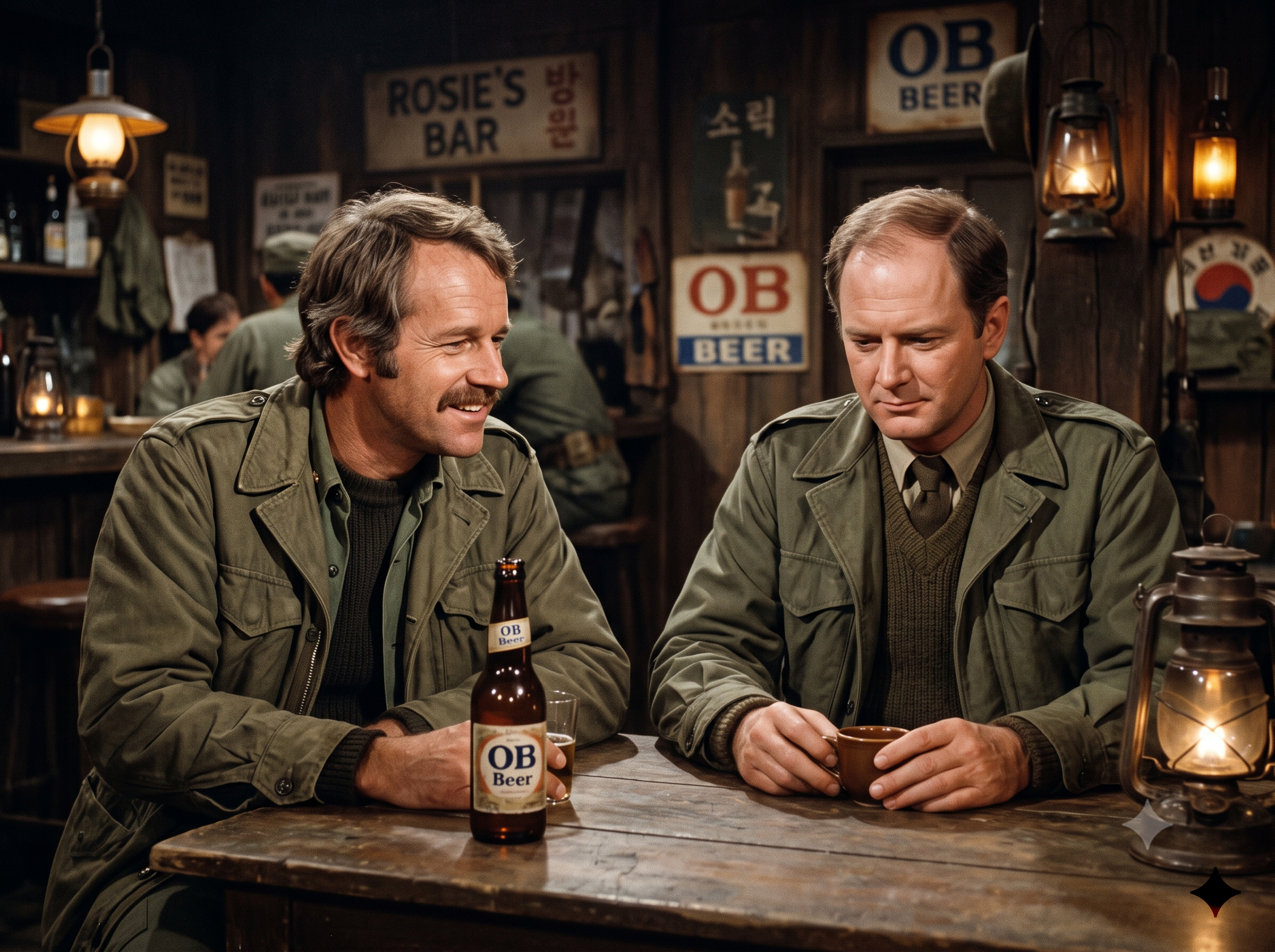
The war usually stopped right at the swinging wooden doors of Rosie’s Bar.
Inside, the dim, sputtering lanterns cast a warm amber glow that made the mud and the blood of the 4077th feel a million miles away. It was a place for bad beer, worse food, and the desperate, necessary illusion that they were just ordinary people killing time on a Friday night.
But tonight, the war had followed Major Charles Emerson Winchester III right to his table.
Charles sat with a rigid, almost statuesque posture, his broad shoulders squared beneath his olive-drab fatigue jacket. Even in this rustic, worn-down watering hole, he managed to look as though he were awaiting service at the finest club in Boston. His tie was perfectly knotted beneath his wool sweater.
Yet, the aristocratic armor was cracking.
His hands were folded tightly around a small, dark ceramic cup. He wasn’t drinking from it. He was merely gripping it, his knuckles white, staring down into the dark liquid as if searching for answers that weren’t there. His expression was a heavy mixture of wounded pride, deep exhaustion, and a reluctant, painful compassion he would never willingly admit to feeling.
Across the rough, scarred wooden table sat Captain B.J. Hunnicutt.
B.J. was the picture of California ease, leaning comfortably forward, his forearms resting on the table. A tall, brown bottle of OB Beer sat right in front of him, the label facing outward.
He wasn’t pushing. He wasn’t probing. He was simply sitting there, projecting a quiet, easygoing friendship. A calm, dryly funny smile played at the edges of his mustache, softening the weary lines around his eyes.
They had just walked out of the O.R. after a brutal, soul-crushing thirty-six-hour shift. The parade of olive-drab ambulances had been relentless.
Normally, Charles would have spent the first hour at Rosie’s loudly complaining about the barbaric conditions, the lack of proper orchestral music, or the sheer indignity of his drafting.
Tonight, he hadn’t said a single word.
The silence between them was thick, heavy with the ghosts of the operating room. Charles had operated on a young corporal barely old enough to shave. The boy had been from Massachusetts. In the brief moments before the anesthesia took him under, the kid had talked about the Boston Pops.
Charles had saved the boy’s life, but he hadn’t been able to save his hand. For a surgeon who worshipped the delicate art of the human fingers, and for a boy who had planned to play the violin, it was a victory that felt entirely like a defeat.
B.J. knew this. He had watched Charles meticulously, desperately try to rebuild the shattered bone and nerve, refusing to step away from the table long after anyone else would have called it.
B.J. took a slow breath, letting the ambient noise of the bar wash over them. The clinking of glasses, the low murmur of tired nurses, the scratchy jazz playing from a distant radio.
“You’re going to squeeze the life out of that cup, Charles,” B.J. said quietly, his voice a gentle rumble over the noise of the room.
Charles stiffened. His eyes snapped up, a flash of defensive, arrogant fire attempting to mask the deep well of sadness underneath.
“I am merely contemplating,” Charles snapped, though his voice lacked its usual booming authority. “A luxury, I realize, that is entirely foreign to the residents of this particular establishment.”
“Looks like you’re contemplating murder,” B.J. replied, his smile never fading. “Or at least a very stern letter to your congressman.”
Charles opened his mouth to deliver a scathing, eloquent retort about B.J.’s lack of refinement. He wanted to push the Californian away, to retreat back into the high stone tower of his Boston lineage where he didn’t have to feel the agony of this wretched peninsula.
But as Charles inhaled, the breath caught sharply in his throat.
His chin trembled, just for a fraction of a second. The carefully constructed facade of Major Winchester shattered against the reality of the boy in post-op. He closed his eyes tightly, the silence suddenly turning fragile, as the great Charles Emerson Winchester III realized he was only a breath away from falling completely apart.
B.J. didn’t flinch. He didn’t offer a pitying look, and he didn’t look away to give Charles his privacy. He just stayed exactly where he was, a steady anchor in a room full of ghosts.
He knew that if he showed an ounce of pity, Charles would bolt for the door and suffer in the freezing solitude of the Swamp.
Instead, B.J. reached out with one finger and casually tapped the neck of his OB Beer bottle.
“You know, Charles,” B.J. said, his tone entirely conversational, “I was talking to the kid in pre-op before they wheeled him into your theater.”
Charles slowly opened his eyes. He didn’t speak, but his grip on the small cup loosened just a fraction. He was listening.
“He told me he played the violin,” B.J. continued, keeping his voice light, almost wistful. “Said he was aiming for the conservatory when the draft board tapped him on the shoulder.”
Charles looked down at his own perfectly steady, miraculously skilled surgeon’s hands. “The median nerve was entirely macerated, Hunnicutt,” Charles whispered, the words carrying a devastating weight. “I grafted what I could. I sutured with the finest silk we have. But the damage…”
He swallowed hard, the wounded pride bleeding into profound, reluctant sorrow. “He will be lucky to hold a pencil. Let alone a bow.”
“I know,” B.J. said softly.
“It is a travesty,” Charles said, his voice gaining a bit of its familiar timber, though it was fueled by grief rather than arrogance. “A brilliant, artistic light, snuffed out by the sheer, unadulterated barbarism of this conflict. It is… unacceptable.”
“It is,” B.J. agreed, taking a slow sip from his bottle.
“I should have been able to bridge the gap,” Charles insisted, leaning forward slightly, the polite restraint breaking down. “If I had been at Mass General, with proper equipment, with proper lighting, with a team that wasn’t functioning on three minutes of sleep and a diet of powdered eggs…”
“Charles.”
B.J.’s voice wasn’t loud, but it was incredibly firm. It cut through Winchester’s spiraling guilt with surgical precision.
Charles stopped speaking, his chest heaving slightly beneath the thick wool of his sweater.
“You gave him his life,” B.J. said, his eyes locking onto Charles’s. The easygoing smile had faded into something intensely earnest. “The kid was bleeding out from a femoral tear when the chopper landed. He was practically gone before you even scrubbed in. You kept him breathing, Charles. You sent him home.”
“But to what kind of life?” Charles demanded quietly, the heartbreak evident in his eyes.
“To a life where he can sit on a porch in Massachusetts and listen to the Boston Pops,” B.J. said simply. “A life where his mother doesn’t get a telegram from the War Department. You didn’t just save a soldier today, Charles. You saved a family.”
The words hung in the warm, dusty air of Rosie’s Bar.
Charles stared at B.J. for a long time. The rigid set of his jaw slowly began to relax. The defensive posture, the wounded pride, the desperate need to be infallible—it all slowly melted away under the gentle, practical truth of B.J.’s words.
Winchester looked down at the cup in his hands. The storm behind his eyes was beginning to pass, replaced by a deep, weary acceptance.
“You are, occasionally, entirely too pragmatic for your own good, Hunnicutt,” Charles muttered.
“It’s a gift,” B.J. smiled, the warmth returning to his face. “Comes from years of trying to reason with Hawkeye.”
Charles let out a short, breathy sound that was halfway between a scoff and a laugh. He finally lifted the small ceramic cup to his lips and took a tentative sip of whatever Rosie had served him.
Instantly, Charles’s face contorted into a mask of pure, aristocratic revulsion.
“Good Lord,” Charles gasped, holding the cup away from him as if it were radioactive. “What in the name of heaven is this?”
“I believe Rosie calls it tea,” B.J. chuckled, leaning back in his chair. “Though I suspect it was brewed in an old jeep radiator.”
“It tastes like distilled despair,” Charles grumbled, fishing a pristine white handkerchief from his pocket and delicately dabbing his lips. “It is an insult to the very concept of agriculture.”
“Try the beer,” B.J. offered, nudging the OB bottle slightly across the worn wood. “It only tastes like mild regret.”
Charles looked at the brown bottle, then back at B.J.
The heavy, suffocating gloom of the operating room had finally retreated, chased away by the amber light, the terrible tea, and the quiet, unassuming grace of a friend who knew exactly when to speak and when to listen.
Charles didn’t reach for the beer. Instead, he wrapped his hands back around his awful cup of tea, sitting a little less rigidly than before.
“I think, Captain,” Charles said, his voice returning to its normal, cultured cadence, “I shall stick with the distilled despair. It feels remarkably appropriate for the setting.”
B.J. laughed quietly, a warm, genuine sound that blended perfectly with the hum of the bar. He picked up his bottle and held it out toward the center of the table.
Charles hesitated for a moment, then leaned forward, lifting his small cup.
They tapped the glass and the ceramic together. It wasn’t a loud clink. It was just a quiet acknowledgement between two tired men in olive drab, finding a fleeting moment of peace in a world gone mad.
“To Massachusetts,” B.J. said softly.
Charles offered a small, rare, completely genuine smile. “To life, Captain.”
In the end, it was never the medicine that kept them whole; it was the people they sat with in the dark.