The Weight of the Ink
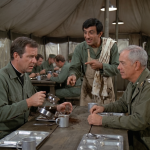
The Swamp was freezing, the O.R. was a meat locker, and the swamp water disguised as coffee in the mess tent tasted exclusively of rusted tin. But inside Colonel Potter’s office, the air always smelled faintly of old leather, horse liniment, and the steadying presence of a man who had seen two world wars and wasn’t about to let a third one break his stride.
On this particular gray Tuesday, the wind from the Uijeongbu mountains was howling through the canvas seams.
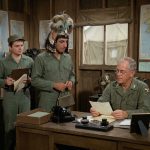
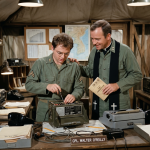
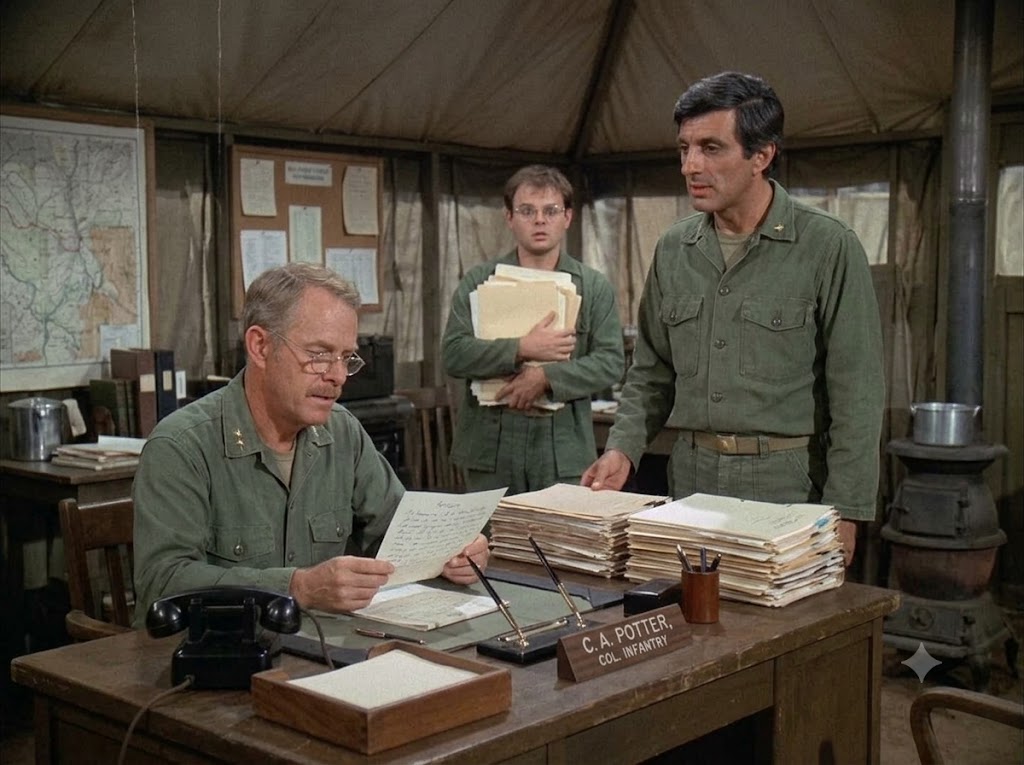
Colonel Potter sat behind his desk, the twin silver stars on his collar catching the dim overhead light. He wasn’t looking at the mountains, though. His eyes were fixed on a single, handwritten sheet of paper, held between fingers that had spent the last eight hours tying off arterial bleeders.
Beside him stood B.J. Hunnicutt, his hands resting lightly on the edge of the desk. B.J.’s mustache was slightly drooped from exhaustion, but his eyes were sharp, locked onto the Colonel’s face, searching for a crack in the old man’s armor.
Behind them both, framing the doorway like a startled field mouse caught in a flashlight beam, was Radar O’Reilly. Radar’s arms were wrapped around a stack of personnel files so massive it nearly chin-high, his spectacles slipping down his nose as he hovered on the threshold, frozen by the sudden, heavy silence in the room.
“Radar,” Potter said, his voice unusually quiet. “Where did this come from?”
Radar swallowed hard, shifting the mountain of paperwork in his arms. “It was tucked inside the monthly supply requisition from Seoul, sir. It wasn’t officially logged. It just… had your name on it, written in blue ink.”
Potter didn’t answer right away. He ran a thumb over the bottom of the page, where the ink had faded to a dusty shadow.
B.J. leaned in just an inch closer. “Sherman? Is it bad news from Mildred?”
Potter took a slow, deep breath, the kind that expands an old cavalryman’s chest until the buttons on his fatigue shirt strain. He didn’t look up. “No. Not Mildred. It’s from a boy named Thomas Miller. Corporal, Company B, Third Infantry. I operated on him during the big push at the Chosin Reservoir, three winters ago.”
B.J. nodded slowly, a shadow crossing his face. Everyone at the 4077th knew about the Chosin Reservoir, even if nobody ever talked about it. It was the kind of memory that lived in the dark corners of the camp, under the cots and behind the bottles of homemade gin.
“He says he’s home in Ohio now,” Potter continued, his voice cracking just a syllable on the word *Ohio*. “Says he’s walking on both legs. Says he’s got a daughter who just turned two.”
Radar let out a tiny, involuntary sigh of relief, but B.J. didn’t relax. He knew Potter’s expressions too well. He saw the way the Colonel’s lower jaw had set into a hard, rigid line.
“That’s beautiful, Sherman,” B.J. said softly. “So why do you look like you just read a casualty list?”
Potter finally raised his eyes, and for a split second, the decades of command stripped away, leaving only an exhausted doctor in a muddy tent. He held the letter out, his hand trembling so slightly you’d miss it if you hadn’t shared a surgical table with him for a year.
“Because, Beej,” Potter whispered, “Thomas Miller didn’t write this letter. His mother did. And the last paragraph starts with the word *’Unfortunately.’*”
The silence that followed was the heavy, suffocating kind that only exists in a war zone when the artillery stops firing.
Radar stood completely still, his knuckles white against the manila folders. He looked from B.J. to the Colonel, his innocent face tightening with the realization that the world had just broken a little bit more, right there in the administrative tent.
B.J. reached out and took the letter from Potter’s fingers. He read the cursive script quickly, his jaw tightening.
The letter explained that Thomas had come home, yes. He had seen his little girl. He had walked through the autumn leaves in Ohio on the legs Sherman Potter had saved. But the winters in Ohio were cold, and the deep-tissue scarring from the frozen mud of Korea had never truly healed. A sudden, aggressive infection had taken him in his sleep just three weeks ago.
His mother hadn’t written to blame anyone. She had written to thank the doctor who gave her family two extra years they never would have had otherwise.
“She wanted me to know,” Potter said, his voice returning to its familiar, dry rasp, though it lacked its usual bite. “She wanted me to know that the graft held. Right up until the end.”
B.J. set the letter back down on the green desk blotter, right next to the wooden nameplate that read *C.A. POTTER, COL. INFANTRY*.
“Two years, Sherman,” B.J. said, his voice grounded and steady, pulling the old man back from the ledge of his own memories. “In this place, we trade in minutes and hours. You gave a mother two years with her son. You gave a little girl a father for the first twenty-four months of her life. That’s not a defeat. That’s a miracle.”
Potter looked at his hands—the old, wrinkled hands that had held so many lives together with silk thread and sheer willpower. “It never feels like enough, Hunnicutt. You patch ’em up, you ship ’em out, and you hope the stitches hold until they reach the horizon.”
Radar took two quiet steps forward, the massive pile of files shifting slightly. “Colonel? Sir?”
Potter blinked, looking at his clerk. “Yes, son?”
“Corporal Miller’s file… it came through my office when he was evacuated,” Radar said, his voice small but remarkably clear. “I remember looking at his charts. You stayed up for thirty-six hours straight that week. You used your own personal supply of penicillin on him because the medical depot was backlogged.”
Potter stared at Radar for a long moment. A faint, bittersweet smile finally touched the corner of his mustache. “Mule muffins. I was just being stubborn.”
“No, sir,” Radar said, adjusting his glasses with his chin. “You were being you.”
From outside the tent, the sharp, distinct sound of Hawkeye Pierce’s laughter drifted in from the compound, followed by the distant clatter of a mess hall tray. The camp was moving on, as it always did, because the chopper blades would eventually spin again, and the wounded would keep coming.
Potter rubbed his eyes beneath his glasses, then straightened his shoulders. The fatherly, indestructible commander of the 4077th was back, though his eyes remained a little brighter than usual.
“All right, Radar,” Potter said, tapping the desk. “Don’t just stand there holding half the paperwork in the Far East Command. Put those files away before your spine collapses.”
“Yes, sir,” Radar muttered, a genuine smile breaking across his face as he turned toward the filing cabinets.
B.J. reached down, picked up the letter from Ohio, and gently folded it, sliding it into the top drawer of Potter’s desk where the Colonel kept his private ledger and the pictures of Mildred.
“Come on, Sherman,” B.J. said, clapping a hand on the old man’s shoulder. “Let’s go find Pierce and see if we can extract something resembling coffee from the mess tent.”
Potter stood up, adjusting his belt, his eyes lingering on the closed drawer for just a second.
“Lead the way, Beej,” Potter said softly. “And let’s make sure we drink it while it’s still warm.”
In a valley surrounded by starch and shadow, they learned that even the smallest victories were worth the weight of the ink.