The Navigation of Open Hearts
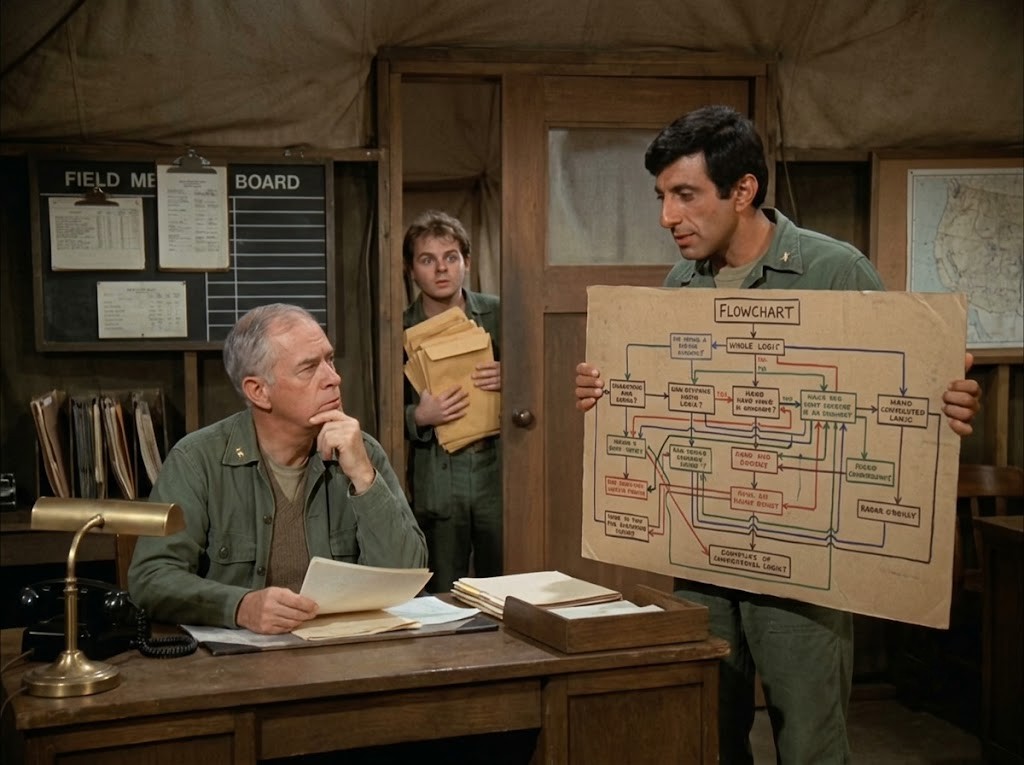
Some days in Korea didn’t feel measured by the ticking of a clock, but by the steady, heavy pile of paperwork accumulating on Colonel Potter’s desk. It was a quiet Tuesday afternoon in the 4077th, the kind of deceptive lull that usually preceded a sudden influx of choppers, leaving the camp in a state of exhausted suspension.
Inside the commander’s office, the air smelled of stale coffee, old canvas, and the distinct, comforting scent of the Colonel’s pipe tobacco.
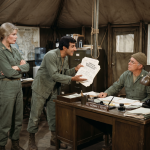
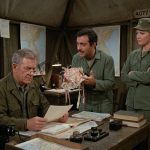
Sherman Potter sat heavily at his desk, his spectacles sliding slightly down his nose as he stared at a bewildering document. His hand propped up his chin, a deep groove forming between his brows that spelled trouble for anyone brave enough to interrupt him.
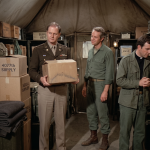
The heavy wooden door creaked open just an inch, revealing Corporal Radar Reilly peeking through the gap. His arms were desperately wrapped around a thick, precariously stacked pile of manila envelopes, his wide eyes scanning the room for signs of an impending storm.
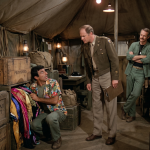
Before Radar could squeak out his usual warning, Corporal Klinger marched into the office with the absolute confidence of a man premiering a masterpiece at the Louvre.
Instead of his usual chiffon or taffeta, Klinger was in standard olive drabs, but he carried something far more theatrical: a massive, hand-drawn cardboard flowchart. It was a complex, dizzying labyrinth of boxes, arrows, and multi-colored lines that looked like a cross between a military supply grid and a madman’s roadmap.
“Colonel, if I may crave your indulgence for a mere moment of your command,” Klinger announced, holding the chart aloft like a sacred tablet.
Potter slowly lifted his gaze from his desk, his eyes traveling from Klinger’s earnest face to the bewildering maze of ink on the cardboard. “Klinger, if that is another elaborate map detailing a subterranean escape route to Toledo via the Yellow Sea, I swear I’ll have you painting the latrines with a toothbrush.”
“No, sir! This is a masterpiece of pure, unadulterated administrative logic,” Klinger insisted, shifting his grip on the heavy board.
From the doorway, Radar’s voice was barely a nervous whisper as he shuffled inward, clutching his envelopes tightly against his chest. “Uh, Colonel… I told him you were busy with the weekly casualty reports, but he said this was a matter of life, death, and supply lines.”
Potter sighed, a sound that carried the weight of thirty years of army bureaucracy. “Alright, Klinger. You’ve got exactly sixty seconds before I lose what’s left of my hair. What in the name of Sweet Initiative am I looking at?”
Klinger cleared his throat proudly, pointing a finger to the very top box of the chart. “Sir, this is the definitive, multi-tiered logistical solution to our unit’s most critical shortage. I call it the ‘Unified Requisition and Flow Initiative for Comfort and Sustainability’.”
Potter squinted at the tiny, meticulous lettering on the cardboard. “Klinger, this just says ‘Whole Logic’ at the top, and down here it looks like it ends in a dead-end labeled ‘Radar’s Office’.”
“Exactly, sir! You see, by bypassing the standard Eighth Army channels and routing our requests through an interconnected web of black-market barters, traded favors, and local favors, we can secure the one thing this camp needs to survive the coming winter.”
Potter leaned forward, his interest piqued despite his deep skepticism. “And what exactly is this vital, life-saving commodity, Corporal?”
Klinger looked at Potter, then back at the chart, his expression suddenly dropping its theatricality and replacing it with a raw, desperate sincerity. “Socks, Colonel. Three hundred pairs of heavy-duty, woolen, un-holed socks for the shift workers and the litter bearers who are freezing their toes off in the mud.”
The office went completely still as the true meaning of the absurd chart hung heavily in the warm, cramped air.
—
Colonel Potter stared at the chart, the sharp retort he had been preparing dying on his lips as the sheer, exhausting reality of their situation settled back into the room.
Radar lowered his stack of envelopes slightly, his shoulders dropping as he looked at Klinger with a quiet, newfound respect. “He stayed up all night drawing it, sir. Used every colored pencil in the clerk’s office.”
Potter reached up, slowly removing his glasses and rubbing the bridge of his nose where the plastic had left a red mark. He looked at Klinger, really looked at him—not as the camp’s resident eccentric or a man bucking for a Section Eight, but as a soldier who spent his nights worrying about the frostbite of his friends.
“Socks,” Potter repeated softly, his voice losing its gruff military edge and adopting the gentle, fatherly tone he reserved for the moments when the war got too close to home.
“Yes, sir,” Klinger said quietly, his chest expanding as he held the heavy cardboard steady. “The boys in the motor pool are swapping boots just to keep their feet dry, and the nurses are wearing three pairs of thin cotton ones that dissolve after one trip to the laundry.”
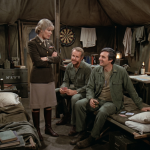
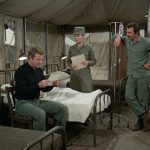
Just then, the screen door to the outer office banged open, and Hawkeye Pierce drifted in, a half-eaten apple in one hand and a stethoscope draped around his neck like a silver scarf. B.J. Hunnicutt followed a step behind him, hands dug deep into his pockets, his face lined with the universal fatigue of the 4077th.
“Did someone say socks?” Hawkeye asked, taking a bite of the apple and leaning over Potter’s shoulder to study Klinger’s chart. “My God, Klinger, it’s beautiful. It looks like a map of my nervous system after a twelve-hour session in post-op.”
“It’s a logistical masterpiece, Pierce,” Klinger shot back, though there was no real heat in it.
B.J. stepped closer, looking at the intricate lines. “Look at this, Hawk. If you follow the blue line from ‘Mano Convoluted Logic’ through ‘Radar O’Reilly,’ you end up at a box labeled ‘Fudge Condescension.’ Is that a typo, Klinger, or your actual strategy for dealing with I-Corps?”
“A gentleman never reveals his behavioral tactics, Captain,” Klinger said, a small, defensive smirk returning to his face.
Potter cleared his throat, a sharp bark that brought the room back to order, though the warmth in his eyes remained. “Alright, that’s enough out of the gallery. Take a seat or beat it, you two.”
Hawkeye and B.J. quietly moved to the side, their humor softening into the easy, supportive presence that defined the camp’s core. They knew what Klinger was doing; everyone in the 4077th spent their spare time trying to patch the holes left by an indifferent supply chain.
Potter picked up a fountain pen, tapping the cap against his chin as he looked back at the chart held by Klinger. “Klinger, if I approve this… this administrative monstrosity, and Eighth Army catches wind that we are trading typewriter ribbons to the 8063rd for surplus winter gear, my neck is on the chopping block.”
“Sir, with all due respect,” Radar chimed in, stepping fully into the room and setting his heavy envelopes down on the corner of the desk. “If we route the paperwork through the ‘Spiritual Guidance’ box that Father Mulcahy approved, it counts as a charitable donation. I check the regulations every night before I go to sleep.”
Hawkeye let out a soft laugh. “There you have it, Colonel. It’s a holy conspiracy. You can’t fight the big guy upstairs, especially when he’s working through Radar and a man in a dress.”
Potter looked at the three younger men and the earnest young corporal beside him. In their tired eyes, he saw the same thing he saw every time he looked in the mirror: a deep, aching desire to keep this small, fragile family safe from the cold, harsh reality of a peninsula halfway across the world.
He leaned forward, pulled the official requisition ledger toward himself, and signed his name with a swift, decisive flourish.
“Alright, Klinger,” Potter said, pointing a finger at the cardboard. “You get your socks. But if I find out you traded my personal supply of cigars to get them, you’ll be wearing those woolen socks on your ears.”
Klinger’s face lit up with a brilliant, genuine smile that made the exhaustion under his eyes seem to vanish. “Sir, your cigars are safer than the gold in Fort Knox. Thank you, Colonel.”
“Don’t thank me yet. You still have to carry that monstrosity out of here without knocking over my lamp,” Potter muttered, though the corners of his mustache twitched upward into a smile.
As Klinger carefully maneuvered the massive flowchart backward through the door, with Radar hovering nearby to ensure he didn’t drop his envelopes, the office seemed to relax. The tension that had held the room since the morning mail delivery dissipated, replaced by the quiet, comforting knowledge that for at least one more day, they were looking out for each other.
Hawkeye clapped B.J. on the shoulder, turning to follow the corporals out into the compound. “Come on, Beej. Let’s go find out if Klinger’s chart has a route that leads to a clean pair of civilian sanity.”
Potter watched them go, the screen door bouncing shut with its familiar, rhythmic slap against the frame. He picked up his pipe, struck a match, and let the warm smoke drift up toward the canvas ceiling, listening to the distant, comforting murmur of his camp.
In a place where everything felt broken, it was the broken logic of friendship that kept them whole.