The Arrows That Point Home
The dust of the 4077th never truly settled; it just hung in the stagnant Korean air, waiting for the next round of choppers to kick it right back into your eyes.
After an grueling fourteen-hour session in Post-Op, the silence of the camp felt less like peace and more like a collective intake of breath. The frantic ring of the telephones had stopped, the ambulances were parked in a neat, quiet row, and the heavy canvas of the tents drooped under the weight of the afternoon heat.
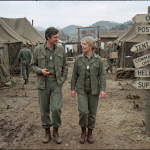
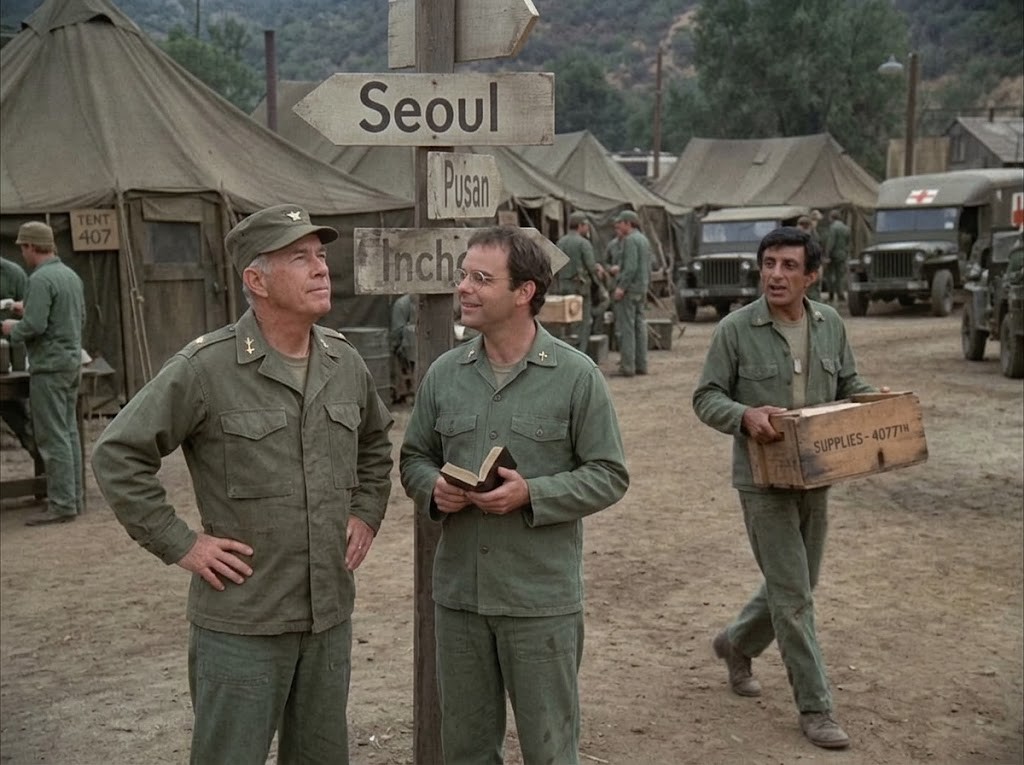
Colonel Sherman Potter stood in the center of the compound, his hands firmly planted on his hips, staring up at the weathered wooden signpost. His eyes traced the familiar, jagged arrows pointing toward Seoul, Pusan, and Inchon, though everyone knew those signs really just pointed to one collective, aching concept: home.
Beside him, Father Mulcahy held his small, leather-bound prayer book open, a soft, serene smile resting on his face as he looked at his commanding officer. The chaplain had a way of appearing right when the weight of command began to bow the Colonel’s shoulders, offering a quiet, grounding presence without uttering a single demanding word.
“You know, Father,” Potter murmured, his voice dry and thick with the fatigue only an old cavalryman could carry, “sometimes I look at these blasted signs and I swear the arrows move an inch closer to Missouri when I’m not looking.”
Mulcahy chuckled softly, turning a page in his book. “Perhaps they do, Colonel. Faith has been known to move far greater things than a few pieces of scrap lumber.”
Their quiet contemplation was broken by the heavy, rhythmic thud of combat boots crossing the dirt.
Hustling toward them from the supply tent was Corporal Max Klinger, stripped of his usual chiffon and high heels, wearing his standard-issue olive drabs but losing none of his trademark theatrical urgency. He was lugging a heavy, weathered wooden crate, his face twisted into a grimace of intense concentration and breathless excitement.
Stenciled across the front of the box in faded black paint were the words: *SUPPLIES – 4077TH*.
“Colonel! Father! You’re not going to believe this,” Klinger panted, shifting his grip on the splintered wood as he neared the signpost. “The supply truck from Seoul just dumped this on the perimeter and took off like his tail was on fire.”
Potter didn’t shift his posture, merely cutting his eyes toward the breathless corporal. “Klinger, if that box contains another shipment of left-handed rubber gloves or industrial-sized jars of creamed corn, I’m going to personally sentence you to a week of wearing nothing but parkas.”
“No, sir, no corn, and no brassieres this time, I swear!” Klinger insisted, stopping just a few feet away, his chest heaving. “I sneaked a peek through the loose slats before I hauled it over here. It’s a stray crate from the docks in Pusan—it’s been sitting in a dead-letter warehouse since last Thanksgiving.”
Father Mulcahy looked up from his book, his gentle eyes widening with a sudden, sharp spark of hope. “A dead-letter crate, Klinger? Do you mean…?”
“Yes, Father,” Klinger said, his voice dropping its usual manic edge, replaced by something fragile and deeply earnest. “It’s the missing winter mail bags. The ones the whole camp gave up on months ago.”
Potter froze, his hands dropping from his hips as a profound, heavy silence fell over the three men, the realization of what lay inside that wooden box hanging in the air like a lightning rod.
—
Klinger set the crate down at the base of the signpost with a dull, heavy thud. For a long moment, none of them moved. In a place like the 4077th, a lost letter wasn’t just paper and ink; it was a lifeline to a world that felt increasingly like a beautiful dream.
“The missing winter mail,” Potter whispered, the rugged lines on his face softening as he looked down at the crate. He thought of Mildred, of the snowy Christmas he had spent wrapped in the cold comfort of a tent, wondering if her cards had simply vanished into the ether of war.
“My goodness,” Mulcahy said softly, closing his book with a gentle snap. “The men have been so disheartened lately. Pierce and Hunnicutt have been pulling their hair out, and Winchester has been more insufferable than usual just to hide how much he misses Boston.”
Klinger wiped a bead of sweat from his forehead, looking up at the Colonel with a rare, completely unselfish devotion. “I didn’t open the bags, Colonel. I knew you’d want to be the one to do it. But I saw the top bundle. There’s a thick stack in there tied with a blue ribbon, addressed to a ‘Sherman T. Potter’.”
A rare, brilliant smile broke across Potter’s weathered face, illuminating his eyes with a youthful warmth that the war usually managed to obscure. “A blue ribbon? That’s my Mildred. She always uses the ribbon from her sewing basket when she writes more than three pages.”
By now, the quiet stir around the signpost had begun to draw attention. From the direction of the Swamp, Hawkeye Pierce and B.J. Hunnicutt emerged, their scrub shirts stained and their eyes bloodshot from the long hours in the operating room, but their curiosity piqued by the gathering.
Margaret Houlihan walked out of the admissions tent, her posture straight and professional, but her eyes instantly locking onto the wooden crate with a sudden, breathless vulnerability. Even Charles Emerson Winchester III sauntered out to his tent flap, pretending to inspect his fingernails while listening intently to every word.
“What’s the convention about, Sherman?” Hawkeye called out, his voice characteristically raspy but carrying a hint of his usual defensive wit. “Did Klinger finally get his discharge, or is the Sultan of Morocco coming for tea?”
“Better than that, Pierce,” Potter barked back, though there was no steel in his voice, only a deep, paternal joy. “Klinger just recovered a piece of lost history. Gather the camp. Every last soul who isn’t tied to a patient.”
Within minutes, a quiet crowd had formed around the signpost. The usual griping and cynical banter of the 4077th faded into an expectant, reverent hush as Potter knelt down beside the crate, using the claw of a hammer Klinger handed him to pry open the top slats.
The wood groaned and splintered, revealing several canvas bags, stained with grease and travel-worn, but completely intact.
Potter reached in and pulled out the first bundle, the one tied with the faded blue ribbon. He held it for a moment, his fingers tracing the elegant, familiar handwriting of his wife, before slipping it safely into his jacket pocket, right over his heart.
“Alright, Klinger,” Potter said, his voice thick with emotion as he stood back up. “You found ’em. You get the honor of reading the names.”
Klinger beamed, a look of pure, dignified pride washing over his face. He reached into the first canvas bag, pulling out a handful of letters, his booming voice echoing across the dusty compound.
“Hunnicutt, BJ! A whole stack from San Francisco!” Klinger shouted.
B.J. stepped forward, a massive, brilliant grin breaking through his mustache as he claimed his letters, immediately stepping aside to press the paper to his nose, breathing in the faint scent of his wife’s perfume and the home he longed for.
“Houlihan, Major Margaret! Three packages!”
Margaret stepped up, her strict military demeanor melting away into a soft, tearful smile as she accepted the small boxes, offering Klinger a quiet, genuinely grateful nod that spoke volumes more than a formal salute ever could.
Even Charles received a heavy, cream-colored envelope from Boston. He snatched it with a haughty sniff, murmuring something about the postal service’s abysmal inefficiency, before retreating to his tent with a speed that betrayed his immense relief.
As the distribution continued, Hawkeye stood near the signpost, waiting patiently. When Klinger finally called his name, handing him a thick packet of letters from his father in Maine, Hawkeye didn’t make a joke. He just looked at the envelopes, his eyes shining with a quiet, profound gratitude.
He looked over at Potter, who was already sitting on a nearby water drum, carefully untying the blue ribbon from his wife’s letters with trembling, steady hands. He looked at Mulcahy, who was watching the joy of his flock with a contented, peaceful smile.
The afternoon sun began to dip below the jagged Korean hills, casting long, golden shadows across the tents and the muddy ground. The fatigue of the fourteen-hour shift was still there, etched deeply into everyone’s faces, but the heavy, suffocating despair had lifted, replaced by the quiet comfort of connection.
They were still thousands of miles from the places they loved, trapped in a valley of mud and wounded soldiers. But for one beautiful, bittersweet afternoon under the weathered signpost, the distance didn’t seem quite so far.
—
In the heart of the 4077th, home was never really a place on a map, but the quiet grace of holding on together.