The Quiet Symphony of the Mess Tent
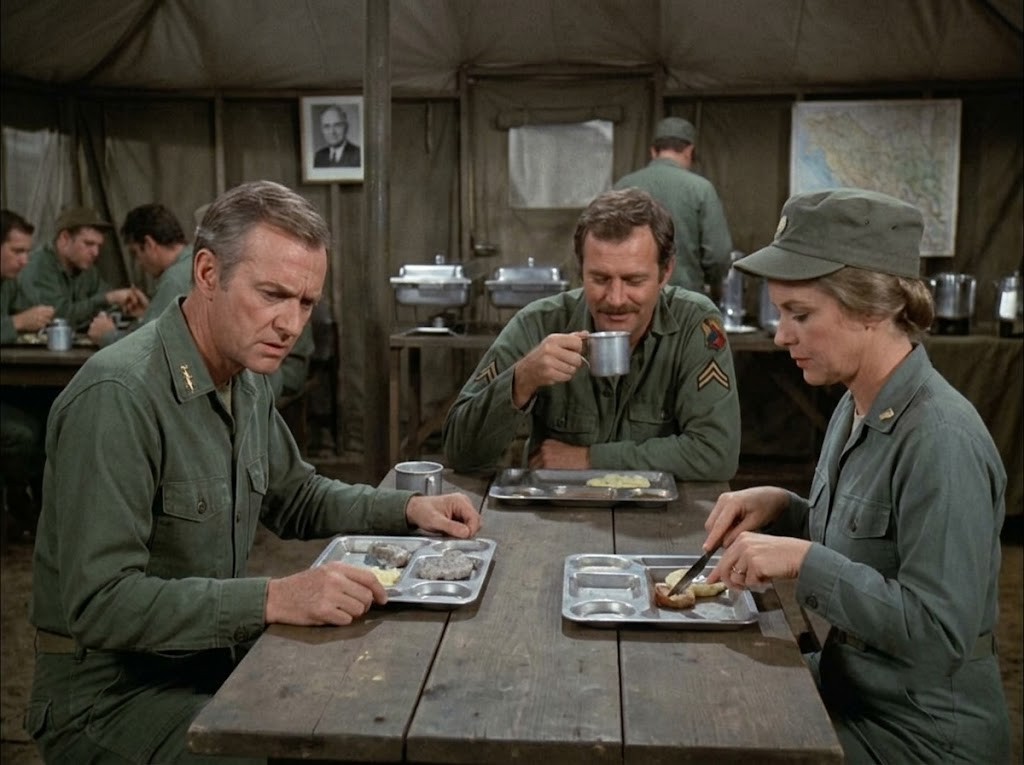
The constant, low-grade rumble of the generator was the heartbeat of the 4077th, a sound you only ever noticed when it stopped. But inside the mess tent, that rumble was usually drowned out by the harsh clatter of aluminum trays and the collective groan of exhausted people trying to identify their lunch.
Today, the canvas walls hummed with a rare, heavy stillness after an ungodly thirty-six-hour session in the O.R.
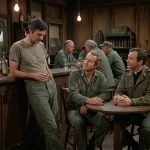
Major Charles Emerson Winchester III sat at the end of the long, weathered wooden picnic table, staring down at his metal tray with an expression usually reserved for a profound moral failing. His posture was, as always, impeccably straight, a defense mechanism against the mud and chaos of Korea. He poked a fork into a grayish lump that the enlistees swore was Salisbury steak, though Charles remained thoroughly unconvinced.
Beside him, B.J. Hunnicutt raised his metal tin cup to his lips, taking a slow, cautious sip of what passed for coffee. A gentle, knowing smile tugged at the corner of B.J.’s mustache, his tired eyes crinkling as he watched Charles conduct a silent autopsy on his lunch. B.J. looked every bit the grounded, steady presence the camp relied on, his olive-drab fatigues slightly rumpled but his spirit stubbornly intact.
Across from them, Major Margaret Houlihan was methodically cutting a small, mysterious potato-like object with her knife. Her utility cap was pinned neatly in place, her face a mask of strict military composure, yet there was a soft tiredness around her eyes. She was a woman holding her world together by sheer force of will, demanding perfection from her nurses because anything less could cost a life.
“I am thoroughly convinced,” Charles began, his rich, cultured Boston accent cutting through the humid air like a silver letter opener, “that Igor has successfully managed to weaponize the potato. This is not sustenance, Hunnicutt. This is a cry for help from the culinary underworld.”
B.J. let out a soft chuckle, setting his cup down on the dark wood. “Come on, Charles. Look at the bright side. If the North Koreans breach the perimeter, we can just hurl the mashed potatoes at them. We’d secure an unconditional surrender by dinnertime.”
Margaret didn’t look up from her tray, her knife slicing through the food with clinical precision. “Keep your voices down, gentlemen. If Colonel Potter hears you complaining about the rations again, he’ll have us all on kitchen police duty, and frankly, I don’t have the stomach to watch Igor peel anything else today.”
In the background, a portrait of President Harry S. Truman looked down from the canvas wall, a silent, stoic witness to the daily absurdities of the 4077th. Nearby, a colorful topographic map of the Korean peninsula hung limply, a reminder of the jagged hills that kept them all trapped in this valley of mud and miracles.
Charles sighed, a theatrical, heavy sound that seemed to come from the very soles of his boots. He looked around the tent, past the metal warming trays and the couple of enlistees eating silently in the shadows behind them. He was looking for Hawkeye, who usually filled these quiet vacuums with an endless stream of frantic, defensive jokes.
But Hawkeye wasn’t there. He was still asleep in the Swamp, too exhausted to even crawl out for sustenance.
Charles turned his attention back to his tray, his fingers tightening slightly around the metal edge. The sarcasm faded from his face, replaced by a sudden, stark vulnerability that he rarely allowed anyone to see. He looked at B.J., then at Margaret, his voice dropping to a low, uncharacteristically quiet register.
“It’s the anniversary,” Charles murmured, his eyes fixed on the dented metal of his tray. “Six months since Billy Vance. The boy from Boston.”
The humor instantly vanished from B.J.’s face, his hand freezing on his tin cup as a heavy, suffocating silence descended upon the table.
—
The mention of the name hung in the damp air of the mess tent, heavy and sudden, changing the entire atmosphere in the blink of an eye. Billy Vance had been a nineteen-year-old private from a neighborhood just a few miles outside Charles’s beloved Beacon Hill, a boy who had died on Charles’s table during a chaotic influx of casualties half a year ago.
Margaret stopped her knife mid-slice, her shoulders tightening as she looked up, her gaze fixing on Charles with a mixture of professional sharpness and deep, buried empathy.
“Charles,” Margaret said softly, her voice losing its strict military edge, replaced by the tender warmth she usually reserved for a frightened patient in the dark of night. “You did everything anyone could have done. We all did.”
Charles didn’t look up, his fingers tracing a small scratch on the wooden table. “I spoke to him before we went in, Margaret. He had that ridiculous, charming Boston inflection. He asked me if the Red Sox had a chance this year. I told him they did, just to give him something to hold onto. I lied to him, and then… I couldn’t save him.”
B.J. leaned forward, his elbows resting on the table, his warm, steady presence anchoring the moment. He knew the weight Charles was carrying; every doctor in this camp had a graveyard of names locked away in their hearts, a heavy ledger they only opened when the O.R. lights finally went down.
“We don’t get to choose the outcomes, Charles,” B.J. said quietly, his voice a calm, comforting balm. “We only get to choose to stand there and try. You stood there. You gave him a piece of home before he went.”
Charles closed his eyes for a brief second, his chest rising and falling in a slow, controlled breath. When he opened them, the haughty, aristocratic shell was back in place, but it was thinner now, transparent to the two people sitting with him.
“The tragedy of this place,” Charles said, his voice returning to its familiar, theatrical cadence though his eyes remained soft, “is that one is forced to eat this dreadful swill while contemplating the fragility of human existence. It is entirely uncivilized.”
B.J. smiled warmly, recognizing the defense mechanism for what it was, and lifted his tin cup again. “To civilization, Charles. Wherever the hell it is.”
“Hear, hear,” Margaret whispered, a rare, genuine smile gracing her lips as she went back to her tray, the tension in her shoulders finally dissipating into the familiar, comforting rhythm of camaraderie.
Behind them, the camp continued to move in its strange, chaotic dance. Radar crept into the back of the tent, looking earnest and alert, holding a stack of papers and scanning the room for Colonel Potter before slipping back out into the compound. From the direction of the administrative tent, the faint, dry bark of the Colonel’s voice could be heard, complaining about a missing shipment of penicillin, followed by Klinger’s loud, theatrical defense of his latest requisition forms.
Inside the mess tent, the three officers sat together in the fading afternoon light, the warmth of their shared fatigue creating a protective bubble against the war outside. They were an unlikely family—a Boston Brahmin, a California family man, and a career army nurse—thrown together by history and held together by a profound, unspoken loyalty.
Charles finally took a small, delicate bite of his food, chewed thoughtfully, and grimaced. “Igor must be court-martialed. Instantly.”
“I’ll sign the paperwork myself, Major,” Margaret said, her eyes twinkling with amusement.
B.J. laughed, the sound bright and human against the canvas walls, as he took another sip of his terrible coffee. They would go back to the O.R. soon enough; the choppers would come, the sirens would wail, and the mud would claim another pair of boots. But for right now, under the watchful eye of Harry Truman and the weight of a shared memory, they had this table, this awful food, and each other.
In the heart of the 4077th, the heaviest burdens were always carried together, one quiet moment at a time.