The Refined Dance on a Mud Road
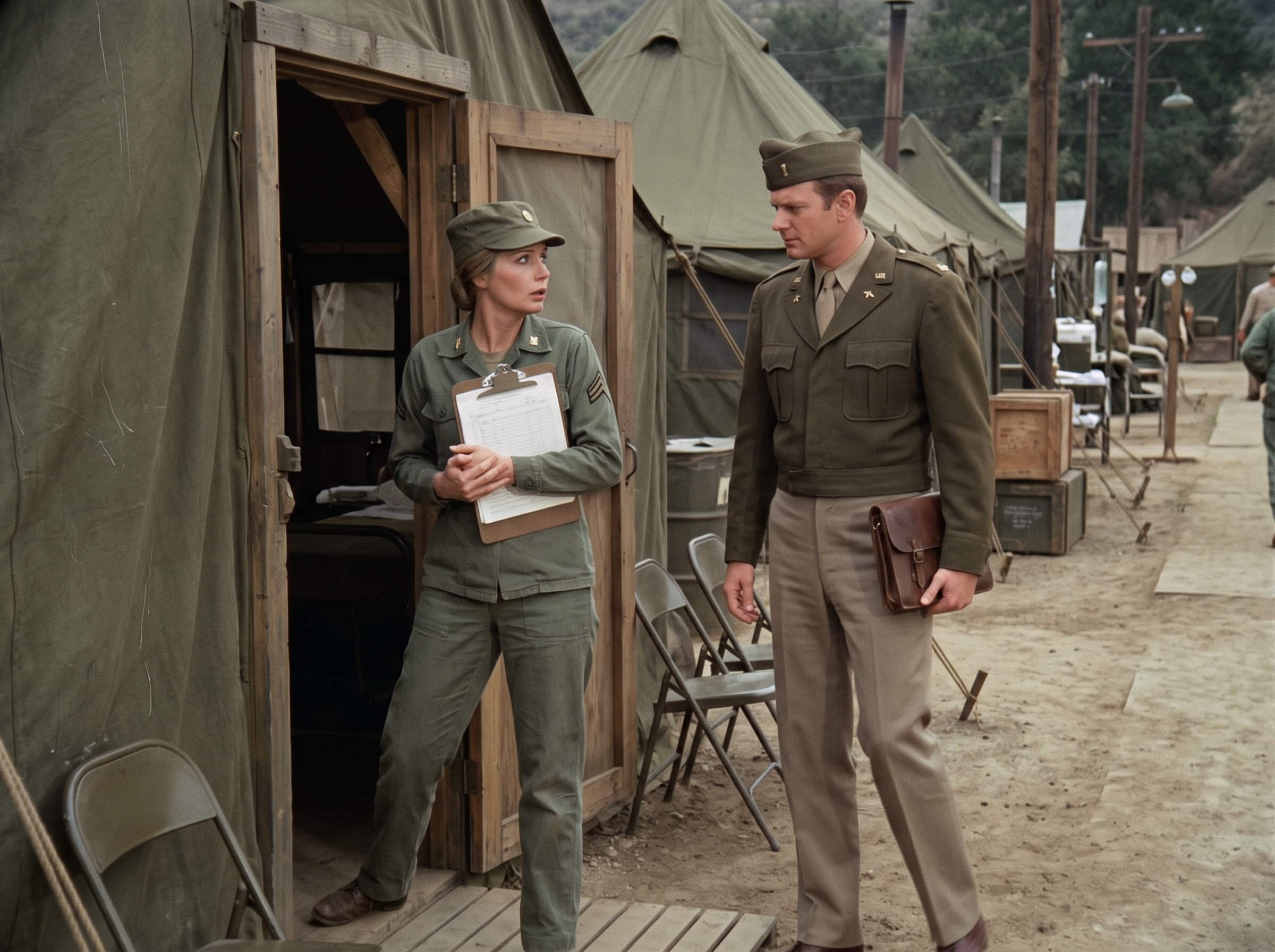
A tired sun was dipping, painting the sprawling camp in a soft, muted wash of gold, dust, and unending olive drab. The air, though cooling, was never still; it hummed with the quiet, persistent noise of life, of a community existing inside a bubble of chaos and care. In this temporary world of canvas, mud, and endless human effort, simple things often became complicated. Take doorways. They were never just entrances; they were chokepoints of duty, moments of pause in a place built for movement.
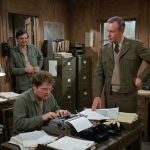
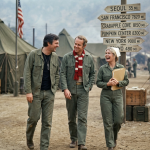
Margaret Houlihan was leaving the combined admin-office tent, her professional spine upright despite a long day, a stack of medical charts clutched to her chest. She stepped out, her cap tilted precisely, already focusing on her next task in the busy OR. But the door opened not onto an empty walkway, but directly into the precise, polished frame of Charles Emerson Winchester III.
They both stopped, a single, frozen moment of complete, unrefined surprise on an olive-drab stage. Margaret, caught mid-step, looked at Winchester, a flash of vulnerability—a human surprise—crossing her usually composed features before a guarded professionalism quickly resettled. Her chart shifted slightly against her, the papers rustling.
Winchester, who was likely returning from some frustrating administrative errand judging by the serious leather satchel he was gripping, executed a backward half-step with a precision that was both dignified and utterly strained. He was politeness personified, but a dry, unmistakable thread of irritation, both with the cramp of the environment and the unexpected human contact, crossed his refined face. He looked at her, then past her, then down at the tight space that was suddenly so crowded. They were two highly structured people in a world defined by the lack of structure, locked in a single, silent second of mutual, polite awkwardness.
“Major Houlihan,” Winchester said, his voice dropping into that familiar, Bostonian baritone that always sounded a few levels above the noisy camp, yet now, was tightly controlled. “One would think the pathways of this institution were wider. Clearly, I was mistaken, yet again.” It was a classic Winchester barb, delivered with impeccable manners.
Margaret didn’t drop her gaze. “And Major Winchester,” she replied, her professional tone slightly warmer than usual, “I was merely exiting my duty post. Your ‘precise’ approach was rather abrupt. A little more situational awareness would serve everyone, regardless of rank.“
A small smile, or the hint of one, twitched at the corner of Charles’s mouth. He knew it was a fair point. This place demanded awareness. The mud made a mockery of refined approaches. He took a further, more complete step backward, a clear, if still stiff, gesture to give her the entire walkway. It was an awkward dance they often performed in this cramped community.
“Indeed,” Charles said, gesturing with a hand that momentarily released its grip on the leather satchel, sweeping it towards the dirt path. “The fault is clearly mine. Allow me to offer my most sincere apologies for impeding your progress. The floor, Major, is entirely yours.“
Margaret didn’t laugh, but her posture softened slightly. She recognized the sincerity beneath the veneer of Bostonian formality. He was just as tired as she was, but his form was his armor. “Thank you, Charles,” she said, using his first name, a rare nod to their complex, evolving friendship. “A moment of grace in a muddy camp is always appreciated.“
She stepped forward, the medical charts held secure, passing him without further contact. Charles watched her go, a small, subtle exhaling of a breath he didn’t know he was holding. He shifted the satchel, composed himself, and continued on his way, stepping out into the larger, chaotic world of the 4077th. For a singular moment, in that doorway, they had been the most polite people in Korea.
The 4077th was a world of doorways where even the most structured people had to learn to share the narrow path.