A Coat of Paint and a Thousand Miles Home
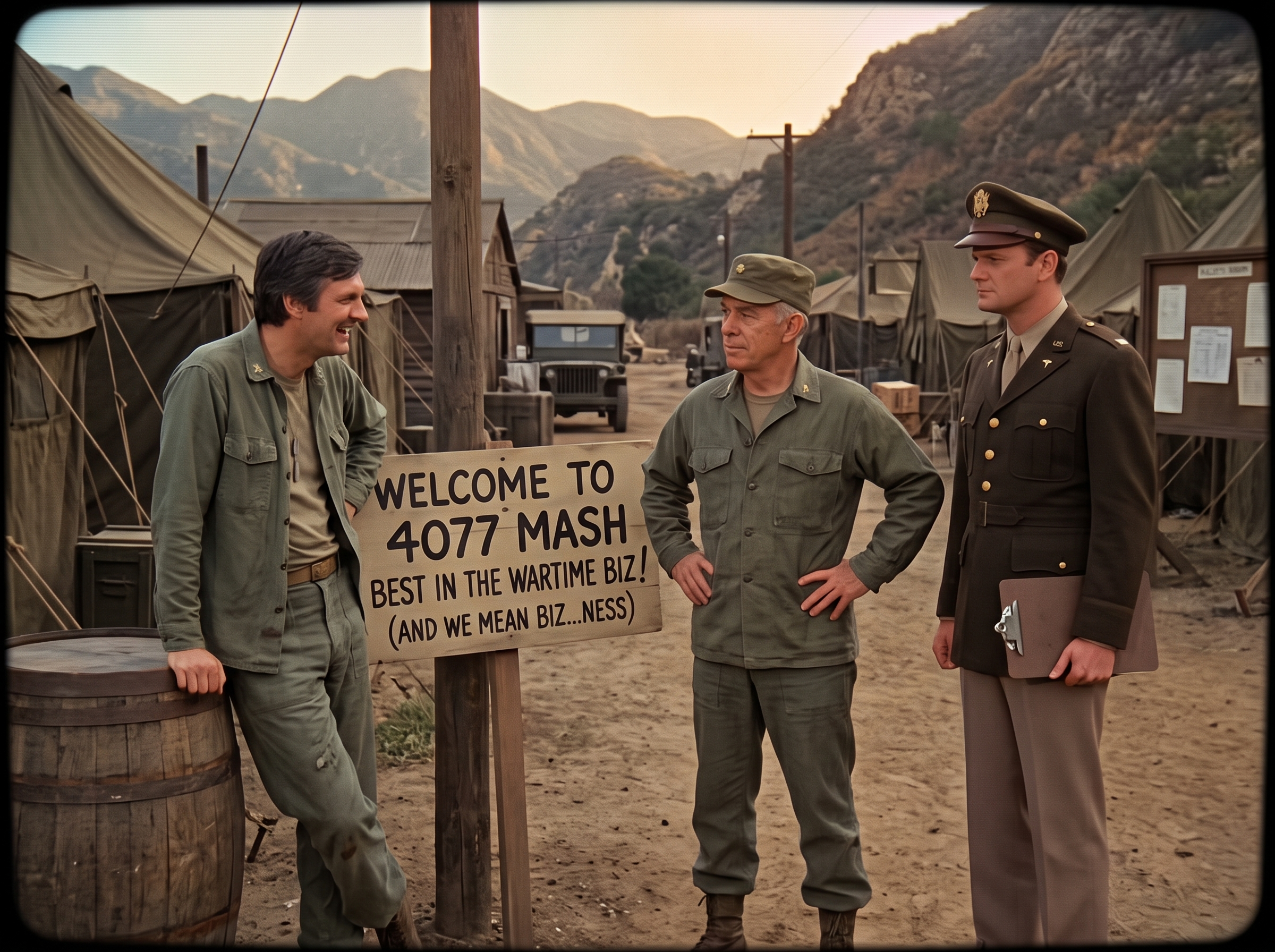
You could always measure the exhaustion of the 4077th by the absurdity of their free time.
It had been three brutal, endless days in the operating room. For seventy-two hours, the world was nothing but the harsh glare of surgical lamps, the metallic clatter of dropped clamps, and the heavy, metallic smell of blood. But finally, the choppers had stopped coming. The wounded were resting, and the camp had fallen into that strange, quiet lull that always felt a little like holding your breath.
Outside in the compound, the afternoon lighting was soft and warm. It cast a slightly muted, dusty beige glow over the canvas tents and the dirt paths, making the whole war look like a faded, lightly worn photograph from a family album.
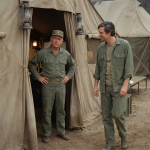
Hawkeye Pierce stood near the center of the camp, leaning casually against a large wooden barrel. His posture was a study in practiced relaxation—a deeply tired slouch designed to make him look like a man without a care in the world. He was still wearing his rumpled, faded olive-drab fatigues, the cotton soft and lived-in. Despite the heavy bags under his eyes, his mouth was curved into a sharp, clever smile.
He was incredibly pleased with himself.
Standing a few feet away, entirely immune to Hawkeye’s charm, was Major Charles Emerson Winchester III. Even in the middle of a dusty Korean compound, Charles managed to hold himself like he was waiting for a valet at the Ritz. His posture was upright, precise, and rigid. His uniform was as crisp as humanly possible under the circumstances. Right now, however, Charles was staring straight ahead with an expression of dry superiority and intense, restrained irritation.
Between them stood the camp’s famous wooden signpost. And tacked right beneath the arrow pointing toward Boston was a brand-new, freshly painted wooden plank.
“I fail to see the humor, Pierce,” Charles said, his voice dripping with aristocratic disdain. “It is juvenile, it is boorish, and it is a complete violation of public property.”
“It’s not public property, Charles, it’s a stick in the mud,” Hawkeye replied mildly, crossing his arms and leaning back further against the barrel. “And I think it’s highly informative. The men have a right to know where they’re going.”
“They are going to the latrine!” Charles barked, his calm finally cracking just a fraction. “They do not need a sign directing them to the ‘Boston Symphony Orchestra—Standing Room Only’!”
“Well, you’re always saying the acoustics in there are magnificent,” Hawkeye shot back, his eyes dancing with dry wit.
Before Charles could launch into a proper, full-volume tirade, the heavy crunch of worn leather boots on the dirt path interrupted them.
Colonel Sherman T. Potter strolled up to the crossroads. He looked just as exhausted as his surgeons, the weight of command settling deep into the lines of his face. He came to a halt, planting his feet firmly in the dusty earth, and rested both hands comfortably on his hips.
Potter didn’t say a word. He just stood there, a portrait of dryly amused, patient authority, looking up at the newly painted sign.
“Colonel,” Charles said immediately, gesturing sharply toward the post. “I demand this… this architectural insult be removed at once. It is an offense to the city of Boston and an insult to the musical arts.”
Hawkeye didn’t move from his slouch, but his smile tightened just a little. “It’s morale, Colonel. The arts are vital to a soldier’s spiritual well-being.”
Potter remained silent. The afternoon breeze gently tugged at the canvas tents in the background. The quiet of the camp suddenly felt very heavy. The humor was just a thin shield, a way to keep from thinking about how far away they all were from the lives they actually wanted. Charles was offended because Boston was his armor. Hawkeye was joking because humor was the only way he survived the lingering ghosts of the OR.
Potter knew that better than anyone.
The old cavalryman’s face remained entirely unreadable. He slowly took a step forward, his eyes fixed on the wet paint. Charles lifted his chin in triumph. Hawkeye braced himself, preparing for the inevitable lecture on military decorum. The tension in the dusty air pulled tight.
Potter reached out a weathered hand, his fingers hovering just inches from the fresh, dripping letters.
“Pierce,” Colonel Potter said softly, his voice gravelly and low.
Hawkeye pushed himself off the barrel, standing up a little straighter. The clever smile finally vanished, replaced by the tired respect of a junior officer. “Yes, Colonel?”
Potter sighed. It was a long, slow exhale that seemed to carry the weight of the entire Korean peninsula. He dropped his hand back to his hip and slowly turned his head to look at his chief surgeon.
“You spelled ‘Symphony’ wrong,” Potter said deadpan. “You forgot the first ‘y’. Right now, it says ‘Simphony’.”
Hawkeye blinked.
Charles closed his eyes, inhaling deeply through his nose in a state of profound, aristocratic despair. “Good Lord,” Winchester whispered, pinching the bridge of his nose. “Not only is he a vandal, he is an illiterate one.”
Potter’s mustache twitched. A warm, dry amusement finally cracked through his stoic expression, crinkling the corners of his eyes. He looked back up at the signpost, his gaze traveling past Hawkeye’s joke, up to the arrows pointing to Crabapple Cove, to Toledo, to Boston.
“And furthermore,” Potter continued, his voice losing its sharp command edge and settling into a quiet, fatherly warmth. “If you’re going to turn my camp into a travel agency, you left off a very important destination.”
Hawkeye shoved his hands into his pockets. “I’m out of wood, Colonel.”
“Then find some,” Potter said gently. “Because Hannibal, Missouri deserves a spot on this pole just as much as Symphony Hall. Mildred makes a pot roast on Sundays that could bring a man back from the dead. I’d like to know which way to walk to smell it.”
The humor drained out of the moment, leaving something much softer and deeply familiar in its place. The teasing banter faded into the quiet, shared ache of homesickness. It was a feeling they all knew intimately, a heavy blanket they wore every single day.
Charles lowered his hand. He looked at the signpost again, but the irritation was gone from his eyes. He looked at Hawkeye, really looking at the exhausted slouch, the bloodshot eyes, and the desperate need to make a joke just to feel human for five minutes. Charles understood. Beneath his refined bluster, Winchester felt the exact same, hollow distance from home.
Charles adjusted his collar, his posture softening just a fraction. He cleared his throat.
“You know, Pierce,” Charles said, his voice quiet, lacking its usual sarcastic bite. “Despite the appalling penmanship… one must admit that it adds a certain necessary fiction to our grim little reality. Perhaps I can overlook it. For now.”
Hawkeye looked over at Charles, surprised by the olive branch. A genuine, quiet smile touched Hawkeye’s lips. It wasn’t his usual clever smirk, but a look of profound, tired gratitude.
“Thanks, Charles,” Hawkeye said softly. “I’ll be sure to add a sign for the valet parking tomorrow.”
“Don’t push it, Pierce,” Charles murmured, though the corner of his mouth twitched upward in a fleeting half-smile.
Potter chuckled, a warm, reassuring sound that seemed to anchor the entire compound. He reached out and gave the wooden post a fond, solid pat. He didn’t see a defaced piece of military property. He saw the coping mechanisms of men he cared for like sons. He saw the humanity they fought so desperately to keep alive in the middle of a war zone.
“Alright, gentlemen,” Potter said, turning away from the signpost and clapping his hands together. “The paint is drying, and my stomach is empty. Let’s go see what fresh tragedy the mess tent is calling dinner.”
“I believe it’s creamed chipped beef, Colonel,” Hawkeye said, falling into step beside him. “Or as I like to call it, an unprovoked attack on our morale.”
“I shall write my congressman,” Charles sighed, stepping smoothly into line on Potter’s other side.
The three of them walked slowly down the dirt path together, side by side. The warm, faded blue of the evening sky stretched out endlessly above them. They were thousands of miles from the places they loved, surrounded by mud, canvas, and war. But in that quiet, weary moment, walking shoulder to shoulder away from a misspelled piece of wood, they were exactly where they needed to be.
Some places aren’t on any map; they are just the people who stand beside you when you’re too far from home.