A Toledo Hustle and a Boston Chill
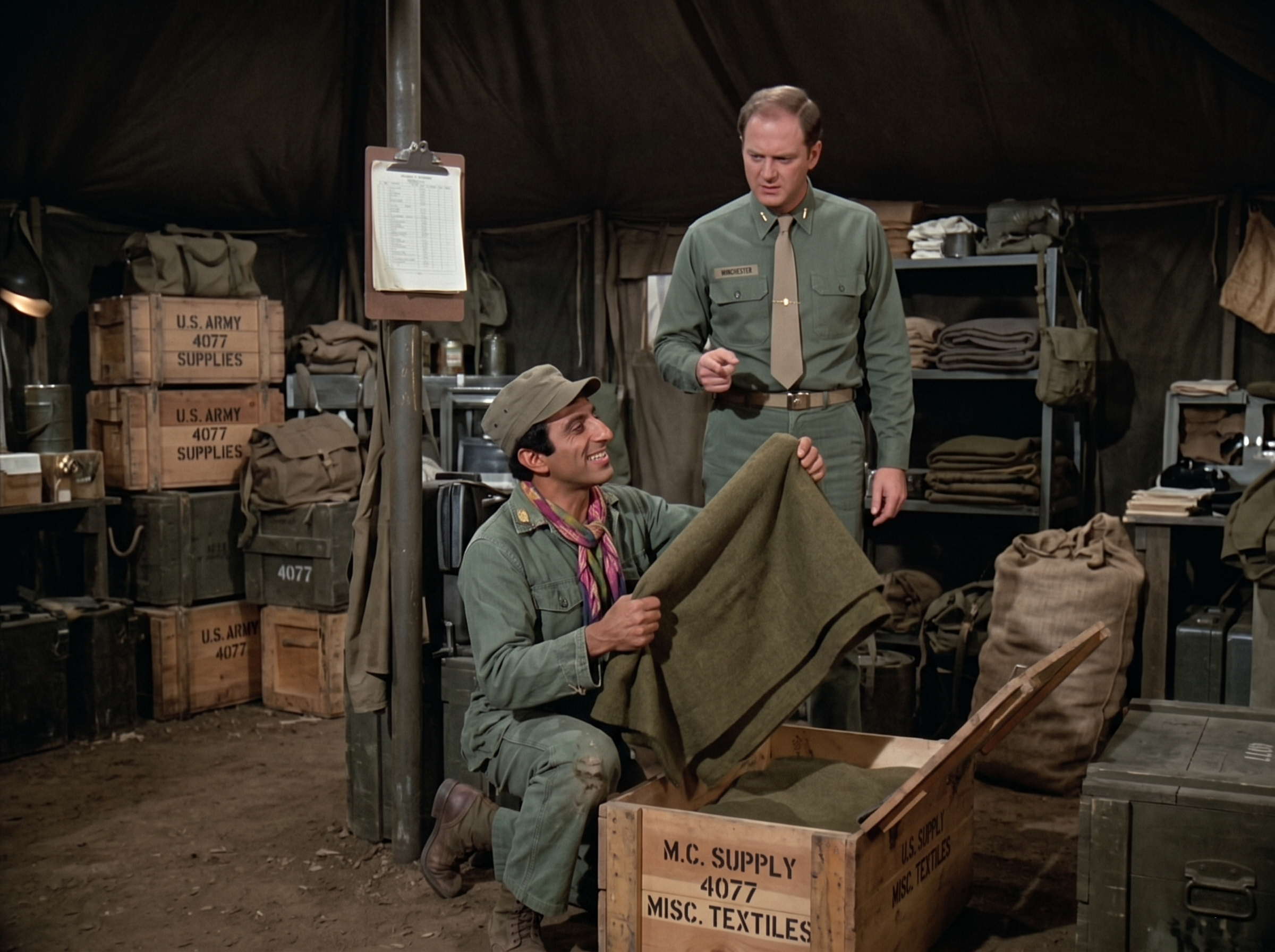
The Korean winter didn’t just knock on your door; it kicked it down, invited itself in, and stole your body heat while you slept.
At the 4077th Mobile Army Surgical Hospital, warmth was a currency far more valuable than gold, brass, or even a ticket home.
The wind howled through the compound, rattling the thin canvas of the tents and turning the mud into a frozen, unforgiving landscape.
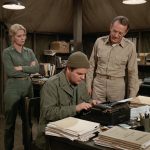
Inside the Supply Area, the lighting was dim and the air smelled heavily of old canvas, damp earth, and the lingering scent of cosmoline.
It was a practical, cluttered space, filled with wooden crates stamped with heavy black lettering, canvas duffel bags, and stacks of folded, scratchy standard-issue bedding.
A lone clipboard hung from a wooden center post, holding a hopelessly long list of items the army had forgotten to send.
Corporal Maxwell Klinger knelt in the dirt, wrapped in his standard green fatigues.
A bright, colorful silk scarf was tucked around his neck, a small rebellion of fashion against the drab olive-drab reality of the war.
He was in the middle of a tedious inventory check, prying open a heavy wooden crate labeled “M.C. SUPPLY 4077 MISC. TEXTILES.”
Klinger expected the usual.
He expected burlap sacks, or perhaps a shipment of summer-weight cotton sheets meant for a base in Florida.
Instead, as he pulled back the heavy wooden lid and dug through the protective packing paper, his hands met something entirely different.
It was heavy, dense, and incredibly soft.
Klinger pulled the item from the depths of the crate, shaking it out in the warm, practical camp light.
It was a blanket, but not just any blanket.
This was virgin wool, thick and plush, dyed a rich, pristine olive drab.
It was an officer’s grade textile, a rare luxury that had somehow slipped through the massive, clumsy fingers of the military supply chain and landed right in Klinger’s lap.
A sly, street-smart expression of theatrical triumph spread across his face.
It was the smile of a Toledo hustler who had just found a winning lottery ticket in the gutter.
“Oh, sweet mother of Toledo,” Klinger whispered to himself, running a hand over the immaculate fabric. “I am going to sleep like an Egyptian pharaoh.”
“You will do no such thing, Corporal,” a crisp, authoritative voice boomed from the entrance of the tent.
Klinger didn’t even drop the blanket. He just slowly turned his head.
Major Charles Emerson Winchester III stood just a few feet away.
Despite the miserable conditions, Charles stood stiffly upright, projecting an aura of proud entitlement.
He wore his standard green shirt and a perfectly knotted tie, looking entirely out of place in the dusty supply tent.
But beneath the rigid posture, there was a subtle tremor in his jaw.
The Swamp’s stove had failed again, and the Boston Brahmin was visibly freezing.
Charles stepped closer, his eyes locking onto the woolen prize in Klinger’s hands.
His posture grew even stiffer, a dry superiority radiating from his every pore as he raised a single, commanding finger.
He prepared to confidently demand the item for himself, and the air in the supply tent grew suddenly thick with comic tension.
“I believe,” Charles enunciated clearly, his finger aimed directly at Klinger’s chest, “that particular item belongs in the quarters of a superior officer. Namely, me.”
Klinger held the blanket tighter against his chest, his triumphant smile shifting into a look of guarded defiance.
“With all due respect, Major,” Klinger said, his tone dripping with exaggerated innocence, “this crate clearly says ‘Misc. Textiles.’ I am the master of the ‘Misc.’ It’s a supply sergeant’s prerogative.”
“A prerogative?” Charles scoffed, taking another step forward. “You are a corporal, Klinger. Your only prerogative is to freeze quietly while your betters acquire the rest necessary to perform miracles.”
“My betters have a heavy coat and a superiority complex to keep them warm,” Klinger shot back, not missing a beat. “I’m a delicate flower of the Midwest. My blood is thin. If I don’t get proper insulation, I’ll wither away.”
Charles let out a sound that was half-sigh, half-growl.
“Do not test my patience, you Toledo brigand. The temperature in the Swamp is currently hovering somewhere between ‘Arctic tundra’ and ‘meat locker.’ My fingers are stiff. A surgeon’s hands are the instruments of salvation, Klinger. They must be protected at all costs.”
Klinger looked at the Major.
Beneath the bluster, the arrogance, and the stiff military bearing, Klinger saw what was really there.
Charles was exhausted.
They had just come off a brutal twenty-four-hour session in the O.R.
The Major’s eyes were rimmed with red, and his usually immaculate uniform looked just a little more lived-in than usual.
The arrogant pointing finger was trembling, and it wasn’t entirely from indignation.
It was from the bone-deep, soul-crushing cold of a Korean winter that didn’t care if you were a farm boy from Iowa or a Harvard-educated aristocrat.
Klinger looked down at the soft, warm wool in his hands.
He thought about his own cot, drafty and miserable.
He thought about the petty satisfaction of denying Winchester something he desperately wanted.
But then, he thought about the Major standing over an operating table for hours on end, piecing together shattered boys with a focus that was nothing short of miraculous.
The hustle was a game they played to stay sane, but underneath it all, they were a family trapped in a frozen hell.
“You know, Major,” Klinger said slowly, dropping the theatrical bravado just a fraction. “According to regulations, I’m supposed to log this and distribute it through proper channels. That could take weeks.”
Charles narrowed his eyes, sensing a shift in the wind. “And your point, Corporal?”
“My point,” Klinger said, gently folding the blanket, “is that the paperwork is a nightmare. It gives me a headache just thinking about it.”
Klinger stood up, brushing the dirt from his knees.
He walked over to where Charles was standing and thrust the folded blanket against the Major’s chest.
Charles instinctively brought his arms up, clutching the thick wool.
He looked at Klinger, momentarily stunned, his prepared arguments evaporating in the sudden warmth of the fabric.
“However,” Klinger continued, pointing a finger back at Charles, mimicking his earlier posture, “if a certain Major were to misplace a tin of those smoked oysters from his latest care package, and perhaps forget to mention it to anyone… well, I suppose I could forget I ever opened that crate.”
Charles stood in the dim light of the supply tent, holding the blanket like a life raft.
He looked at Klinger’s sly, knowing smile.
The Major understood exactly what was happening.
It wasn’t a trade. It was an act of grace, wrapped in a Toledo hustle to save them both the embarrassment of a genuine emotional moment.
Charles pulled the blanket closer, a tiny, almost imperceptible softening appearing at the corners of his mouth.
He straightened his spine, regaining his aristocratic composure.
“Extortion,” Charles declared, his voice dry but lacking its usual sting. “Pure, unadulterated extortion. You are a scoundrel of the highest order, Klinger.”
“Thank you, sir,” Klinger beamed. “I aim to please.”
“I shall leave the oysters on my footlocker,” Charles muttered, turning toward the exit. “See that you don’t track mud into my quarters when you steal them.”
“I’ll wear my finest slippers, Major,” Klinger called out as Charles pushed through the canvas flaps and out into the biting wind.
Klinger stood alone in the quiet supply tent, surrounded by the crates and the cold.
He didn’t have the blanket, but as he went back to his inventory, he realized he felt just a little bit warmer anyway.
In a place where everything was broken, they survived by keeping each other stitched together, one small, unacknowledged kindness at a time.