Fixing the Road Home
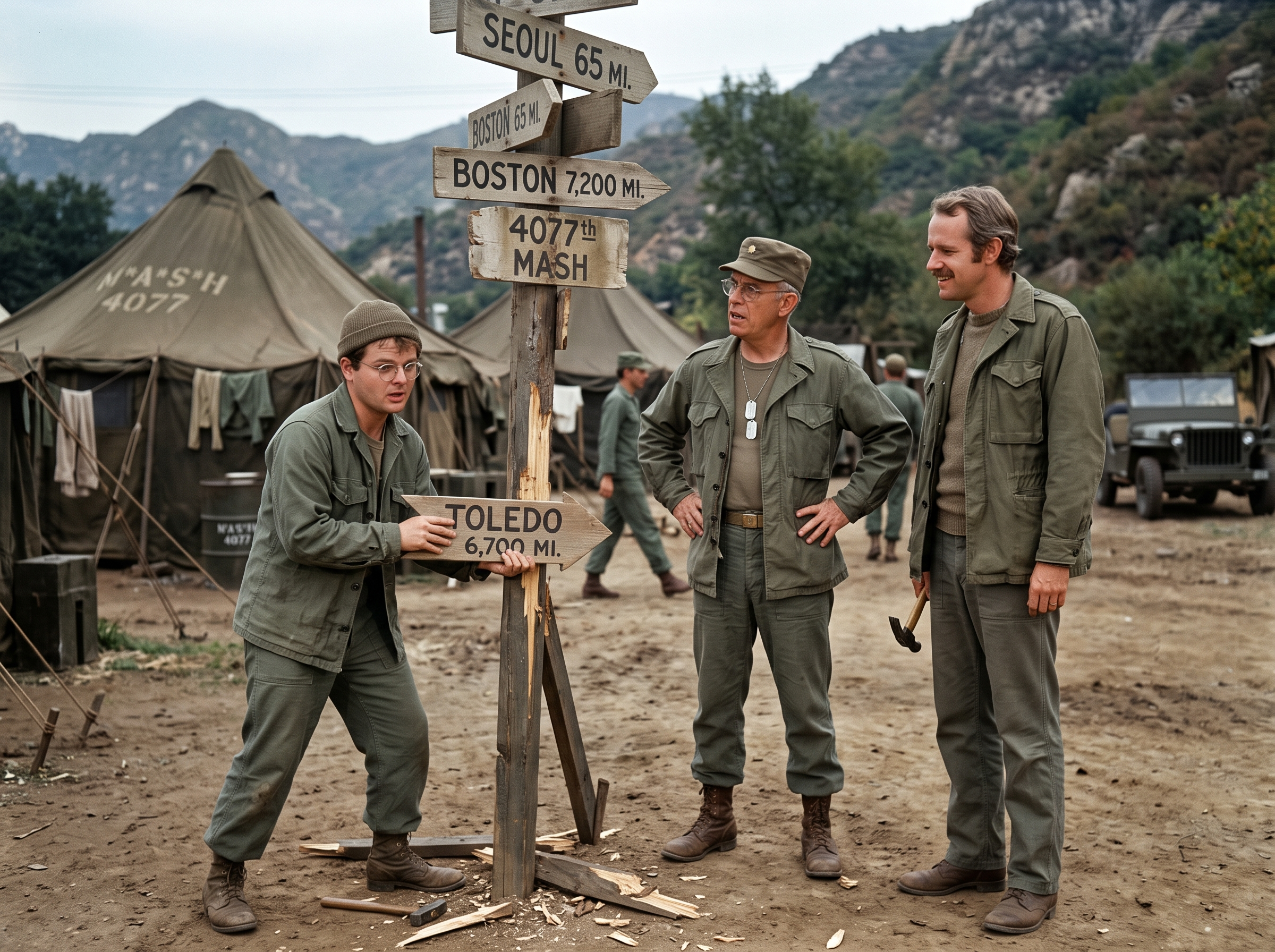
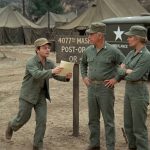
The signpost was the undeniable heart of the 4077th.
It stood proudly in the center of the dusty, barren compound, an anchor in a sea of olive drab tents.
It pointed everyone back to the varied lives they had left behind.
But today, that vital wooden compass was broken.
A careless, rushed maneuver from a supply jeep had backed right into the iconic wooden pillar.
It hadn’t snapped completely in half, but the central post was violently, deeply splintered.
Worse, several of the heavy wooden arrows had been knocked entirely loose, dangling sadly toward the dry Korean dirt.
It was a quiet afternoon, the kind of rare, golden lull where the roar of incoming choppers was thankfully absent.
Instead of catching up on desperately needed sleep, Colonel Sherman T. Potter had taken it upon himself to lead the repair detail.
He stood firmly planted in the dust, his hands resting heavily on his hips.
His fatigue jacket was unbuttoned, revealing his standard olive undershirt and the dull silver of his dog tags catching the muted daylight.
Potter looked at the splintered wood with the gentle exasperation of a father staring down a broken window.
“Alright, son, hold her steady,” Potter directed, his voice a gravelly, grounded rumble that carried easily across the camp.
“We need it perfectly level. Toledo cannot be tilted. It’s bad for morale.”
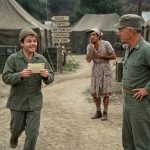
Corporal Walter “Radar” O’Reilly was doing his absolute, earnest best.
Wearing his signature knit beanie and round wire-rimmed glasses, Radar was hunched awkwardly over the post.
His young face was a mask of pure, nervous concentration.
He had both hands clamped tightly around the heavy wooden arrow that proudly read “TOLEDO 6,700 MI.”
He was trying to align it perfectly with the jagged, raw wood of the damaged center pole.
But the heavy wooden plank was unwieldy in his hands, and the splintered post offered no flat surface to brace against.
Standing just a few feet away, Captain B.J. Hunnicutt watched the struggle with a dry, easygoing smile.
B.J. was the designated muscle for the operation, holding a heavy iron hammer loosely by his side.
He wore his familiar green sweater under his fatigue jacket, looking entirely relaxed against the weary backdrop of canvas and distant mountains.
He was clearly finding immense, quiet amusement in the mundane, highly serious nature of this camp chore.
“Just a fraction to the left, Radar,” Potter instructed, leaning in slightly, his eyes squinting against the soft glare of the sun.
“You’re pointing them toward Cleveland. Nobody wants to go to Cleveland.”
“I’m trying, sir,” Radar squeaked, his small arms beginning to tremble under the awkward, shifting weight.
“But the splinters are digging into the ‘T’, and if I push too hard, I think the whole state of Ohio is gonna fall right off.”
“Don’t force it, son,” Potter said gently, adjusting the brim of his field cap.
“It’s a delicate operation. Precision. That’s what separates the cavalry from the mud-sloggers.”
B.J. chuckled softly, tapping the heavy steel head of the hammer lightly against his thigh.
“You want me to just nail it, Colonel?” B.J. offered mildly, his mustache twitching with a suppressed grin.
“I think Toledo is eager to get back on the map before roll call.”
“Patience, Hunnicutt,” Potter replied firmly, without taking his eyes off the precarious sign.
“You don’t just slap a man’s hometown back onto a post willy-nilly. It requires dignity.”
Radar shifted his boots in the loose dirt, desperately trying to get a better grip on the wood.
But as he adjusted his footing, the heavy wooden arrow suddenly slipped.
The jagged edge of the sign caught roughly against the splintered main post.
There was a sharp, terrible cracking sound of dry wood snapping.
Radar gasped loudly, his eyes going wide with terror behind his glasses.
The Toledo sign broke completely free from its remaining moorings, slipping violently out of his tired hands.
The heavy wooden arrow plummeted toward the dirt, taking a large, vital chunk of the main post’s structural support down with it.
Radar scrambled desperately, diving clumsily toward the dirt to catch the sign before it hit the ground.
He managed to grab it just in time, ending up on his knees in the heavy dust.
He knelt there, clutching the piece of wood tightly to his chest like a wounded bird.
He looked up at Colonel Potter, his face pale with sudden, overwhelming guilt.
“I broke it, sir,” Radar whispered, genuinely devastated by the accident.
“I broke Toledo. And I think I took a piece of Boston with it.”
For a brief second, the quiet of the compound felt incredibly heavy and still.
The signpost was sacred ground around the 4077th.
It was the one tangible thing that proved the rest of the world, and their real lives, still existed out there somewhere.
Potter didn’t yell.
He didn’t even sigh.
The gruff, military exterior softened instantly, replaced by the deep, weary humanity that made him the true father figure of the camp.
Potter reached down and placed a steady, reassuring hand on Radar’s trembling shoulder.
“You didn’t break anything, son,” Potter said gently, his voice losing all its commanding bark.
“It’s just wood, Radar,” B.J. added warmly, stepping forward into the center of the mess.
B.J. knelt gracefully in the dirt beside the young corporal, offering a comforting, easy smile.
“And besides,” B.J. said, reaching out to tap the painted letters of the sign.
“Toledo is a lot tougher than it looks. It can take a few bumps along the road.”
Radar swallowed hard, looking anxiously between the two officers.
“But the post is completely splintered now, sir,” Radar pointed out nervously, gesturing to the ruined pillar.
“There’s nothing flat left to nail it to. How are we ever going to fix it?”
Potter took his hands off his hips and crouched down slightly to thoroughly inspect the fresh damage.
He ran a weathered, experienced finger over the fresh, jagged wood of the central pole.
“Well,” Potter mused quietly, narrowing his eyes thoughtfully as he surveyed the problem.
“In the cavalry, when a saddle strap breaks in the middle of a hard ride, you don’t throw away the horse.”
“You improvise,” Potter declared, standing back up to his full height.
Potter pointed firmly toward the distant motor pool.
“Radar, go fetch me a length of bailing wire and some of that heavy canvas tape from the supply shed.”
Radar nodded eagerly, scrambling quickly to his feet and dusting off his knees.
“Yes, sir! Right away, sir!”
As Radar trotted off across the compound, Potter turned to B.J., giving the younger surgeon a knowing, affectionate look.
“He acts like he just dropped the Hope Diamond,” Potter muttered fondly, shaking his head.
“To him, he did, Colonel,” B.J. said softly, looking down at the heavy hammer resting in his hand.
“To all of us, really. It’s a very long walk home.”
Potter nodded slowly, turning his gaze up at the remaining arrows still clinging to the post.
Seoul, 65 miles.
Boston, 7,200 miles.
“That it is, Hunnicutt. That it is,” Potter agreed, his voice thick with a sudden, quiet fatigue that settled deep in his bones.
“But as long as this post is standing, we know which direction to start walking.”
A few minutes later, Radar returned, completely breathless, clutching a thick coil of wire and a heavy roll of tape.
The three of them immediately went to work.
It wasn’t a pretty repair.
It was a messy, improvised, desperate fix—exactly the kind of triage they performed every single day in the operating room.
Potter held the splintered core of the wood together tightly, his hands unyielding.
Radar meticulously wrapped the bailing wire around the post, his small hands pulling the metal taut with all his strength.
Then, B.J. stepped up to finish the job.
With Radar holding the Toledo arrow firmly against the newly wrapped section, B.J. swung the hammer.
The sharp, echoing thwack of metal on metal rang out loud and clear across the quiet compound.
B.J. drove the heavy nails in deep, making absolutely sure the wood bit down hard and fast.
He hit it with the steady, measured rhythm of a man who intimately understood the importance of holding broken things together.
“There,” B.J. said, stepping back and resting the hammer casually on his shoulder.
The sign wasn’t perfect.
The Toledo arrow sat just a little lower than before, and the central post was now heavily bandaged in wire and tape.
It looked bruised.
It looked battered.
It looked exactly like the people of the 4077th.
Radar stepped back, wiping a heavy smear of dirt from his forehead, a proud, deeply relieved smile finally breaking across his young face.
“Looks pretty good, doesn’t it, sir?” Radar asked eagerly.
Potter put his hands back on his hips, surveying their handiwork with a slow, deeply approving nod.
“It’ll hold, son,” Potter said softly, the gentle warmth returning to his eyes.
“It’ll hold until we don’t need it anymore.”
The three men stood there together in the muted daylight for a long moment, simply looking up at the repaired sign.
They were tired, they were dirty, and they were thousands of miles away from everything they truly loved.
But as the soft Korean breeze gently rattled the wooden arrows, they stood shoulder to shoulder, entirely at home with each other.
Some things are worth holding together, even when the rest of the world feels like it’s falling apart.