Sorting Out the Sunshine (and the Forms, Duplicated and Triplicated)
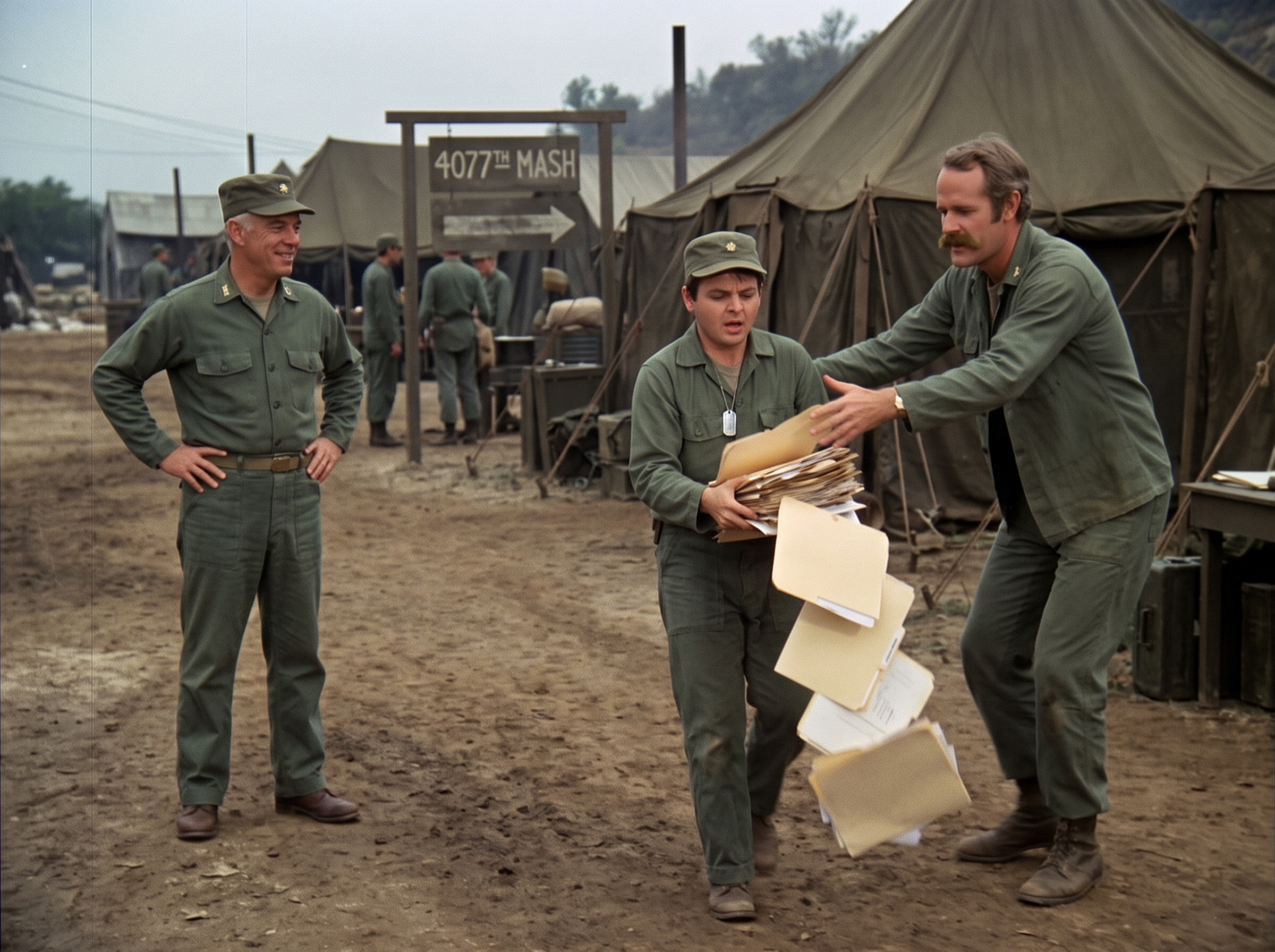
The morning sun over the 4077th MASH was, as usual, a dusty, uncompromising affair. It wasn’t a benevolent sun, just a tired one that had seen too much. It baked the mud into dust and made the canvas of the tents smell like forgotten things. On the dirt path between the mess tent and the main complex, a small, mundane human crisis was unfolding under its gaze. It was exactly the kind of quiet, slightly absurd disaster that defined their long, tired days. A pile of paperwork was proving to be a mountain too high for one short, earnest clerk to climb.
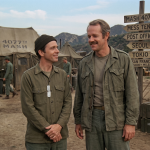
Corporal Radar O’Reilly was walking with a strange, delicate shuffle. He was holding onto a stack of documents so large it obscured his entire head. It was a tower of manila files, loose forms, and carbon copies that seemed to defy gravity. Radar’s short arms were wrapped around the center of the mass, his knuckles white with the strain. He was navigating the uneven dirt path with his body at a precarious forward lean. A few background soldiers milled about near the main complex sign, but Radar was focused. A small, anxious noise escaped his lips with each carefully planted step.
A single loose paper fluttered out from the very top. It was like the final piece of sand on a dune. Radar felt the balance shift. He stopped, holding his breath, trying to stabilize the entire edifice. But the stack had a mind of its own. It wobbled, then began to groan. A cascade of paper started to spill from the bottom corner, catching the slight breeze. For a brief second, it was beautiful, like a cloud of paper butterflies in the desert. Then, it became chaos.
He lets out a small, silent “noooo.” The top third of the pile slips, then the middle. The sheer volume of paper begins to overwhelm him. Files are sliding, folders are separating, and forms are catching the wind. Radar’s eyes are wide under his cap, and his mouth is open in silent panic. He is now stumbling, desperately trying to catch everything at once and failing spectacularly. The papers are a swirling vortex of bureaucracy surrounding him.
B.J. Hunnicutt has been watching this. He’s leaning casually, arms loosely spread in a mixture of dry amusement and genuine concern. He has that grounded, solid smile that seems to say, “This, too, shall pass.” But the smile is already beginning to fade. Seeing Radar in freefall, the amusement turns to the instinctive urge to protect. B.J. is leaning, his hand starting to extend toward the falling forms. His expression is shifting from a laugh to that pained grimace of watching someone trip. “Radar, you gotta prioritize the essential carbon—” The rest of the thought is drowned out as the paper pile collapses completely.
Colonel Potter is further back, hands firmly on his hips. He watches from a distance, observing the whole glorious mess. He has that broad, patient smile of a man who has seen a lot worse. He doesn’t interfere. He knows a good learning opportunity when he sees one, especially one wrapped in comic absurdity. Radar is practically buried in a mound of forms, folders, and documents, and B.J. is standing over him, his smile a complicated thing, half-sympathy, half-“I told you so.“
And that’s when everything stops, just for a second. The world is a silent, paper-strewn landscape. Radar is still on his feet, but utterly lost within the swirling forms. B.J. is reacting. Potter is observing. It’s the perfect moment of 4077th suspension, where the mundane becomes a quiet, public performance of human struggle and inevitable collapse. Resolution feels a lifetime away, and the dirt path has never looked so cluttered. Radar’s quiet gasp is the only sound in the sudden silence, and the mountain of files has won.
The direct reaction was immediate. B.J. didn’t just reach out; he practically dove. His large hands corralled the falling forms like a shepherd with very confused sheep. A few papers did find the dirt, dusting their edges in Korean red clay, but B.J. managed to catch the core of the cascade. Radar was still stumbling, a few final papers fluttering from his arms like feathers, but B.J. was there, a steadying presence.
Radar’s eyes were the size of dinner plates. “Colonel! Major! I’m so, so sorry. It was the supply requisition for the—” He couldn’t even finish the sentence, he was so flushed.
B.J. just smiled, that quiet, steadying smile. “It’s alright, Radar. Think of it as a quality control test for the wind resistance of our forms. They did, uh, remarkably well in the ‘falling’ category.” He knelt down, gathering the folders with easy efficiency. “You just gotta know when to let the low-priority carbon go, son. This was high-level stuff. We almost lost the requests for more olive drab thread for the next three months.“
“And the coffee?” Radar whispered, still clutching a few crumpled forms to his chest.
“Well, the coffee requisition is still on its own separate mountain,” B.J. said, stacking the files. “We’ll just have to hope that mountain is stable. You know how volatile coffee bureaucracy can be. One wrong slip, and we’re looking at instant for the foreseeable future.“
“Let it go, son,” Potter called from his spot, hands still on his hips. He hadn’t moved a muscle, but his voice was full of that fatherly, tired warmth. “Just pick ’em up, clean ’em off. Some days the paperwork wins. The trick is to keep it from taking you down with it. We’ve got more important things to organize than a few dust-covered requisitions.“
Radar looked from B.J. to Potter and back. The sheer relief on his face was enough to break your heart. He nodded, once, and immediately fell to his knees, meticulously cleaning and stacking every file he could find.
As they sorted the forms, other small, human interactions washed over them. Margaret walked by, checked her watch with military precision, and gave Radar a pointed look. “Company clerk. Unorganized clerk. I hope this isn’t the entire supply list for Pre-Op. Because if it is, Corporal, you’ll be typing it all again, from memory, while standing on your hands.” She continued on without a smile, but you could see the slight relaxation in her shoulders. The efficiency mattered, but the family did too.
Even Hawkeye poked his head out from a nearby tent pole, a martini glass in hand. “Look at that, Beejay. Radar is auditioning for the role of ‘Distributed Bureaucrat.‘ I bet those are the requisition forms for more ice. Or perhaps more logic. It’s hard to tell.” He gave a lazy salute. “Keep up the, uh, excellent work. Just don’t lose the request for more martini olives. Some things are sacred.“
B.J. rolled his eyes and went back to work. “Ignore the martini-driven, existentialist observation, Radar. Just keep gathering the forms.“
It took a good ten minutes to get the paper mountain back into its messy, yet somewhat ordered, state. Radar stood up, a much smaller pile in his arms, his cap adjusted. The path was clean. The dirt was settled. The 4077th sign still watched over them, immutable and faded.
Potter finally walked over. He gave Radar’s arm a gentle, yet firm, pat. “Well done, son. You kept your head when the bureaucracy tried to bury you. B.J., thanks for the assist. We make it through another small, ridiculous catastrophe. Now, go deliver those forms before the coffee supply really does collapse.“
Radar managed a shaky, but genuine, salute. “Yes, sir, Colonel.” And with that, he was off, walking with a much more deliberate, careful shuffle.
B.J. watched him go, the complicated, amused-and-tender smile back on his face. “One down, a thousand paper-mountain ranges to go, Colonel. We just sort out the sunshine and the carbon forms, don’t we?“
Potter chuckled, a dry, warm sound. “It’s a good day when the forms are the only thing falling in the camp, Beejay. We’ll take our small victories when we can find them. Now, about that requisition for more olive drab thread…“
The day continued, as it always did, with the same mixture of fatigue, humor, and quiet tenderness. The small paper cascade was forgotten by the mess tent and the background soldiers. But it was just another tiny stitch in the fabric of the community they had built—a family that found laughter in the absurdity and solace in the shared human failures, in a place where hope was duplicated, triplicated, and sometimes just a bit dusty.
And the papers, once sorted, just made room for tomorrow’s mountain.