The Melody in the Mud
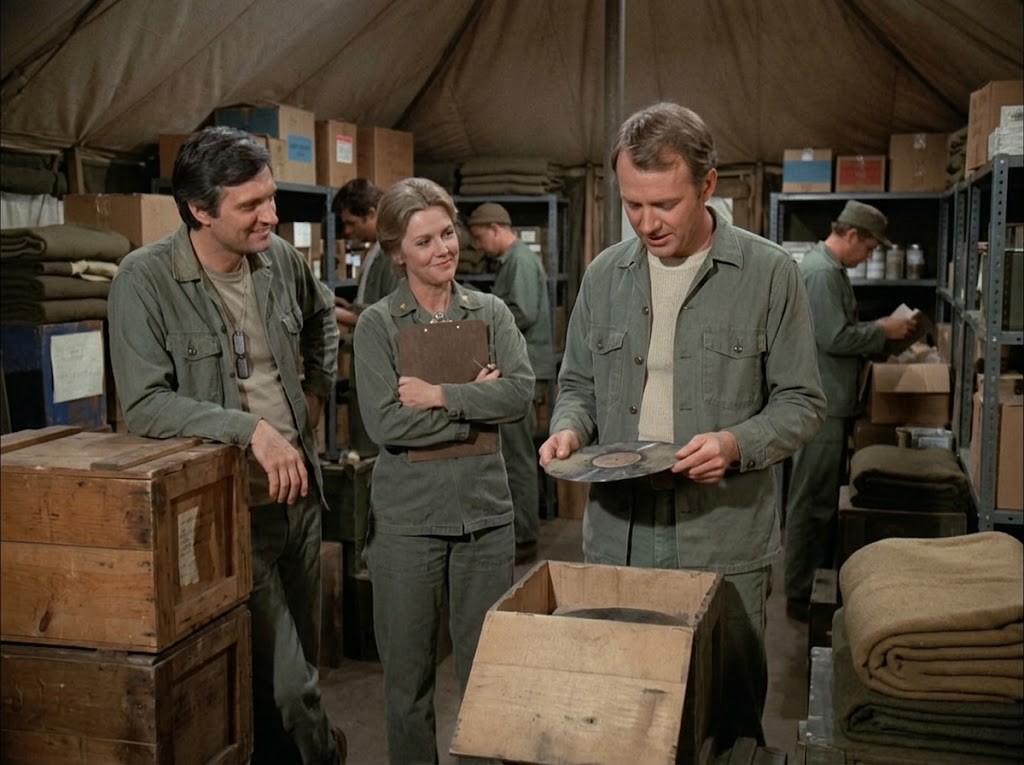
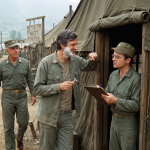
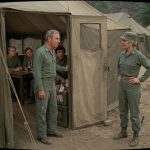
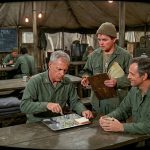
The Supply Tent always smelled of damp canvas, old wool blankets, and the faint, metallic sting of floor wax that never quite did its job. On an afternoon when the shelling in the distance sounded like a low, persistent headache, that tent was the closest thing to a sanctuary the 4077th had. It was a place where time didn’t tick in surgeries, but in cardboard boxes, clipboards, and crates.
Hawkeye Pierce leaned against a stack of wooden crates, his hands tucked loosely into his pockets, his posture a masterclass in calculated exhaustion. A faint, knowing smile played on his lips, the kind he wore when he was trying to coax a spark of life out of a gray day. Beside him, Margaret stood with her clipboard cradled against her chest like armor, her sharp eyes softened by a rare, quiet curiosity that she usually kept locked away beneath her starched collar.
Between them stood BJ Hunnicutt, looking at the object in his hands as if it were a fragile piece of ancient history. It was a vinyl record, pulled from a newly arrived crate of winter supplies—scratched, slightly warped from the long journey across the Pacific, and covered in a fine layer of dust. It didn’t belong in a war zone, which made it the most valuable thing in the camp.
“Well, look at that,” BJ murmured, his voice carrying the warm, grounded cadence of home. “A little piece of the real world, wrapped in cardboard and lost between thirty pairs of combat boots.”
Hawkeye shifted his weight, his eyes tracking the light reflecting off the worn grooves. “Careful, Beej. If the brass finds out we have something capable of producing harmony in Korea, they’ll court-martial the turntable.”
“It’s a miracle it didn’t shatter into a million pieces near Incheon,” Margaret said softly, her professional edge giving way to a small, tentative smile. “Who is it? Can you make out the label?”
BJ turned the record toward the dim light of the tent, squinting at the faded red paper in the center. The silence in the tent grew heavy, the kind of stillness that only happens when a room full of tired people suddenly remembers what they left behind.
Just behind them, the supply clerks kept moving, sorting blankets and shifting boxes, their quiet murmurs providing a steady heartbeat to the room. But for the three of them, everything had narrowed down to that single piece of vinyl.
BJ’s eyes widened slightly as his thumb brushed away a smudge of dirt from the title. He looked up, his expression a mix of sudden ache and profound disbelief. “It’s not a commercial release, Hawkeye. Look at the handwriting.”
Hawkeye stopped leaning against the crates, his smirk vanishing as he stepped closer. Margaret leaned in, her breath catching slightly.
“It’s from San Francisco,” BJ whispered, his voice cracking just enough to let the weight of Peg and Erin spill into the room. “It’s a home recording. It has my name on it.”
The silence that followed wasn’t the heavy, suffocating kind that came after a long session in the OR; it was a fragile, sacred quiet. Hawkeye looked at BJ, the easy wit completely drained from his face, replaced by the fierce, protective loyalty of a brother. He reached out, his hand resting briefly on BJ’s shoulder, a solid weight in a shifting world.
“Well,” Hawkeye said, his voice dropping an octave, losing its theatrical edge and becoming entirely human. “What are we waiting for? Radar’s office has that wind-up phonograph, and I happen to know he keeps the needle hidden in a jar of pickled eggs.”
Margaret didn’t reprimand them for neglecting their duties, nor did she mention the pile of inventory waiting on her clipboard. Instead, she quietly stepped ahead of them, acting as an impromptu vanguard to clear a path through the busy camp.
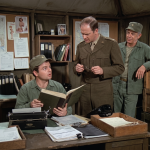
Within minutes, they were crowded into the small, cluttered office. Word traveled fast in the 4077th, and by the time BJ carefully lowered the scratched record onto the turntable, a few more faces had appeared at the screen door. Colonel Potter stood just inside the threshold, his hands behind his back, his stern face holding a look of quiet, fatherly understanding. Klinger, holding a stack of requisitions, paused by the filing cabinet, his usual theatrical complaints completely forgotten.
The phonograph gave a loud, scratchy hiss as the needle found the groove. For a terrifying three seconds, there was only the pop and crackle of damaged vinyl. BJ held his breath, his knuckles white against the edge of Radar’s desk.
Then, through the surface noise, a sound broke through. It was thin, tinny, and distant, but unmistakable.
It was the sound of a young woman laughing, followed by the clumsy, joyful strumming of an out-of-tune guitar. *“Hi, Daddy,”* a soft voice called out across five thousand miles of ocean. *“Erin wanted to show you her new song. Go ahead, sweetie.”*
A tiny, toddler-sized babble followed, accompanied by a frantic, rhythmic banging on the guitar body. It wasn’t music; it was beautiful, chaotic noise.
BJ closed his eyes. A slow, radiant smile spread across his face, even as his eyelashes grew wet. He didn’t look away from the spinning disc, listening to the ghost of his kitchen back in California filling a tent in the middle of a mud-soaked valley.
Hawkeye watched his friend, his own expression a mixture of profound happiness for BJ and the sharp, bittersweet pang of his own loneliness. He looked down at his boots, a quiet, respectful smile tugging at his lips. He didn’t say a word. He didn’t need to.
Margaret stood beside the desk, her chin tilted up in her usual military posture, but a single tear tracked a clean line through the dust on her cheek. She didn’t bother to wipe it away.
Even Colonel Potter took off his cap, holding it against his chest, his eyes fixed on the floorboards as he thought of Mildred and the quiet afternoons in Missouri that felt a million lifetimes away. For two minutes, the war didn’t exist. There were no incoming choppers, no supply shortages, and no endless rows of green tents. There was only a little girl, a broken guitar, and the immense, unbreakable thread of love holding them all together.
The record reached the end of the track, the needle clicking rhythmically against the inner groove—*click, click, click*—until Radar gently lifted the arm.
The silence returned, but the air in the room felt different now. It felt lighter, warmer, and a little easier to breathe.
BJ took a deep breath, looking around at the faces of his makeshift family. He carefully lifted the record, holding it against his chest just like Margaret had held her clipboard earlier.
“She’s gotten bigger,” BJ said, his voice steady now, filled with a quiet strength. “Her laugh is bigger.”
“She gets her musical talent from her father’s side, clearly,” Hawkeye said, the dry humor returning like an old friend, breaking the tension just enough to let everyone smile. “That guitar playing was purely avant-garde.”
“An absolute masterpiece, Captain,” Potter said, stepping forward to pat BJ on the arm. “Now, let’s get back to work before the North Koreans hear how bad our brass section is.”
The crowd dispersed slowly, returning to the mud and the routine of the 4077th. But as BJ walked back toward his tent, escorted by Hawkeye and Margaret, the distant sound of artillery didn’t seem quite as loud anymore.
In a place where tomorrow was never a guarantee, sometimes all it took was a scratched piece of vinyl to remind them exactly what they were fighting to get back to.