The Weight of a Single Sheet
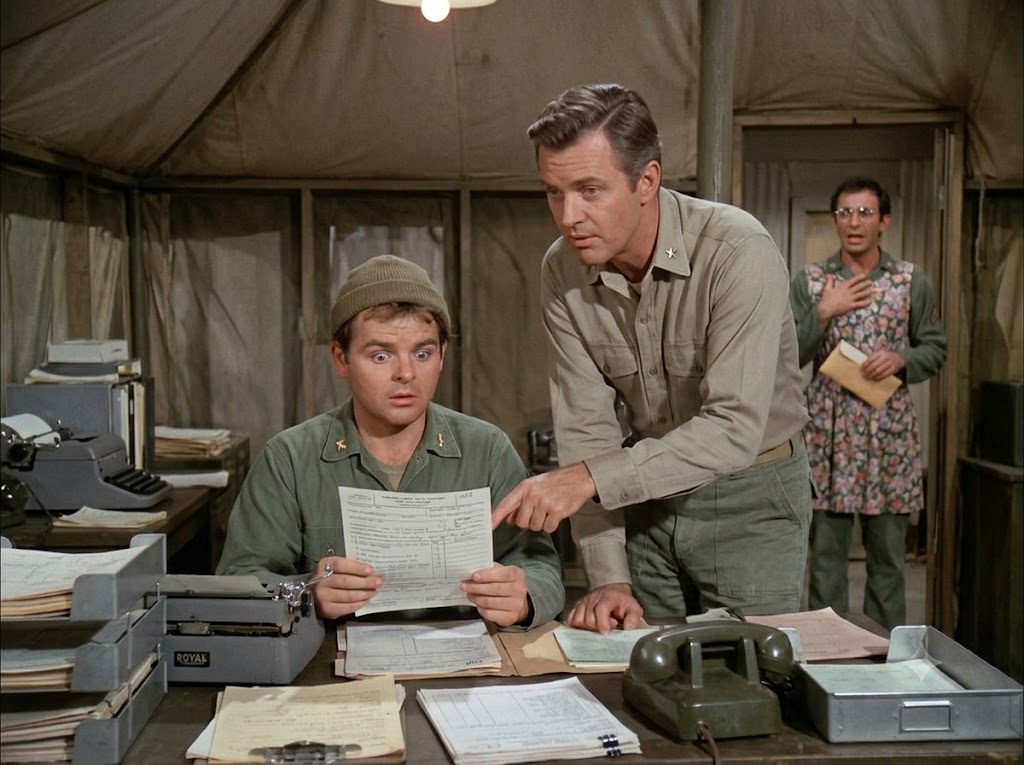
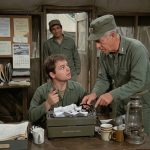
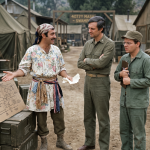
The Korean sun had a way of turning the clerk’s tent into a canvas oven by mid-afternoon, making the constant hum of the Royal typewriter sound more like a relentless locust than a tool of bureaucracy. Corporal Radar O’Reilly sat frozen, his fingers hovering over the keys like a pianist who had suddenly forgotten the notes, his wide eyes glued to the official form in front of him. Beside him stood Lieutenant Mitchell, a young liaison officer from I-Corps whose pressed uniform and pristine posture looked entirely foreign against the sweat-stained canvas of the 4077th. Mitchell’s finger pressed firmly against a single line of ink on the paper, his face tight with the grim authority that only a man carrying bad news can muster.
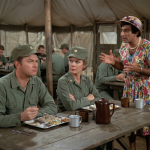
In the background, the screen door banged shut, and Corporal Maxwell Klinger froze mid-stride, his favorite floral apron clutched against his chest, an unopened envelope dangling from his fingertips. The usual theatrical complaints about the heat and his pending Section 8 discharge died in his throat as he caught the heavy, suffocating silence hanging over the desk. Radar’s breath hitched, the boy from Ottumwa suddenly looking far smaller than his oversized olive-drab uniform.
“Are you absolutely certain, Lieutenant?” Radar whispered, his voice cracking slightly as his thumb unconsciously sought the edge of his desk where his worn teddy bear usually slept. “There’s no mistake in the serial numbers?”
Lieutenant Mitchell didn’t look away from the paper, his expression hardening as he delivered the ultimate, unyielding verdict of the United States Army. “The signatures are verified, Corporal. It’s official. Effective immediately.”
The words seemed to hang in the muggy air, heavy and immovable. Klinger took a slow, tentative step forward, the colorful flowers of his dress contrasting sharply with the stark, gray reality of the military paperwork. For all his dramatic schemes to escape the war, Klinger possessed an innate, fiercely protective radar of his own when it came to the people he considered family, and right now, the youngest member of that family looked entirely broken.
“Radar?” Klinger asked softly, his usual brassy voice dropping to a rare, tender register. “What is it, kid? Is it something from home?”
Radar didn’t answer right away; his eyes remained locked on the form, reading the sterile, typed words over and over as if he could somehow change their meaning through sheer force of will. The 4077th was a place where life and death arrived in waves of dust and chopping helicopter blades, but sometimes the deepest wounds were delivered quietly, stamped in triplicate on a standard issue supply form.
“It’s the winter shipment,” Radar finally managed to choke out, his chest heaving under his green fatigues. “The whole medical consignment for the next three months… they routed it to the 8055th by mistake. The antibiotics, the sterile gauze, the surgical gloves… everything Hawkeye and B.J. need. It’s all gone. And the Lieutenant says the system can’t reissue the request for another sixty days.”
Lieutenant Mitchell sighed, the rigid posture softening just a fraction into the universal posture of a man trapped in an impossible system. “The logistics are locked, Corporal. With the mud season coming, the roads are completely choked. I’m sorry, but on paper, those supplies don’t exist for you anymore.”
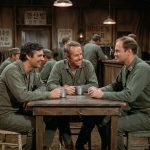
Just then, Captain Hawkeye Pierce walked into the tent, a half-empty glass in his hand and a joke on his lips, but he stopped when he saw the tableau before him. He looked from Mitchell’s stern finger to Radar’s pale face, and finally to Klinger, who was already holding the envelope like a shield. Hawkeye’s smile faded, replaced by the deep, bone-weary lines that only hours in the operating room could etch into a man’s face.
Instead of shouting or launching into a sarcastic tirade against the high brass, Hawkeye gently stepped up to the desk, leaning over Radar’s shoulder. He looked at the young corporal, whose eyes were starting to shine with unshed tears of frustration—the heavy burden of a boy trying to protect an entire camp of wounded men with nothing but a typewriter and a telephone.
“Hey, easy, son,” Hawkeye said quietly, placing a warm, steady hand on Radar’s shoulder, his fingers squeezing through the coarse fabric. “Look at me, Radar. Did we lose a patient today?”
Radar shook his head, his lower lip trembling. “No, sir. But without those supplies…”
“Without those supplies, we do what we always do,” Hawkeye interrupted, his voice laced with that quiet, fierce tenderness that kept the 4077th afloat. “We borrow, we steal, we swap Klinger’s silk dresses for penicillin, and we make do. The Army operates on paper, Radar. But we operate on heart. Don’t you ever let a piece of paper scare you.”
Klinger stepped up beside them, nodding firmly as he placed a comforting hand on Radar’s other shoulder. “He’s right, kid. I’ve got a cousin in Seoul who owes me a favor, and a supply sergeant in Incheon who thinks I look beautiful in gingham. We’ll get your supplies.”
Lieutenant Mitchell looked at the three of them—the cynical surgeon, the dress-wearing guard, and the trembling clerk—and slowly lifted his finger from the desk. A look of quiet understanding crossed the young officer’s face as he gently took the form, folded it, and slid it into his pocket.
“I’ll see if I can find a typo in the routing codes,” Mitchell said quietly, offering a small, human nod before turning toward the door. “Sometimes paperwork gets lost in the mud.”
As the screen door banged shut again, the tent returned to its familiar, humid rhythm. Radar let out a long, shaky breath, looking up at Hawkeye and Klinger with a small, grateful smile that completely wiped away the fear in his eyes. They were thousands of miles from home, surrounded by a war that made no sense, but standing around that cluttered wooden desk, they knew they would never have to face the cold alone.
In a place where paper held all the power, it was the quiet strength of family that always wrote the final chapter.