A Quiet Moment of Madness in the 4077th
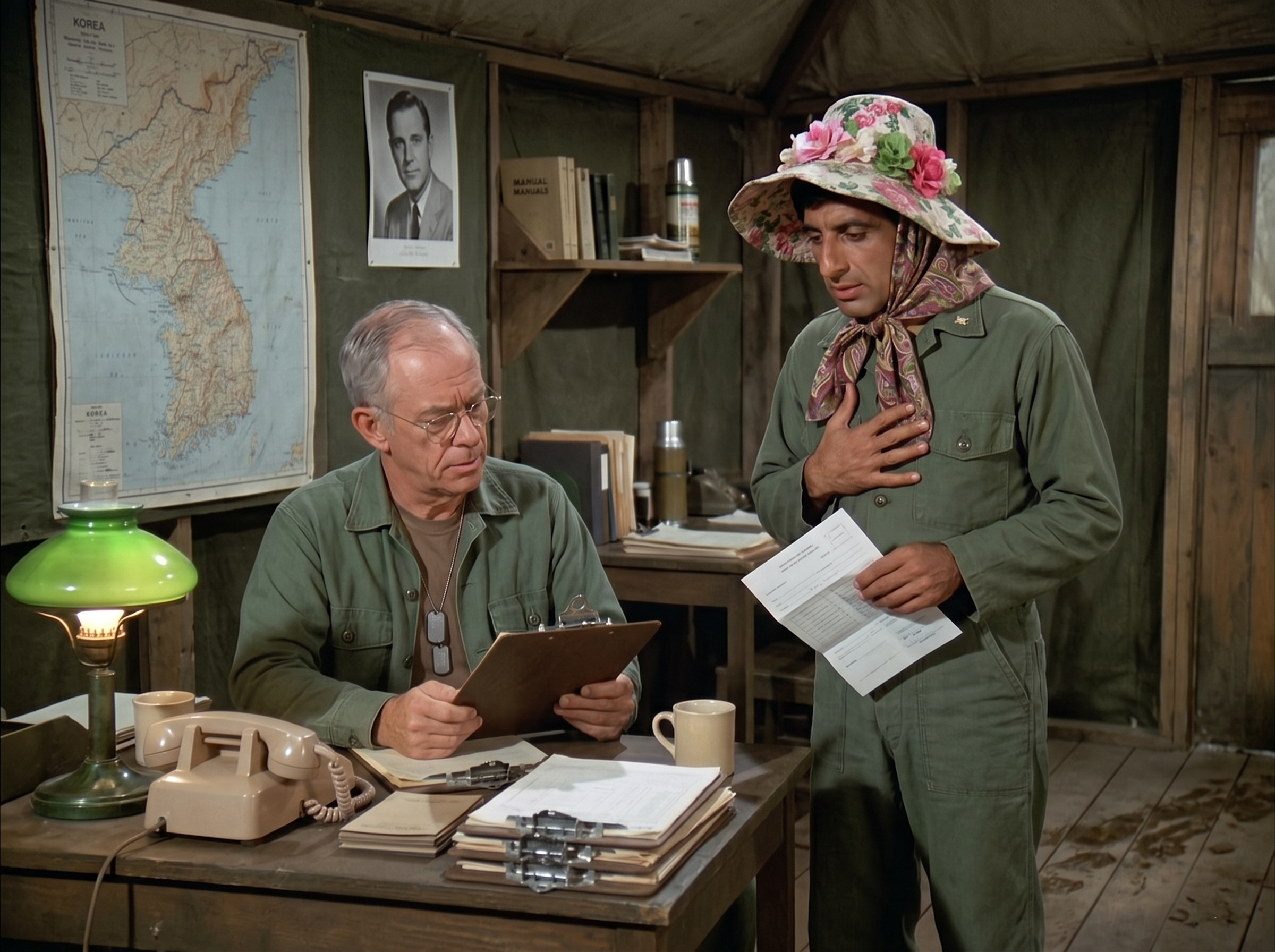
The afternoon sun was doing its best to turn the colonel’s office into a kiln, but the air inside held that specific, stagnant stillness that only happens when the war has decided to take a lunch break. Colonel Potter sat behind his desk, the familiar green lamp casting a soft, jaundiced glow over the paperwork that seemed to breed in the dark corners of the tent. He was halfway through a requisition form, his brow furrowed with the kind of practiced annoyance that usually meant the supply lines were failing again.
Then, the flap of the tent parted, and the sanity of the day officially went out the window.
Max Klinger didn’t just walk in; he made an entrance. He was sporting a floral-patterned straw hat, a masterpiece of artificial roses and daisies that looked like it had been salvaged from a very optimistic garden party. A silk scarf was tied snugly beneath his chin, framing a face that carried a look of such exaggerated, tragic intensity that it bordered on performance art.
“Colonel,” Klinger sighed, his hand pressed dramatically against his chest as if he were clutching a fragile heart. “I have come to you with a matter of the utmost urgency. My nerves are completely frayed, and the local fashion scene in the mess tent has become frankly intolerable.”
Potter didn’t even look up at first. He just sighed, a low, rumbling sound that spoke of a man who had seen everything from the trenches of the Argonne to the operating tables of Korea. He slowly lowered his clipboard, peering over the top of his spectacles with a gaze that was equal parts weary resignation and reluctant, hidden amusement.
“Klinger,” Potter rumbled, his voice steady as a heartbeat. “If that’s another section eight plea printed on the back of a grocery list, I’m going to personally see to it that you’re assigned to latrine duty until the next century.”
Klinger didn’t flinch. He just held out a piece of paper, his eyes wide and glistening with an almost performative tear. “It’s not a request for discharge, sir. It’s an invitation. And frankly, it’s a cry for help.”
The room went silent, the only sound the hum of the desk lamp and the distant, mocking chirp of a cricket. Potter took the paper, his jaw tightening as he scanned the lines, and his expression shifted from irritation to a genuine, bewildered frown. It was a letter—not from the Army, but from home—and as he read it, the color drained from his face, replaced by a sudden, sharp stillness that hit the room like a physical weight.
Potter stared at the paper. It wasn’t a bureaucratic disaster or a supply shortage. It was a letter from his wife, Mildred, describing a small, inconsequential joy—a garden party she was attending—that somehow felt worlds away from the mud and the blood of their current reality. For a man who had spent his life surrounded by the machinery of war, the contrast was jarring, a sudden, blinding reminder of the life he was missing.
He looked up at Klinger. Klinger’s theatrics had vanished. The floral hat, the scarf, the absurd costume—suddenly, they didn’t look like a joke anymore. They looked like a shield. Klinger, in his own strange, persistent way, was trying to create something beautiful, something ridiculous, something *human* in a place that tried its best to strip that away.
Potter’s grip on the clipboard loosened. “Klinger,” he said, his voice dropping into a register so quiet it almost vanished. “Did you really think I wouldn’t recognize that handwriting?”
Klinger swallowed hard, his hand slowly falling away from his chest. The bravado left his shoulders, and for a fleeting second, he was just a kid from Toledo, tired and scared and miles from home. “I… I thought maybe it would make you smile, sir. You’ve been staring at those reports for three days. You looked like you were turning into one of the files.”
Potter looked at the hat again—the gaudy, ridiculous flowers. A slow, genuine smile tugged at the corner of his mouth, the kind that crinkled the skin around his eyes. He reached up and adjusted his own glasses, feeling the familiar, grounding weight of his uniform. The absurdity of the situation didn’t make him angry; it made him feel remarkably, achingly alive.
“It’s a terrible hat, Klinger,” Potter said, his voice raspy with a sudden, unexpected emotion. “The flowers are all wrong, and the scarf makes you look like a grandmother at a funeral.”
Klinger’s face flushed, but a small, sheepish grin broke through. “I was going for ‘daring Parisian tourist,’ sir.”
“You missed,” Potter chuckled, leaning back in his chair. The tension that had held the tent hostage for the last few minutes evaporated, replaced by the quiet, heavy warmth of two men who understood that keeping your sanity was a full-time job. “But I’ll tell you what. If you keep that hat out of the O.R., I might just let you borrow my favorite fishing magazine.”
Klinger beamed, the relief so palpable it was almost a physical thing. He gave a sharp, snappy salute that didn’t quite belong in the 4077th, but felt entirely right for that precise moment. He turned, the silk scarf fluttering behind him as he headed for the door, leaving the colonel alone again with his paperwork.
Potter sat for a long time, listening to the sounds of the camp outside—the distant laughter, the rumble of a jeep, the low murmurs of tired men and women finding their own ways to survive. He picked up his pen, looked at the letter from Mildred, and then back at the door where the madman in the flower hat had disappeared. He didn’t feel quite so tired anymore.
Sometimes, all you need to win the war is a little bit of nonsense to keep the heart from going cold.