A Notice on the Signpost
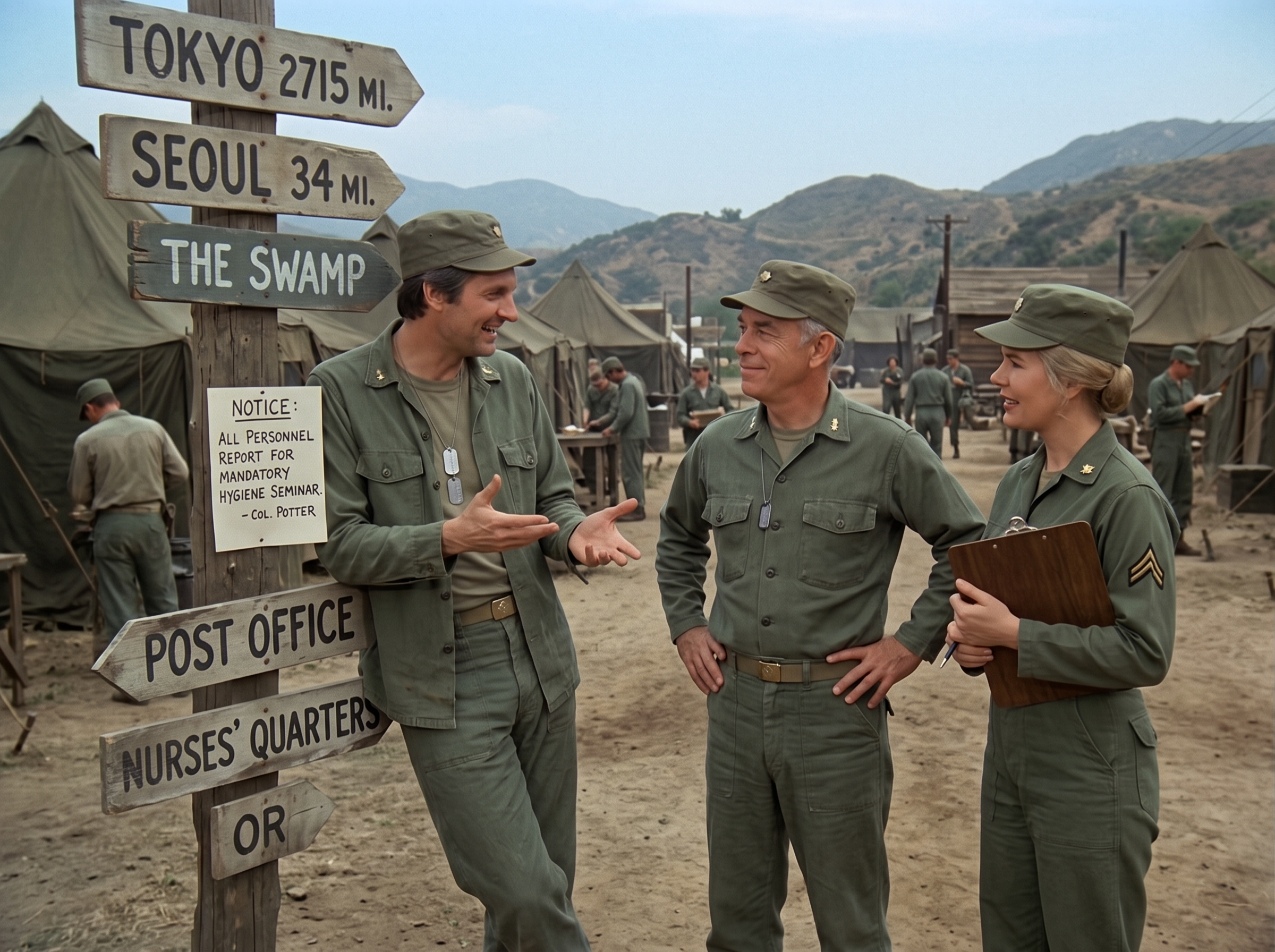
The dust around the 4077th signpost always seemed thicker in the mornings, as if it settled overnight just to remind them where they were. On this particular humid Tuesday, three figures were gathered near the familiar cluster of wooden arrows pointing towards Seoul, Tokyo, and “The Swamp,” each engrossed in the latest piece of white paper tacked to the bulletin board.
B.J. Hunnicutt, looking tall even while leaning casually against the worn wooden signpost, squinted behind his sunglasses at the freshly posted notice. He adjusted his fatigue cap, his usual easy smile slightly shadowed by the content he was reading.
Colonel Potter stood centrally, hands planted firmly on his hips, a posture that signaled both authority and a certain seasoned weariness. He was reading the notice for what was likely the tenth time that morning, his expression stern, his jaw set.
To his right stood Margaret Houlihan, immaculate as always in her fatigues despite the heat. She held her clipboard tightly, her stylus poised, her gaze fixed on the paper with professional focus, yet her expression held a trace of defensive annoyance.
The notice itself, typed neatly on standard Army issue paper, was simple enough, yet in the context of their endless rotation of shifts, it felt like an added weight. It was a new directive from I-Corps, demanding a weekly, detailed “Morale and Efficiency Report” from all medical officers, including narrative accounts of “positive interactions and streamlined procedures.“
“Narrative accounts?” B.J. muttered, his voice dry. “I thought our narrative accounts were usually delivered over the O.R. table while dodging bone fragments.“
Colonel Potter sighed, a sound that seemed to carry the weight of command and personal exhaustion. “Hunnicutt, it’s a directive. We comply, we file, we forget. That’s how the Army works.“
“Comply and forget,” B.J. repeated, pushing off the signpost. “Sounds like a winning strategy for sanity around here. What positive interaction should I document first? The time Frank almost stitched his own glove to a patient’s appendix?“
“Captain,” Margaret cut in, her tone sharp but weary, “this is about maintaining standards. If I-Corps wants documentation on morale, we provide it. Efficiency is the backbone of this unit.“
B.J. gave her a knowing look that she pointedly ignored. “Efficiency? I haven’t slept in thirty-six hours, and neither have you, Margaret. This isn’t efficiency; it’s paperwork designed by someone sitting in an air-conditioned office in Tokyo.“
Potter rubbed his temple. “It doesn’t matter who designed it. We do it because we have to. It’s the order.“
“An order to document morale when we’re all running on coffee and hope,” B.J. countered, his wit softening but his point remaining sharp. “It feels a bit like being asked to write a review of the mud.“
The compound around them was busy; nurses and corpsmen moved between tents, jeeps rumbled in the distance, and the distant sound of the generator hummed—a constant backdrop to their lives. They were all tired, deeply tired, but this small bureaucratic addition felt like an unnecessary poke.
A moment of quiet understanding stretched between them. The humor was there, as it always was with B.J., but it was grounded in a shared exhaustion. Potter didn’t smile, but his rigid posture eased slightly. Margaret’s grip on her clipboard didn’t loosen, but she looked down at the paper with a different kind of focus.
Part 1 ended on this silent acknowledgment—a shared breath in the endless sprint, where the absurdity of administrative demands briefly brought three weary souls a little closer together.
“You know, Colonel,” B.J. began again, his voice lower, the edge of sarcasm replaced by a quiet fatigue. “Last night in the O.R., after we lost that young corporal…” He trailed off, looking out towards the helicopter pad.
Potter turned slightly, waiting.
“…I remember Klinger handing me a cup of the hottest, muddiest coffee I’ve ever had,” B.J. continued, a small, genuine smile finally breaking through. “He didn’t say anything. Just pressed it into my hand and nodded. For a minute, it was the best thing I’d ever tasted. Does that count as a positive interaction? Or streamlined morale?“
Potter’s face softened significantly. The fatherly warmth that defined his leadership, even behind the regulations, was now visible. “It counts for more than any report I’ll ever sign, son. That’s for sure.“
Margaret looked up from her clipboard, her usual defensive demeanor momentarily lowered. She hadn’t expected B.J. to offer vulnerability instead of a joke. She cleared her throat slightly. “I supposed I could… document the extra shifts the nurses have been picking up without complaint. Or the way Father Mulcahy always seems to have a kind word just when someone needs it.“
She looked at B.J. and then at Potter, and for a fleeting second, the strict Major Houlihan faded, replaced by the woman who deeply cared for her staff and the people she worked alongside. She quickly resumed her professional stance, but the moment had been shared.
“Good ideas, Margaret,” Potter said, nodding gently. “You see, Hunnicutt? We can find things. We have to. Otherwise, this whole thing…” He gestured vaguely towards the compound, “…this whole thing gets too much to carry alone.“
He patted B.J. on the shoulder—a brief, reassuring touch. “I-Corps wants their narrative accounts? Fine. We’ll give them narratives about dedication and teamwork and…” He paused, catching B.J.’s eye again, “…and the occasional decent cup of coffee.“
B.J. smiled, a weary but comforted smile that matched Potter’s quiet resilience. “Yes, sir. And maybe about the morale-boosting effects of watching Frank try to fill out a narrative report about his morale.“
A genuine, brief chuckle escaped Colonel Potter—a rare sound that always seemed to momentarily lift the tension in the area. Margaret even allowed herself a small, fleeting smile, shaking her head as she looked down at her clipboard, already beginning to jot down her notes.
They were still in Korea. Still tired. Still facing the same relentless challenges. The notice was still tacked to the signpost, and the bureaucratic report still had to be filed. But the small moment of shared weariness, memory, and wry humor had shifted something.
The signpost with its arrows pointing across the world stood behind them, a symbol of how far they were from home, yet the connection they felt in this dusty compound was undeniable.
Slowly, B.J. turned, adjusting his sunglasses, and began to head back towards The Swamp, perhaps to attempt a few minutes of rest. Margaret clicked her stylus and nodded to the Colonel before marching efficiently towards her office tent. Potter took one last look at the signpost before turning and heading towards his own office, a slightly steadier pace in his step.
They were a found family, bound together not by choice but by circumstance, supporting each other with humor, empathy, and the quiet understanding that they were the only ones who truly knew what it was like to be here, together, under the shadow of the signpost in the dust of the 4077th.
The reports were just paper, but the connection was real.