The Extra Stitch in the Standard Issue
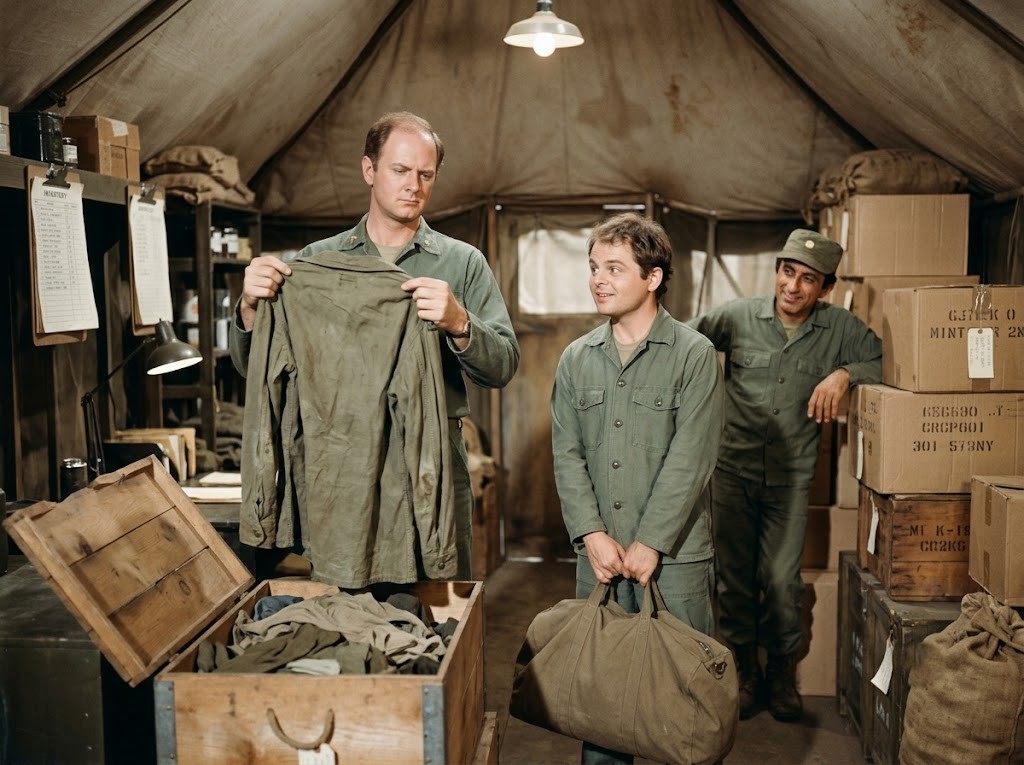
Supply Tent 4077 was always a place where the war smelled like stale canvas, damp cardboard, and the faint, sweet scent of Klinger’s stolen lavender soap.
Outside, the Korean wind was picking up, rattling the ropes and bringing with it the distant, low rumble of artillery that nobody talked about but everybody heard. Inside, the lightbulb swung gently on its cord, casting long, tired shadows across the rows of wooden crates.
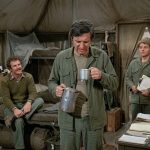
Charles Emerson Winchester III held the olive-drab fatigue jacket by its shoulders as if he were inspecting a soiled rag found in a Boston alley. His fingers, usually so precise on a scalpel or a piano keyboard, pinched the rough fabric with unmistakable disdain.
“Radar,” Charles sighed, his aristocratic voice dripping with a mixture of exhaustion and profound disappointment. “I requested a replacement uniform, not a relic from the Great War. This garment appears to have survived an encounter with an exceptionally angry badger.”
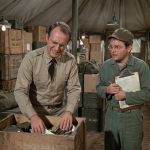
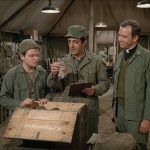
Radar stood a few feet away, clutching his canvas duffel bag like a shield, his knuckles white against the strap. His oversized glasses reflected the dim light, and a small, hopeful smile tugged at the corner of his mouth, though his eyes remained anxious.
“It’s the last medium we have in the crate, Major,” Radar said, his voice dropping to that earnest, boyish pitch that usually disarmed everyone from privates to generals. “I dug all the way to the bottom. Corporal Klinger even helped me check the back supply bunker, but the bugs got to the rest of them.”
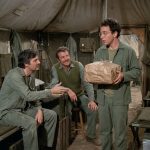
In the background, leaning casually against a towering stack of cardboard boxes, Klinger watched the exchange with a knowing grin. Still in his olive-drab utility shirt, a stark contrast to his usual vibrant afternoon ensembles, Klinger found a rare moment of comfort in the sheer predictability of Charles’s outrage.
“He’s right, Doc,” Klinger chimed in, crossing his arms and shifting his weight. “That jacket’s got character. Think of it as a custom vintage piece from the Maison de Swamp. Very exclusive.”
Charles didn’t laugh; his jaw tightened as he pointed a manicured finger at a jagged, poorly mended tear near the left pocket. “Character, Corporal, is achieved through intellect and pedigree, not through substandard stitching and what appears to be a dried gravy stain from the winter of 1951.”
He shook the jacket out, a small cloud of supply-room dust rising into the air, causing Radar to blink rapidly. Charles looked closer at the collar, his eyes narrowing as he noticed something that made his sarcastic commentary suddenly freeze in his throat.
The room went completely quiet, the dry humor evaporating in an instant as Charles stared at the faded black ink stamped inside the collar, his chest tightening with a sudden, suffocating realization.
Radar noticed the change immediately, his small-town intuition acting long before Charles could mask his expression. The Major’s hand began to tremble slightly, the heavy fabric of the jacket suddenly feeling much heavier than it had a moment before.
“Major?” Radar asked softly, taking half a step forward, the duffel bag lowering to his side. “Is something wrong with it? I can… I can try to find some soap and scrub that spot out myself if you want.”
Charles didn’t answer right away; he slowly turned the collar over, his thumb tracing the faded, stenciled name that was barely legible beneath the years of dust and wear. It read: *Winchester, C. E. II.*
Klinger pushed himself off the crates, his smirk vanishing as he walked over to stand beside Radar, the two of them looking at the aristocratic surgeon who had suddenly gone as still as a statue.
“Charles?” Klinger asked, his voice losing its theatrical edge, replaced by the genuine warmth of a man who had seen too many people break down in the middle of nowhere.
“It belonged to my brother,” Charles whispered, the Boston grandiosity completely drained from his voice, leaving it thin, fragile, and utterly human. “Colin. He was deployed during the initial push… before they realized one Winchester in a combat zone was more than enough for our mother’s heart to bear.”
He held the jacket closer now, no longer disgusted by the rough material, his fingers feeling the jagged, hand-stitched repair near the pocket. “He wrote to me about this. He tore it on a piece of shrapnel while loading an ambulance. He said he mended it himself with a curved suture needle he stole from a field kit.”
Radar looked at the jacket, then up at Charles, his eyes filling with that deep, boundless empathy that kept the 4077th from falling apart. “He made it back home, didn’t he, Major?”
“Yes,” Charles said quietly, his eyes fixed on the clumsy stitches. “He returned to Boston. But a piece of him… a piece of him always stayed over here. I never understood what he meant by that. Not until I arrived at this wretched station.”
The three men stood in the dim light of the supply tent, surrounded by the cold realities of a forgotten war, yet bound together by a single piece of olive-drab cloth. Klinger reached out, his hand gently resting on Charles’s shoulder for just a second—a gesture of solidarity from one tired soldier to another.
“Looks like it found its way to the person who needed it most,” Klinger said softly, before turning to walk back toward the tent flap, giving the Major his privacy.
Charles looked down at Radar, the young clerk still standing there, waiting anxiously to see if the world was going to be alright. A rare, genuine smile broke through Charles’s stern countenance, softening the lines of fatigue etched deep into his face.
“Thank you, Walter,” Charles said, using Radar’s real name with a quiet reverence that made the kid’s shoulders relax. “The fit, I believe, will be absolutely perfect.”
In the quiet corners of the 4077th, even the most stubborn hearts found that the threads of family were woven deepest in the places we least expected to find them.