The Symphony of the Swamp
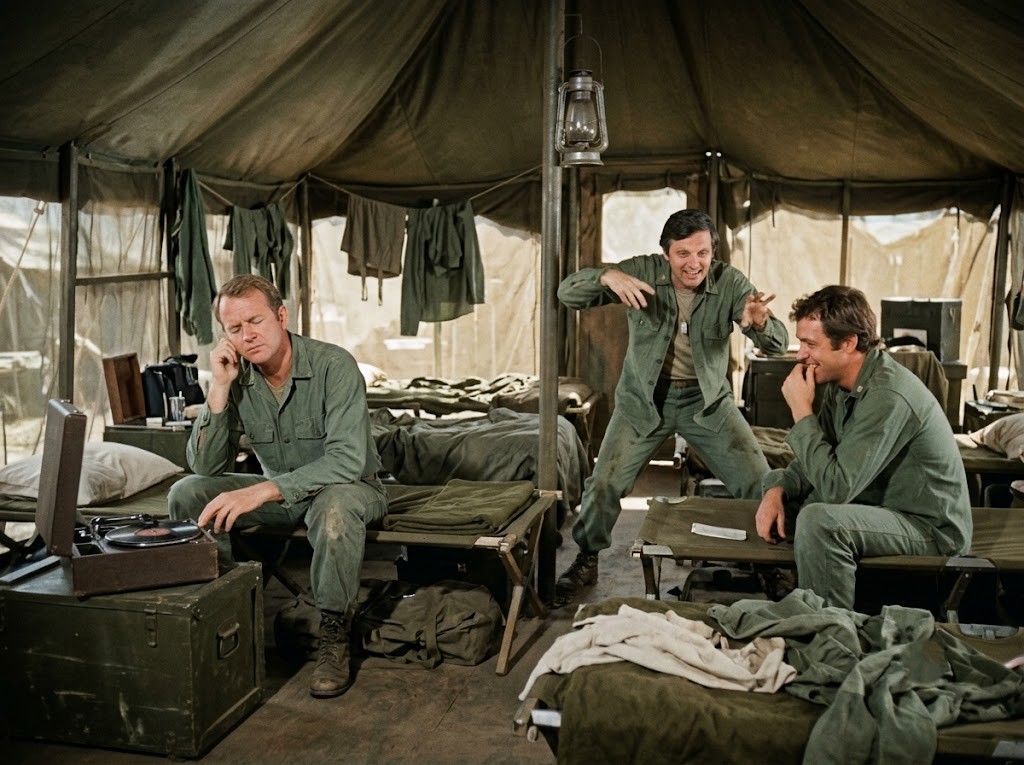
The mud in Korea has a way of sticking to your soul long after you scrape it off your boots. Inside the canvas walls of the Swamp, the only shield we had against the endless hum of generators and distant artillery was whatever piece of home we could cling to. For Major Charles Emerson Winchester III, that shield was made of black vinyl and spun at precisely seventy-eight revolutions per minute.
It had been a brutal thirty-six hours in the Operating Room. The kind of shift that leaves your surgical gown stiff with dried blood, your lower back aching like an old rusty hinge, and your mind spinning in dark, exhausting circles. We had all crawled back to our respective cots, desperate for a few hours of oblivion before the next batch of choppers arrived.
But Charles, as stubborn as the Boston aristocracy that bred him, refused to simply sleep. He had unboxed his prized portable phonograph, carefully setting it atop a green army footlocker. With his eyes clamped shut and one hand pressed tightly over his ear, he leaned in toward the tiny speaker, trying to drown out the harsh reality of Uijongbu with the elegant, orderly notes of Mozart. He looked like a man trying to protect a flickering candle in the middle of a typhoon.
Behind his back, the spirit of the 4077th was operating on a completely different frequency.
Hawkeye Pierce, fueled by sheer sleep deprivation and a manic need to break the heavy silence, was creeping up like a theatrical, green-clad monster. He raised his hands into claws, pulling a wild, exaggerated face, silently mocking the grand nobility of Charles’s classical sanctuary. Sitting on the adjacent cot, B.J. Hunnicutt watched the spectacle, a tired but genuine grin spreading across his face, his hand lifting to catch a chuckle before it could disrupt the maestro.
For a moment, it was classic Swamp diplomacy—pure, ridiculous nonsense designed to keep the dark thoughts at bay. Hawkeye lunged a fraction closer, his fingers dancing in the air as if playing an invisible, chaotic piano over Charles’s shoulder. B.J. let out a quiet, stifled snort, waiting for Charles to inevitably turn around and unleash a booming, aristocratic lecture on their utter lack of culture.
But Charles didn’t turn around.
Instead, as the record reached a quiet transition in the music, a sudden, heavy tremor shook the ground from a distant shelling. The delicate arm of the phonograph skipped violently, dragging the needle across the vinyl with a harsh, agonizing screech that shattered the melody entirely.
Charles didn’t yell. He didn’t explode in anger. He simply kept his eyes shut, his hand still pressed to his ear, but his shoulders suddenly slumped forward in a wave of absolute, crushing defeat. A single, quiet breath escaped him, sounding less like the proud Major Winchester and more like a lost man who had finally run out of hiding places. The laughter in the room died instantly, the joke freezing in mid-air as Hawkeye froze in his tracks, his hands slowly lowering as he realized this wasn’t just another day of teasing the high-born Bostonian.
—
The silence that followed the scratching of that needle was louder than any joke Hawkeye could have cracked. The manic energy drained from the tent, leaving only the heavy, humid air and the stark reality of three exhausted doctors trapped in a canvas box half a world away from home.
Hawkeye dropped his hands completely, the goofy grin vanishing from his face, replaced by a look of quiet concern. He glanced at B.J., whose smile had completely faded. B.J. sat up a little straighter on his cot, his eyes fixed on the slumped shoulders of the man who usually carried himself with the posture of a king.
“Charles?” Hawkeye asked softly, his voice stripping away the usual layer of dry wit.
Charles didn’t move for a long moment. His hand slowly dropped from his ear, resting heavily on his knee. He looked down at the ruined record, the scratch glaring back at him under the dim light of the hanging lantern.
“It was a gift,” Charles said, his voice unusually quiet, devoid of its theatrical pomp. “From my sister, Honoria. She sent it to arrive for my birthday. It took three months to get through the postal service.”
He finally opened his eyes, staring blankly at the spinning, silent turntable. “I thought… if I could just hear the allegro clearly, just once, I could pretend for five minutes that I was sitting in the Symphony Hall in Boston. I could pretend that the air didn’t smell of ether and damp earth.”
B.J. swung his legs over the side of his cot, leaning forward. “We’re sorry, Charles. We didn’t mean to—”
“No, Hunnicutt,” Charles interrupted, waving a dismissive, tired hand. “Do not apologize. You did not cause the artillery to shake the earth. You did not cause this miserable, God-forsaken peninsula to exist. You were merely being your usual, juvenile selves.”
He stood up slowly, his joints popping, and began to carefully lift the arm of the phonograph. The vulnerability was being locked away again, the aristocratic armor sliding back into place, but the cracks were still visible.
Hawkeye stepped forward, crossing the small space between their cots. He looked at the scratched record, then at Charles’s tired, weathered face.
“You know,” Hawkeye said, his tone shifting into that gentle, grounded warmth he usually reserved for patients in the post-op ward, “Mozart is good. Don’t get me wrong. The guy knew his way around a harpsichord. But he never had to perform an emergency anastomosis while the sky was falling.”
Charles offered a faint, cynical smirk. “Your appreciation for the finer arts remains profoundly underdeveloped, Pierce.”
“Maybe,” Hawkeye smiled softly. “But I do know a thing or two about making things work when they’re broken.”
Hawkeye reached over, gently taking the record from Charles’s hands. He inspected the scratch, running a thumb over the groove. He looked over at B.J. with a knowing nod. B.J. instantly understood, reaching under his cot to pull out a small roll of medical tape and a fine-tipped antiseptic swab.
“It won’t ever play perfectly again, Charles,” B.J. said quietly, walking over to join them around the footlocker. “But if we clean out the shaving from the scratch, the needle might just skip past it without ruining the rest of the movement.”
Charles watched them, his skeptical brow furrowing, but he didn’t stop them. He sat back down on his cot, watching as Hawkeye carefully cleaned the groove and B.J. used his surgical precision to smooth out the microscopic edge of the vinyl scratch.
For a few minutes, the three surgeons of the 4077th weren’t fighting a war, arguing over politics, or pulling pranks. They were just three tired men, huddled around a battered piece of home, using the same hands that saved lives to save a piece of music.
“Alright, Maestro,” Hawkeye said, gently placing the record back on the turntable. “Give it a spin.”
Charles hesitated, then clicked the switch. The turntable began to rotate. He carefully lowered the needle.
The music began again, filling the tent with its sweet, familiar cadence. As the song approached the damaged section, all three men held their breath. The needle reached the scratch. There was a sharp, brief *pop*—a sudden, imperfect hitch in the rhythm—but then, the melody pushed forward, continuing its beautiful, stubborn climb.
Charles closed his eyes again, a soft, genuine smile touching the corners of his mouth. He didn’t put his hand over his ear this time. He just listened to the music, imperfect and scarred, yet somehow entirely beautiful.
Hawkeye walked back to his cot, catching B.J.’s eye. They both lay back down, pulling their olive-drab blankets up to their chins. The music drifted through the Swamp, out past the flaps of the tent, and into the dark Korean night, a small, fragile reminder that even in the midst of madness, humanity always finds a way to play on.
Beneath the jokes and the exhaustion of the 4077th, we always managed to find our own kind of harmony.