The Weight of the Paper Trail
Some days, the war didn’t arrive in green helicopters or on blood-stained stretchers. Sometimes, it crawled into the 4077th on the back of a supply truck, disguised as a mountain of official correspondence.
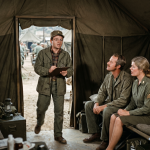
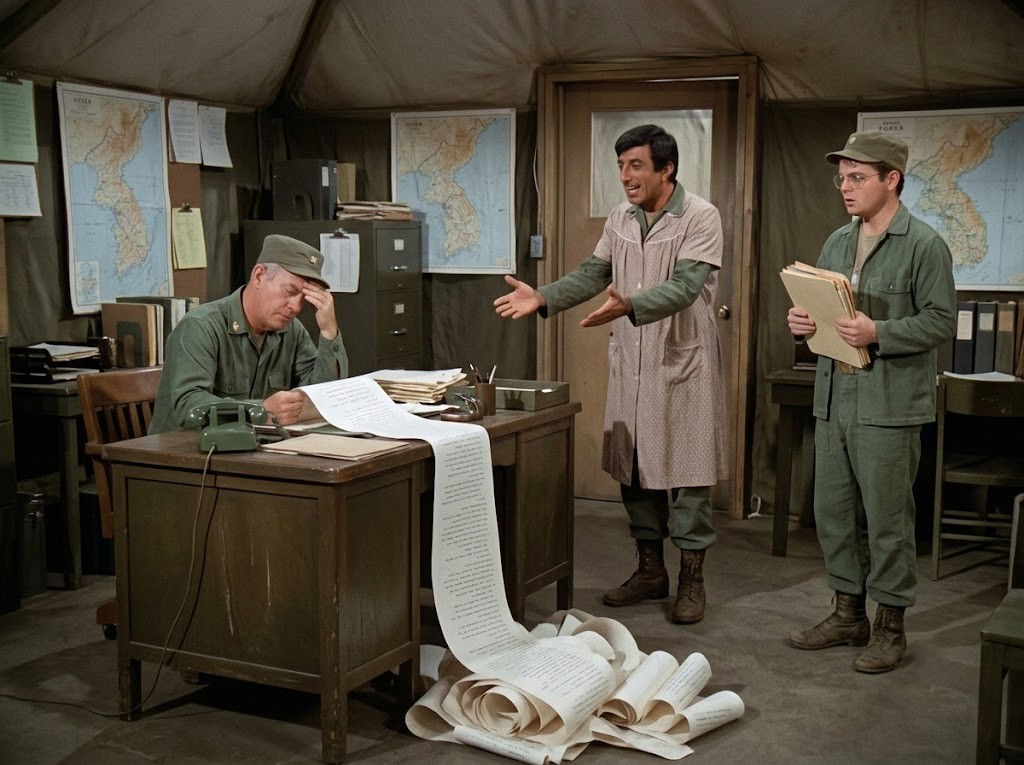
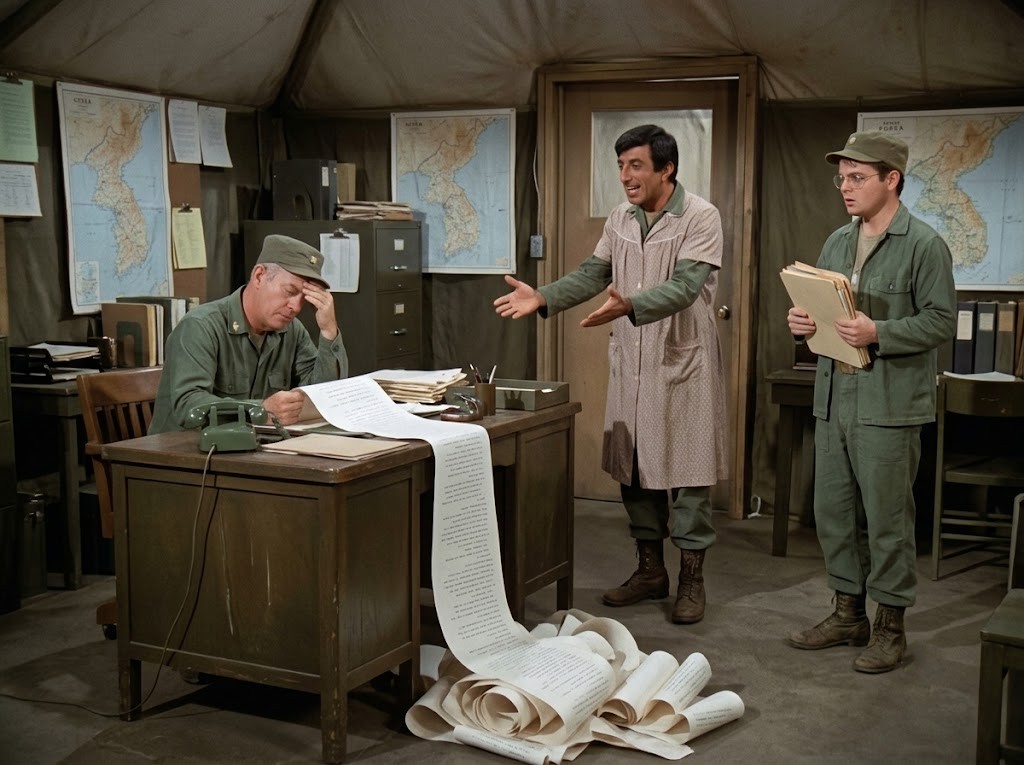
Colonel Potter rubbed his temples, his eyes pinned to the endless stream of white paper pooling onto the floor of his office. The teletype machine had been humming like a mechanical cicada since dawn, spitting out a directive that seemed to have no beginning and no foreseeable end.
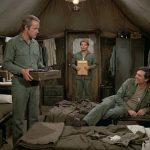
Beside the desk, Corporal Radar O’Reilly stood at attention, his small hands clutching an armload of manila folders like a shield against the incoming bureaucracy. His glasses caught the dim light of the tent, his wide eyes shifting nervously between the long scroll of paper and the mounting frustration on his commander’s face.
Then there was Klinger.
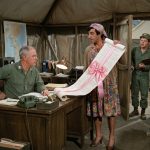
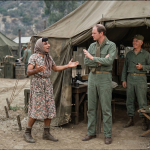
Standing in the center of the office, Klinger gestured with wide, theatrical swings of his arms, his floral-patterned housecoat swaying gently over his olive-drab trousers and heavy combat boots. His face was a picture of desperate earnestness, his dark eyes pleading for a sanity that the army standard operating procedure simply could not provide.
“Colonel, I swear to you on my mother’s stuffed grape leaves, it’s all right there in paragraph four, subsection B,” Klinger pleaded, his voice ringing with the passion of a defense attorney making a final appeal. “They are denying my hardship discharge based on a clerical error made in Tokyo by a man who has clearly never seen a mortar shell or a dress pattern!”
Potter didn’t look up immediately. He just let his hand slide down his face, his fingers catching on the stubble of a long, sleepless week. The map of Korea hung on the canvas wall behind him, a reminder of the frozen reality just outside their door, while inside, they were drowning in ink.
“Klinger,” Potter sighed, his voice carrying the dry, gravelly weight of a man who had survived three separate wars and countless regular army regulations. “According to this teletype, the entire Far East Command is currently short on three things: penicillin, clean socks, and patience. My supply of the third just hit zero.”
“But Colonel!” Klinger took a step forward, his hands extended as if trying to physically catch the sympathy slipping away from the room. “Look at the length of that thing! It’s an epic poem of administrative denial! They spent more paper telling me ‘no’ than it took to draft the Magna Carta!”
Radar shifted his weight, the folders in his arms crinkling softly. “Sir,” he whispered, his voice cracking slightly with its usual youthful anxiety. “Tokyo says if we don’t file the triplicates for the missing tongue depressors by nineteen-hundred hours, they’re going to withhold the next shipment of canned peaches.”
Potter’s hand remained pressed against his forehead, a barrier between himself and the absurd theater of the situation. The paper kept spilling over the edge of the mahogany desk, curling into a chaotic white nest at their feet, a physical manifestation of a system that felt completely detached from the lives it governed.
The silence in the tent grew heavy, punctuated only by the distant, rhythmic thud of artillery in the hills—a grim reminder of why they were all there in the first place, and how little the paperwork actually mattered to the boys on the line.
Potter finally dropped his hand, looking at the long white scroll, then at Radar’s anxious face, and finally at Klinger, who stood frozen in mid-gesture, waiting for the axe to fall.
The colonel let out a long, slow breath that sounded less like anger and more like the profound exhaustion of a father trying to keep his family safe in a storm.
“Radar,” Potter said quietly, his tone shifting from commander to counselor. “Tell Tokyo they can take their canned peaches and shove them directly into their strategic reserves. We’ll eat cream of wheat until the supply lines clear up.”
Radar blinked, a small, relieved smile tugging at the corner of his mouth. “Yes, sir. No peaches. Got it.”
Potter then turned his sharp, blue eyes onto Klinger. The theatrical outfit, the desperate plea, the sheer ridiculousness of a man in a housecoat arguing over military regulations in a combat zone—it was the kind of nonsense that would have had a regular army general reaching for a court-martial. But Potter had been at the 4077th long enough to see past the wardrobe.
He knew that Klinger’s dresses weren’t just a ticket out; they were a protest against the madness, a way to keep a piece of Toledo alive in a valley where young men came apart at the seams.
“Klinger,” Potter said, his voice softening just enough for the warmth to show through. “You think you’re the only one who looks at these forms and wants to scream? This army runs on paper, son. It uses it to cover up the mistakes, the delays, and the fact that we’re all stuck in a place we don’t belong.”
Klinger’s arms slowly dropped to his sides. The defensive posture melted away, leaving just a tired kid from Ohio who missed his family. He looked down at the scroll of paper piling around his boots.
“I just thought… maybe this time, sir,” Klinger muttered, his voice losing its dramatic edge, replaced by a quiet, vulnerable sincerity. “Maybe someone over there would read it and see a real person.”
“They don’t see people over there, Max. They see numbers,” Potter said, standing up from his desk and walking around to the front, stepping carefully over the white coil. He placed a firm, heavy hand on Klinger’s shoulder. “But we see you here. And right now, I need you whole, not discharged. I need you helping Radar clear this mess before the night shift comes in.”
Klinger looked at Potter, then at Radar, who gave a small, encouraging nod. The found family of the 4077th had a strange way of closing ranks when the weight of the outside world got too heavy. There was no discharge coming today, but there was a shared understanding, a quiet pact to survive the bureaucracy together.
“Yes, sir,” Klinger said softly, pulling the housecoat a little tighter around himself, a gesture that looked less like a performance and more like a comfort. “I’ll get the trash bin.”
“Good lad,” Potter said, returning to his chair. He looked at the map on the wall, then back to his desk, picking up a pen with a renewed, quiet resolve. “Radar, let’s start with the tongue depressors. Write them a letter that makes them cry.”
In a place where tomorrow was never promised, sometimes the greatest victory was simply surviving the absurdities of today together.