The Brightest Colors in the Olive Drab Desert
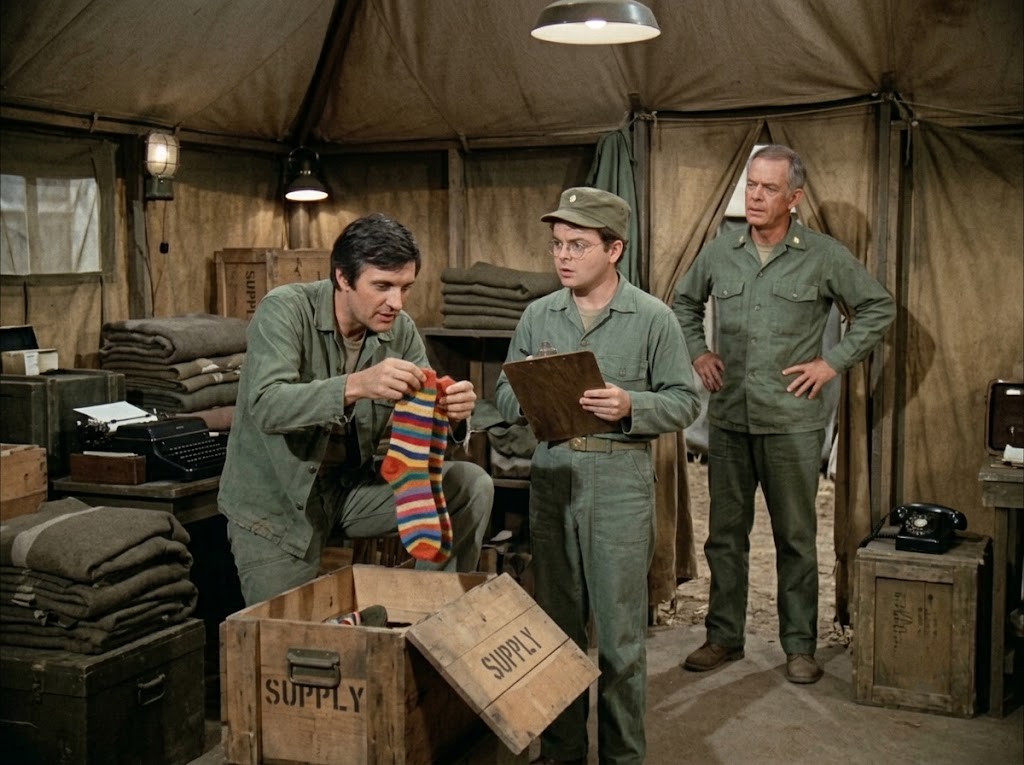
Some days in Korea didn’t just drain your body; they eroded your spirit. For three straight days, the rain had beaten against the canvas tents of the 4077th, turning the compound into a sea of thick, brown mud that sucked at your boots with every step. Inside the supply tent, the air smelled of damp wool, old paper, and the lingering chill of a winter that refused to pack its bags and go home.
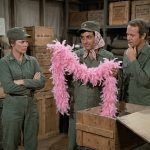
Hawkeye Pierce leaned over an open wooden supply crate, his shoulders slightly hunched from the exhaustion of a grueling twelve-hour shift in Post-Op. He had gone in looking for extra blankets to keep the shivering patients warm, but instead, his fingers wrapped around something entirely foreign to the United States Army.
With a slow, deliberate movement, Hawkeye pulled the object from the crate, holding it up to the dim light of the single overhead bulb.
It was a pair of hand-knitted woolen socks, vibrantly patterned with thick, cheerful stripes of red, blue, yellow, and orange. In a world where every single item was dyed a monotonous, crushing shade of olive drab, they looked like a small, captured rainbow.
“Well, look at this, Radar,” Hawkeye said, his voice carrying that familiar, dry cadence that always sought to poke a hole in the gloom. “The Pentagon has finally done it. They’ve launched a psychological warfare campaign against boredom. One look at these, and the enemy will surrender out of sheer aesthetic shock.”
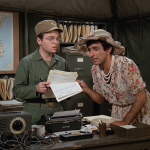
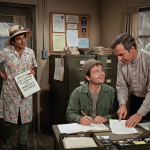
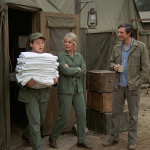
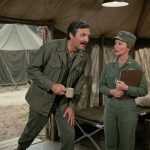
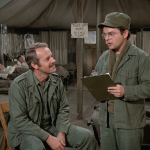
Radar O’Reilly stood right beside him, clutching his trusty wooden clipboard tightly against his chest. His oversized glasses reflected the lone lightbulb as he stared at the colorful socks, his face a perfect picture of earnest bewilderment. He shifted his weight, his eyes darting from the socks to his inventory sheets.
“Gee, Captain, I don’t know,” Radar murmured, checking his pen. “The manifest just says ‘M-1945 Woolen Hose, Olive Drab, Bulk Quantity.’ It doesn’t say anything about… well, looking like a box of melted crayons. If the Quartermaster finds out we accepted non-regulation hosiery, he’ll have my hide.”
“Relax, Radar,” Hawkeye chuckled, gently stretching the fabric between his hands. “These aren’t regulation. These have a soul. Feel that wool—it doesn’t feel like it was woven from repurposed steel wool and army discipline. Someone’s grandmother knitted these with love. Probably meant them for a cousin in Toledo who’s currently freezing his toes off in an office, while they ended up in a supply crate bound for the armpit of the world.”
From the shadows near the tent flap, Colonel Sherman Potter watched the exchange, his arms resting firmly on his hips. His seasoned, fatherly face was etched with a mixture of skepticism and deep, unspoken fatigue. He stepped forward into the light, his eyes locking onto the bright stripes hanging from Hawkeye’s hands.
“Pierce, what in the name of Sam Hill are you holding?” Potter asked, his voice a gravelly bark that carried years of cavalry authority, yet lacked any real venom. “We’re running a Mobile Army Surgical Hospital, not a traveling circus. Those things look loud enough to wake the dead.”
“They’re a medical necessity, Colonel,” Hawkeye countered instantly, turning to face his commanding officer without dropping the socks. “A visual tonic for the weary surgeon. I feel my morale rising just looking at them. In fact, I think my left foot is writing a poem about them right now.”
Potter walked closer, his boots clicking faintly on the floorboards. He looked at the crate, then at Radar, who looked like he wanted to swallow his clipboard to escape any impending reprimand. The tension in the room grew quiet, heavy with the weight of the endless war outside.
“Radar, check the crate again,” Potter ordered quietly, his demeanor shifting from dry amusement to sudden gravity. “Where did that box really come from?”
Radar scrambled, digging his hand deep into the wooden crate beneath the standard army blankets. His fingers brushed against something flat and paper-thin at the very bottom. He pulled it out, his face going pale as he read the handwriting on a torn, water-stained note.
“Colonel… Captain…” Radar whispered, his voice trembling slightly. “It’s not a supply mix-up. Look at the name on the bottom of the box.”
—
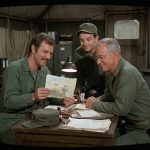
Hawkeye’s humor faded instantly, replaced by the sharp, protective focus he usually reserved for the operating table. He reached over and took the damp note from Radar’s shaking fingers, while Colonel Potter stepped in close, reading over his shoulder.
The handwriting was neat, written in faded blue ink that had started to bleed into the cheap paper. It was addressed to Private First Class Billy Jenkins, B Company, 3rd Battalion.
“Billy Jenkins,” Potter read aloud, his voice dropping into a low, somber register. “He was through here three nights ago. Shrapnel wound to the chest. We worked on him for four hours.”
The silence that followed was absolute, save for the rhythmic patter of the rain against the canvas overhead. Every man in that tent knew the name. They remembered the boy’s face—he couldn’t have been more than nineteen, with wide, terrified eyes that had stared up at the operating room lights, whispering about his mother’s kitchen back in Ohio. They had saved him, barely, before shipping him out to the evac hospital in Seoul.
“The note is from his mom,” Hawkeye said quietly, his voice devoid of any sarcasm now. He read the words aloud, his tone soft and steady. “‘*Dear Billy, I know how cold it gets over there in the winter. Your father says the Army provides everything, but I know they don’t provide a mother’s touch. I knitted these stripes so you could always find a little bit of home in the dark. Keep your feet warm, my sweet boy. Love, Mom.*'”
Radar looked down at his boots, swallowing hard. The innocent clerk who saw everything and felt everything too deeply was clearly struggling to keep his composure. “The box must have arrived at the supply depot just after he was moved, sir. They must have just thrown it into our truck with the rest of the blankets because the unit routing was confused.”
Potter took the note from Hawkeye, his thumb gently brushing over the ink. His stern expression softened into something deeply paternal, a look worn by a man who had seen too many boys sent away from home to fight in distant lands.
“She sent a whole box of them,” Potter murmured, looking down into the crate. Sure enough, beneath the top layer of green army-issue wool lay a dozen more pairs, each one uniquely colored, each one a vibrant, defiant strike against the drab reality of Korea. “She didn’t just knit them for Billy. She knitted enough for his whole squad.”
“But Billy’s in Seoul now,” Radar said, looking up with genuine concern. “And his squad is somewhere up near the line. What do we do with them, Colonel? We can’t send them back to Ohio. It’d break her heart.”
Hawkeye looked down at the socks in his hand. The bright red and yellow stripes seemed even more intense now, charged with the warmth of a kitchen thousands of miles away, a place where the air didn’t smell of ether and damp canvas.
“We don’t send them back,” Hawkeye said firmly. He looked at Potter, a silent understanding passing between the cynical doctor and the old soldier. “We use them. We give them to the kids in the ward who are waiting for the buses. The ones who think nobody remembers they’re freezing out here.”
Potter nodded slowly, a small, proud smile touching the corners of his mustache. “For once, Pierce, your medical opinion makes perfect sense. Corporal O’Reilly, adjust the inventory. Mark these down as… essential psychological therapy supplies.”
“Yes, sir!” Radar said, a sudden spark of joy returning to his eyes. He quickly scribbled on his clipboard, a wide grin breaking across his face. “Item: One box of mother’s love. Quantity: Unlimited.”
By the next morning, the rain had finally stopped, though the cold remained. In the pre-op ward, three young soldiers sitting on the edge of their cots, waiting for transport back to the states or further south, looked down at their feet in absolute wonder. Emerging from the bottoms of their standard-issue trousers were bright, ridiculous stripes of purple, green, orange, and blue.
Hawkeye walked through the ward with a tray of penicillin, a familiar grin back on his face. “Don’t let the MPs catch you,” he warned one smiling private. “Those socks are a clear violation of the Army’s strict policy against happiness.”
The young soldier laughed, the sound bright and healing in the crowded tent. He reached down, touching the thick wool, his eyes shining with a sudden, comforting warmth.
Later that afternoon, Potter stood outside his office, watching the transport bus pull away into the muddy road. Through the dusty back window of the bus, a row of colorful, striped socks was pressed playfully against the glass—a vibrant, absurd farewell from the boys heading home.
Potter took a deep breath of the crisp air, feeling the familiar, bittersweet ache that came with life at the 4077th. They couldn’t stop the war, and they couldn’t mend every broken heart. But sometimes, in the middle of the mud and the gray, they could hand a piece of home to a child who needed it most.
In a world made entirely of olive drab, it was the bright, handmade colors of home that kept us human.