The Line to O’Reilly’s Farm
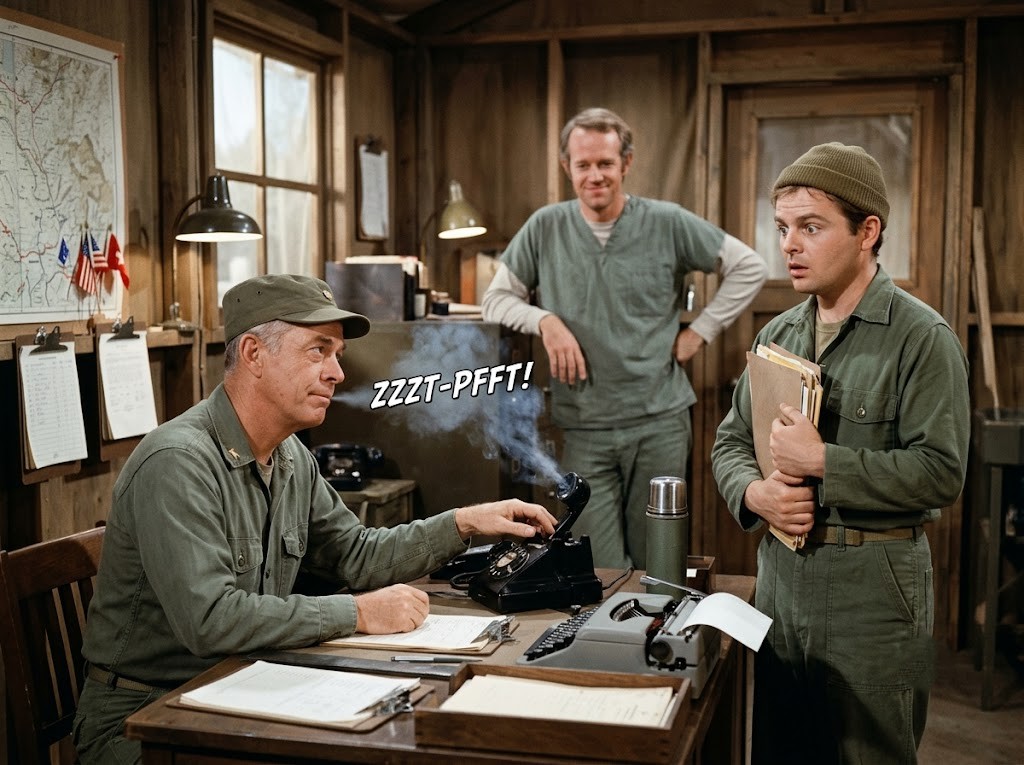
You didn’t expect perfection in the middle of a Korean muddy field, but you least expected the office itself to go up in smoke.
It was one of those rare, quiet Tuesday afternoons where the only casualties being treated in the M*A*S*H 4077th were paper cuts and mild dehydration.
The war had taken a breather, leaving us all with just our own tired humanity.
I was leaning against the doorframe of the Headquarters, arms folded over my fatigues, enjoying the absolute, pristine lack of gunfire.
In my mind, I was already a beer or three deep back in the Swamp, but something about this still, warm day kept me pinned right there.
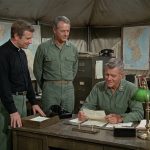
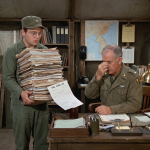
Colonel Potter was at his desk, where he always was, a rock against which the chaotic waves of 4077th life broke.
He was focused on some clipboard full of requisitions, his face set in that dry, capable expression that somehow made you believe everything would work out.
He reached for the black desk phone, probably trying to get through to Seoul about that shipment of proper surgical gloves we were short on.
Beside him, little Radar O’Reilly was standing there, the eternal sentry of paperwork.
His green beanie was pulled down tight, and he was clutching a thick bundle of medical files to his chest like they were gold bars.
Radar’s eyes, as they often were, were wide and expectant, watching the Colonel’s every move.
When Potter finally got a dial tone and brought the receiver to his ear, there wasn’t a human voice on the other end.
Instead, a loud, sharp *ZZZT-PFFT!* erupted from the earpiece, audible even to me in the doorway.
It sounded exactly like a short-circuiting appliance, and that’s when I noticed it.
A thin, grey curl of smoke—not from a cigar, mind you—started snaking out of the phone’s receiver.
Colonel Potter just sat there, the phone pressed to his ear, blinking once, slowly.
He looked less surprised than simply annoyed, as if the universe was just being difficult.
Radar’s expression was a masterpiece of distress.
His mouth was open, his face was pale, and he looked at the smoking phone as if it had personally betrayed him.
It was one of those moments that was funny because it was so mundane, and serious because everything in Korea was serious.
That smoking phone receiver, for a second, felt like a much bigger problem than the war itself.
It felt like a final insult, the little bit of infrastructure that couldn’t handle the strain of human effort.
And it left us all waiting for the next *zzzt* to make it entirely, and forever, dead.
Radar looked like he was about to drop every file he owned. “Colonel, the phone! It’s… it’s smoking!”
“So I perceive, Corporal,” Potter said, still holding it to his ear, a look of profound resignation on his face.
He carefully lowered the smoking receiver back onto the cradle, but the smoke wouldn’t stop.
A second later, the *ZZZT-PFFT!* sound happened again, softer this time, like the phone’s last gasp.
The entire office now smelled faintly of melting plastic and old dust.
The silence that followed was heavy, a complete vacuum where the buzz of bureaucracy should be.
This wasn’t just a broken phone; in Korea, it was our only link, our lifeline to everything outside this little, beleaguered camp.
It was how we ordered blood, how we asked for help, and sometimes, if you were lucky, how you got word from home.
Potter rubbed his temples with one hand. “Well, that’s that. The phone line to O’Reilly’s farm is officially out of order.”
“But Colonel,” Radar stammered, “I… I was supposed to call my mom. This morning.”
He looked genuinely devastated, the loss of his planned weekly check-in striking a deeper blow than any incoming casualty report.
I pushed off the doorway, the amusement drained from me, seeing the look on Radar’s face.
I put a hand on Radar’s shoulder. “Your mom knows you love her, Radar. Phone call or not. The farm will still be there tomorrow.”
The Colonel sat up straighter, the fatherly steadiness returning.
“Corporal,” Potter said, his voice quiet and firm, “get onto I-Corps. Tell ’em we need a signals unit yesterday. If they question you, tell ’em their own medical supply orders are going to be smokin’ in the wind if we don’t fix this.”
Radar nodded, the small sense of purpose settling his nerves. He carefully placed the armful of files onto a side table.
“I’ll… I’ll do that, Colonel,” Radar said, and for a fleeting moment, he looked almost brave.
He took one last look at the smoking, lifeless phone, and then he was gone out the door, moving with that Radar purpose.
Potter stared at the receiver, the smoke having finally petered out.
He was right, of course. Everything would have to wait. The gloves, the supply lists, the updates. The quiet was louder now, more fragile.
This tiny, mundane failure in the corner of a war zone didn’t change anything, but it changed everything about how our day would go.
It reminded us that we were held together not by great machinery, but by the smallest, weakest, human connections.
“Good man,” Potter muttered, more to himself than to me, referring to Radar.
I watched him reach for his pen, ready to fill out the paperwork about the non-working phone that required more paperwork.
Life, and the 4077th, would go on, one smoking receiver, and one letter home at a time.
Some connections just can’t be broken, even when the lines go dead.