The Red Tape and the Green Gown
The war had a funny way of hiding in the paperwork.
It was mid-afternoon at the 4077th, and the camp had fallen into that rare, fragile quiet that only comes after a marathon session in the OR. The kind of quiet where the only sounds were the flapping of the canvas tents in the Korean wind and the distant, lazy hum of a jeep engine.
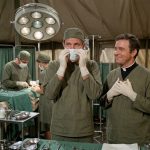
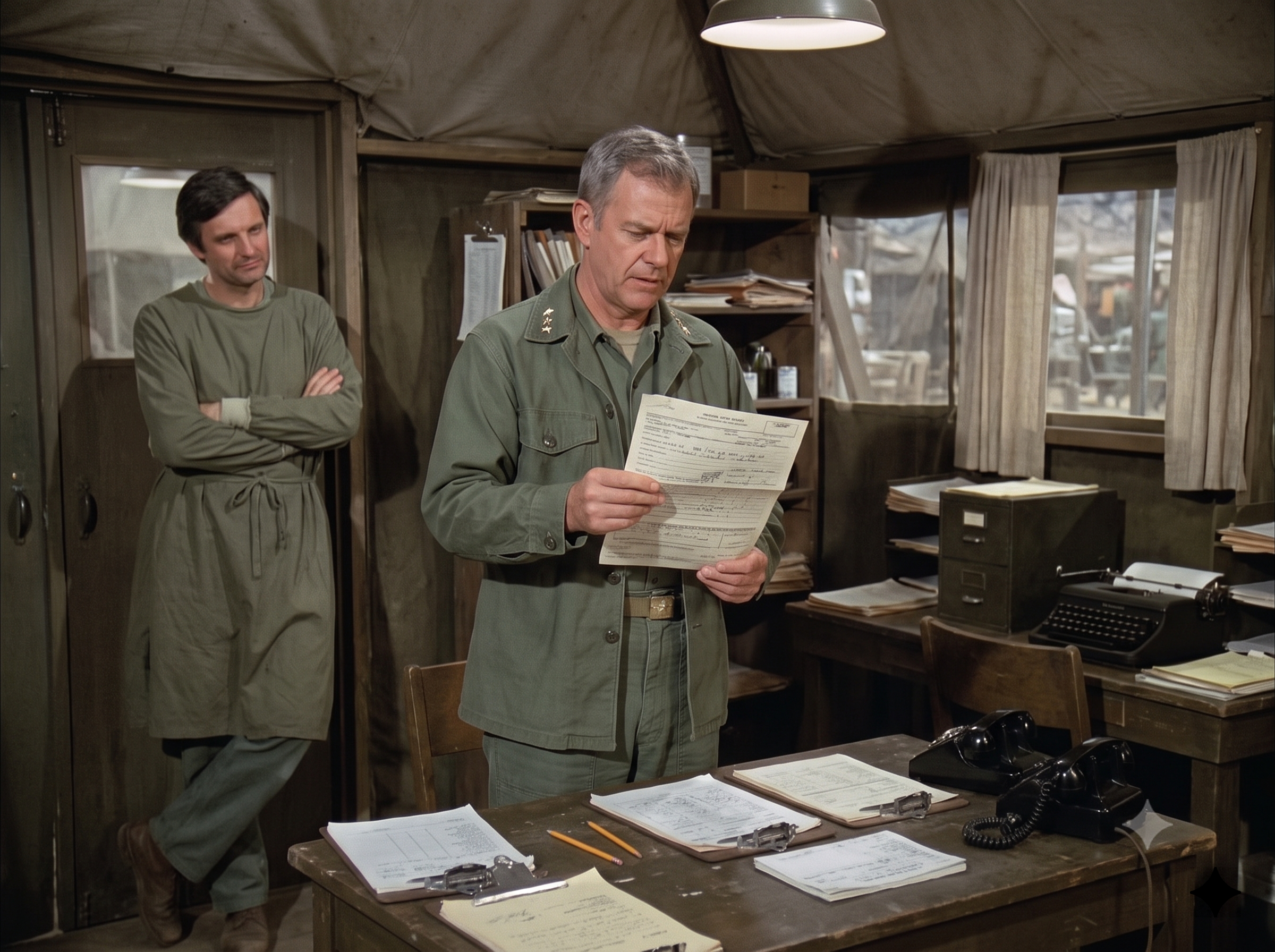
Hawkeye Pierce, still wearing his rumpled green surgical gown over his fatigues, wandered into the clerk’s office looking for a distraction, a cup of coffee, or perhaps just a place to stand that didn’t smell like ether. He didn’t find coffee. Instead, he found his commanding officer engaged in a bitter standoff with a piece of paper.
Colonel Sherman T. Potter stood in the dead center of the room, planted firmly on the wooden floorboards. In his hand, held out at arm’s length as if it might suddenly detonate, was a standard-issue, multi-carbon military requisition form.
Hawkeye stopped in the doorway. He didn’t say a word. He just leaned his shoulder casually against the wooden frame, crossed his arms over his chest, and watched. A sharp, highly amused smirk slowly spread across his exhausted face. There was nothing quite as entertaining to a drafted civilian as watching a Regular Army man hit the impenetrable brick wall of Army logic.
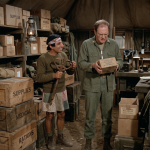
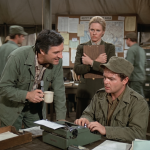
Behind the Colonel, the clerk’s desk was a familiar landscape of organized chaos. There was the heavy black field phone, stacks of manila folders, wooden clipboards holding the daily rosters, and the dark metal typewriter waiting patiently in the back. Radar O’Reilly was nowhere to be seen, likely off at the motor pool trying to trade three crates of creamed corn for a working radiator. That left the Colonel entirely alone to face the bureaucracy.
Potter’s face was a masterpiece of fatherly, dry exasperation. He squinted at the beige paper. He pulled it a few inches closer to his face. He pushed it back out again. His lips moved slightly, silently mouting the words on the page as if trying to force them to make sense through sheer willpower.
“Is it written in ancient Aramaic, Colonel?” Hawkeye finally asked, his voice low and laced with his trademark dry wit. “Or did the Pentagon just discover a new, highly classified alphabet?”
Potter didn’t jump. He didn’t even turn his head. He just kept his eyes glued to the paper, his voice rumbling out in a gravelly sigh.
“Pierce, I have been in this man’s army since horses were our primary mode of transportation,” Potter said slowly, his tone dripping with a tired disbelief. “I have read orders that were drafted in the mud, orders typed by men who were half-blind, and orders that were frankly hallucinated. But this… this piece of paper right here…”
Potter finally lowered the form, turning his head to look at Hawkeye with an expression of profound, soul-deep bewilderment.
“This,” Potter declared, his voice rising in dramatic disbelief, “is a direct insult to the English language, the United States military, and my own personal sanity.”
Hawkeye pushed himself off the doorframe, the smirk still dancing in his eyes as he took a few slow steps into the clerk’s area.
“Well, don’t keep me in suspense, Sherman,” Hawkeye said, gesturing vaguely at the paper. “What are we looking at? A declaration of war against our own mess tent? Because I’ll sign that one right now.”
Potter let out a sharp, humorless chuckle. “Worse. It’s a response from Quartermaster Command in Seoul. Three weeks ago, Radar filed a request for two dozen boxes of standard, sterile surgical gloves. You know, the things you people need so you don’t leave your fingerprints on some kid’s spleen.”
“I’m familiar with the concept,” Hawkeye nodded, his tone dropping a fraction of its sarcasm. “We’re down to our last three boxes. B.J. washed his last pair so many times they look like melted Swiss cheese.”
“Exactly,” Potter said, tapping the paper with his index finger. “So, I read this response expecting a delivery date. Instead, some desk-jockey captain down in supply has informed us that under the new directive 409-J, surgical gloves are no longer classified as medical supplies.”
Hawkeye stopped, his brow furrowing. “I’m sorry, what? What are they classified as?”
Potter took a deep breath, looking back down at the form. “According to this, they are now classified as ‘Apparel, Rubberized, Hand-Fitted, Sub-Category: Waterproofing.’ And to requisition them, I don’t need a medical sign-off. I need the signature of a Naval officer with the rank of Commander or higher, certifying that the 4077th is operating in a designated maritime flood zone.”
Silence hung in the busy, modest little office. The sheer, magnificent absurdity of the situation echoed off the tan canvas walls.
Hawkeye stared at the Colonel. The Colonel stared back.
Slowly, Hawkeye’s smirk faded, replaced by a soft, genuine laugh. It wasn’t a loud laugh, just a quiet, tired release of air. He looked down at the wooden floorboards, shaking his head. “A maritime flood zone,” Hawkeye repeated softly. “In the middle of the Korean mountains. Of course. It makes perfect sense. We’ll just ask the Navy to send a submarine up the nearest creek.”
Potter didn’t laugh, but the hard, exasperated lines around his eyes softened. He walked over to the desk and dropped the offending piece of paper next to the field phone. He leaned his hands on the desk, suddenly looking every bit of his age.
“It’s madness, Pierce,” Potter said quietly. “Absolute, unadulterated madness. We’ve got boys coming through here in pieces, and I have to spend my afternoon arguing with a piece of paper about whether or not we’re a naval base.”
Hawkeye walked up to the desk, standing shoulder-to-shoulder with his commanding officer. The humor was entirely gone now, replaced by that deep, unspoken bond that held the whole camp together. It was the warmth of shared survival. Underneath the green scrubs and the military fatigues, they were just two tired men trying to hold back the tide with a teaspoon.
“You know, Colonel,” Hawkeye said gently, his voice losing its usual theatrical edge. “There’s a rumor going around that a certain supply truck from the 8063rd might be breaking down near our perimeter tomorrow morning. And I hear that when supply trucks break down, boxes of rubberized, hand-fitted apparel have a habit of falling off the back.”
Potter looked up, turning his head to meet Hawkeye’s gaze. He studied his chief surgeon for a long moment. He saw the dark circles under Hawkeye’s eyes, the stains on the green gown, the desperate, quiet need to just keep going.
Potter reached out and picked up a pencil. He pulled the ridiculous military form toward him. With a swift, decisive motion, he drew a massive, bold ‘X’ across the entire page, followed by his signature.
“You don’t say,” Potter murmured, a small, wry smile finally touching his lips. “Well. If a truck happens to break down, it would be downright unneighborly of us not to help them lighten their load.”
“Just being good Samaritans, Sherman,” Hawkeye agreed, a warm, genuine smile returning to his face.
Potter picked up the canceled form and tossed it into the metal wastebasket beside the desk. The sound of the crumpled paper hitting the bottom was incredibly satisfying.
“Go get some sleep, Pierce,” Potter said, his voice returning to its normal, fatherly cadence. “Before the choppers come back. I’ll handle the Navy.”
Hawkeye gave a sloppy, informal two-finger salute. “Aye-aye, Captain.”
He turned and walked back out the door, leaving the Colonel in the quiet office. Potter stood alone for a moment, looking at the empty doorway, shaking his head with a fond, tired sigh before reaching for the next stack of papers. The war would always be absurd, but as long as they navigated the madness together, they just might make it through.
In the end, the greatest defense against the insanity of war wasn’t a weapon or a regulation, but the quiet, rebellious comfort of walking through it together.