The Toledo Petition
The afternoon sun baked the canvas roof of the commanding officer’s tent, turning the air inside thick and stifling.
It was one of those rare, quiet lulls at the 4077th, the kind of heavy silence that always felt like it was holding its breath.
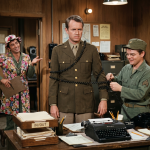
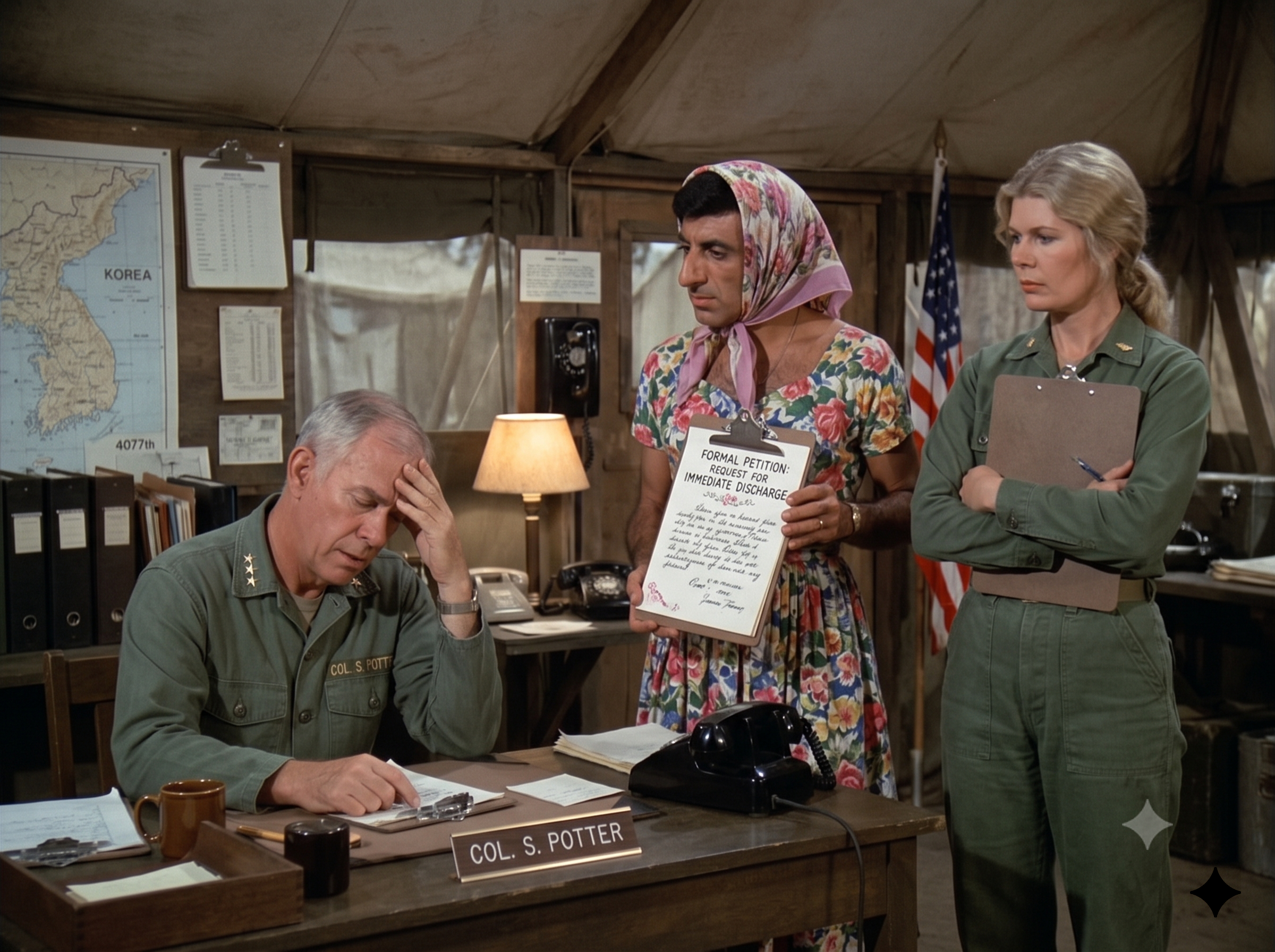
Behind his modest wooden desk, Colonel Sherman T. Potter sat practically buried under a mountain of requisition forms, morning reports, and supply manifests.
The soft, warm glow of his practical desk lamp highlighted the deep lines of exhaustion etched into his face.
He leaned heavily on his left elbow, his fingers pressed firmly against his forehead as if he were trying to physically hold his own sanity inside his skull.
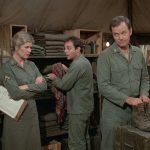
Standing sharply to his right was Major Margaret Houlihan.
She was dressed in standard-issue green fatigues, her blonde hair pulled back neatly, her posture as rigid as a flagpole.
Her arms were crossed tightly over her own clipboard, her face set in a mask of composed, professional frustration.
She had been in the middle of requesting a desperately needed rotation schedule for her nurses when the interruption occurred.
And at the 4077th, interruptions usually came dressed in floral print.
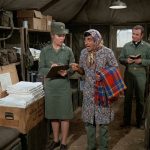
Corporal Maxwell Klinger stood front and center, completely ignoring the tension in the room.
He was wearing a brightly patterned summer dress—a vibrant explosion of pink, blue, and yellow flowers—paired with a matching pink-trimmed headscarf tied elegantly beneath his chin.
His posture was immaculate. He did not look like a man playing a joke; he looked like a weary diplomat presenting terms of surrender.
In his hands, he held a clipboard facing outward so the Colonel could read it clearly.
The document was written in meticulously neat, looping handwriting.
At the very top, in bold, heavily inked letters, it read: FORMAL PETITION: REQUEST FOR IMMEDIATE DISCHARGE.
“Colonel,” Klinger said, his voice dropping an octave into a tone of supreme, unshakeable dignity. “I have outlined my case with airtight legal precedent.”
Margaret closed her eyes for a brief, painful second. “Corporal, the Colonel and I are trying to run a hospital. We do not have time for the Toledo follies.”
“With all due respect, Major,” Klinger replied, not breaking eye contact with Potter. “This is a matter of life, death, and severe psychological deterioration. I am merely exercising my rights as a completely unbalanced citizen.”
Potter didn’t look up. He just kept rubbing his temples.
The heavy black rotary field phone sat silent on his desk, right next to his half-empty coffee mug and the wooden nameplate that read COL. S. POTTER.
For a long moment, the only sound in the office was the faint hum of the generator outside and the scratching of a jeep driving past the compound.
Potter sighed. It was a deep, gravelly sound that seemed to carry the weight of three different wars.
“Klinger,” Potter mumbled into his hand. “I have read Section Eight requests written on toilet paper. I have read them written in lipstick on the back of a mess tray.”
“This is different, sir,” Klinger insisted smoothly. “This one is notarized. By me.”
Margaret tightened her grip on her own clipboard. “Sir, if we could just get back to the nurse’s duty roster…”
“I have cited fourteen different examples of my unfitness for military service,” Klinger pressed on, stepping just an inch closer to the desk.
Potter finally stopped rubbing his head.
He slowly lowered his hand, his eyes red-rimmed and intensely tired, and looked up at Klinger.
He looked at the floral dress. He looked at the pink headscarf. He looked at the perfectly manicured petition.
Then, Colonel Potter did something that made both Klinger and Margaret freeze.
He reached out, took the clipboard from Klinger’s hands, laid it flat on his desk, and picked up his heavy fountain pen.
Margaret let out a sharp, shocked breath, her professional composure cracking.
Klinger stood completely paralyzed, his eyes wide, hardly daring to believe what was happening.
Potter unscrewed the cap of the pen, holding the silver nib just a fraction of an inch above the signature line.
The silence in the tent stretched out, tight and fragile as a tripwire.
Klinger’s knuckles turned white as he gripped the edge of the wooden desk, terrified that breathing too loudly might break the spell.
Potter stared at the document, his face completely unreadable.
The tip of the fountain pen hovered right above the paper, casting a tiny, sharp shadow in the light of the desk lamp.
“Let’s see here,” Potter muttered, his voice dry as prairie dust.
He adjusted his reading glasses and began to read aloud, his tone perfectly flat.
“‘Whereas the undersigned, Corporal Maxwell Q. Klinger, does hereby declare himself suffering from an acute and irreversible allergy to the color olive drab…'”
Margaret let out an exasperated puff of air. “Oh, for heaven’s sake.”
“‘…and whereas his continued presence in a combat zone threatens the structural integrity of his civilian wardrobe, particularly his chiffon evening gowns…'”
Potter paused, looking over the rim of his glasses at Klinger.
“Chiffon, Klinger?”
“It snags terribly on the camouflage netting, Colonel,” Klinger replied, his voice trembling with absolute sincerity. “It’s a tragedy, sir. A crime against tailoring.”
Potter looked back down at the paper. “‘Therefore, it is demanded by the laws of common decency and the state of Ohio that he be immediately returned to Toledo.'”
Potter let the silence hang for another long moment.
Then, with agonizing slowness, he screwed the cap back onto his fountain pen.
He didn’t sign it.
Klinger’s shoulders instantly slumped, the majestic theatricality draining out of him like air from a punctured tire.
“Colonel, please,” Klinger whispered, dropping the legal persona entirely. “I’m telling you, I’m cracking up. Yesterday, I looked at a plate of powdered eggs and I started crying.”
Potter leaned back in his chair, the leather creaking in protest.
The fatherly exhaustion returned to his face, softening the harsh lines around his eyes.
“Son,” Potter said gently. “If crying over powdered eggs was a sign of insanity, I’d have to discharge the entire United States Army.”
Margaret uncrossed her arms, her rigid posture relaxing just a fraction.
She looked at Klinger, her face softening into something resembling quiet sympathy.
“Besides, Corporal,” Margaret said, her voice surprisingly gentle. “If the Colonel sent you home, who would maintain the master filing system? You’re the only one who can read Hawkeye’s handwriting on the post-op reports.”
Klinger looked at her, entirely unconsoled. “Major, I’ll write you a translation key. I’ll leave you a Rosetta Stone of his terrible penmanship.”
Potter picked up Klinger’s petition and handed it back to him across the desk.
“It’s a beautiful piece of paperwork, Klinger,” Potter said honestly. “Your penmanship is a thing of beauty. But I can’t sign it.”
Klinger took the clipboard, hugging it to his floral chest. “Because of the war, sir?”
“Because of the war,” Potter agreed softly. “And because we need you here. Insanity and all.”
Potter looked out the flap of the tent, staring at the dusty, sun-bleached compound of the 4077th.
“We’re all tired, Klinger,” Potter said, his voice dropping into that quiet, intimate register he only used when the brass wasn’t listening. “We all want to go home. We’re all stuck in this mud together. And the only way we get through it is by relying on each other.”
Klinger looked down at his shoes.
For a second, underneath the floral print and the pink scarf, he just looked like a tired kid from Toledo who missed his mother’s cooking.
“Yes, sir,” Klinger murmured.
“Now,” Potter said, clapping his hands softly on the desk, returning to business. “I believe Major Houlihan has a nurse’s roster that actually requires my signature.”
Margaret stepped forward, sliding her clipboard onto the desk, slipping seamlessly back into her professional demeanor.
“Thank you, Colonel. If you’ll just sign right here, I can get the night shift properly rotated.”
Klinger turned to leave, his dignity wounded but remarkably intact.
Before he reached the door of the tent, Potter called out to him.
“Oh, and Klinger?”
Klinger paused and looked over his shoulder. “Yes, Colonel?”
Potter offered a small, weary, completely genuine smile.
“That shade of pink really does bring out your eyes. Don’t let the camouflage netting ruin it.”
A faint, proud smile tugged at the corner of Klinger’s mouth.
He stood a little taller, adjusted his clipboard, and gave a sharp, perfectly executed military salute, despite the dress.
“Thank you, sir,” Klinger said.
He turned and marched out of the office, stepping back into the heat and the dust of the war.
Potter picked up his fountain pen once again, uncapped it, and signed Margaret’s roster.
The brief moment of comic relief was over, absorbed back into the endless, grinding routine of the mobile hospital.
But as the heavy silence settled back over the room, the weight of it felt just a little bit lighter to carry.
Even in the middle of a war, the truest act of survival was simply finding a way to smile together.