A Quiet Moment of Shared Weight
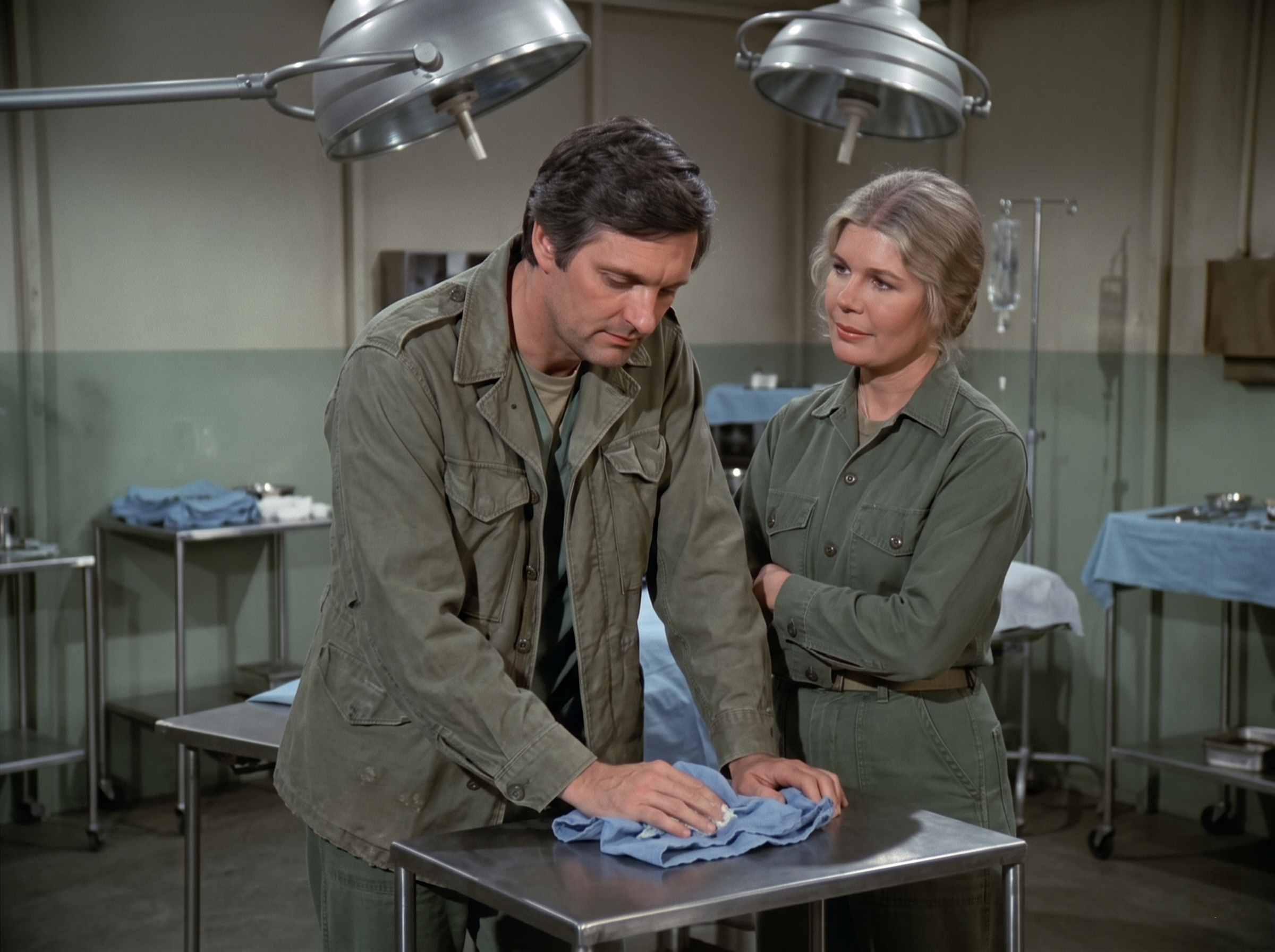
The final dust from the last outgoing helicopter had long since settled, and the silence of the Operating Room was louder than a barrage.
The air still hung heavy with the copper tang of blood and the pervasive, cloying smell of ether. It was the aftermath of a session that had stretched over forty hours, the kind of brutal, relentless shift that left you feeling less like a human and more like a machine running on fumes and stubbornness.
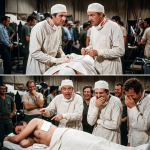
Hawkeye Pierce stood by a stainless steel table, the central table where so many lives were fought for, now just an empty metal surface.
He was still in his faded olive utility jacket, a concession to the unexpected chill of a Korean night that had seeped into the OR. He was leaning on the table, staring down with an intensity that seemed too great for what lay before him: a simple blue cloth, crumpled and concealing something small.
His face, a canvas of fatigue and profound exhaustion, was stripped of its usual quick wit. There were no jokes, no defiant banter, not even a satirical observation. There was only a profound weariness.
Margaret Houlihan stood slightly behind him, her arms folded across her chest. Her strong, composed features were shadowed with the same exhaustion. She watched him, her eyes not sharp or demanding, but full of a quiet, watchful concern. She hadn’t left his side since the last patient was carted out.
For all their clashes over procedures and rules, in moments like this, they were just two medics, united in the shared burden of everything they had seen, done, and couldn’t do.
“You should get some sleep, Pierce,” she said, her voice surprisingly soft.
Hawkeye didn’t look up. He continued to gaze at the blue cloth.
“It’s okay,” he replied, his voice barely a whisper. “I’m just… holding it.”
His usual armor of jokes and sarcasm, designed to keep the horror at bay, was gone. And for the first time in as long as Margaret could remember, the silence that took its place was terrifyingly real. It was a silence that made you wonder if a man’s spirit can simply wear away.
Margaret moved closer, her crossed arms tightening slightly, not defensively, but in a gesture of internal strength. She understood what he meant.
He wasn’t physically holding anything. He was holding the silence. He was holding the weight of all the boys who had just passed through, and all the ones who wouldn’t be leaving. He was holding onto his own fragile sanity.
For a long moment, she just stood there, letting her presence be enough. The simple act of not leaving him alone in that terrible silence was the kindest thing she could offer.
“It’s okay to let it go sometimes, Pierce,” she said gently.
Hawkeye finally took a shallow breath and slowly began to unfold the blue cloth. Inside was a tiny, delicate object: a child’s sterling silver teething spoon, its end gently bent, as if someone had carried it as a good luck charm.
“He said it was from his sister,” Hawkeye murmured. “He called it his ‘good luck scooper.’”
He didn’t need to finish the story. Margaret knew. The boy hadn’t made it. This small spoon was all that remained of a life, a promise of a future that had just ended. The sheer, small absurdity of it—a baby’s spoon in a war zone—was more devastating than a mortar round.
He looked down at his own hands, calloused and stained, and back at the small spoon. He seemed profoundly lost, as if his usual defiant self-assurance had simply vanished.
“I can’t even think of a decent pun about ‘scooping up trouble,'” he said, a ghost of a smile touching his lips, gone as fast as it came. He looked at her, his eyes searching. “Is that a bad sign?”
Margaret felt a small tug of genuine warmth. “The worst,” she said, with the driest humor she could muster, letting a small, rare softness show. “But I think we can make an exception, just this once.”
She reached out and lightly covered the small silver spoon with the other edge of the blue cloth, her hand momentarily brushing against his sleeve.
“It’s over for now,” she said. “The table is clean.”
He looked at the cloth, then at her. The concern in her eyes was genuine and deep. She saw the pain he was desperately trying to hide, and she was acknowledging it without judgment. It was a moment of absolute, found-family vulnerability.
Slowly, the tension left his shoulders. He straightened up, the immediate crush of the fatigue still there, but perhaps with a different, more human weight.
“You are a remarkably resilient woman, Major,” he said, the respect in his voice clear. “I’m not sure I could have done that last suture without you.”
It was a compliment, as direct and sincere as he ever gave.
“And you, Captain,” she replied, “are an impossible, insufferable man. But you are a good surgeon.”
It was as warm an admission as she was capable of.
They stood together for a few more seconds, not saying anything, just breathing in the quiet of the OR. Then, with a silent understanding, they began to turn and walk out, towards the dawn and the promise of a few hours of sleep, carrying the memory of the spoon and the shared, quiet strength that was the only thing that kept the 4077th from breaking apart.
Sometimes, the smallest things carry the heaviest weight.