The Paperwork of Surviving the Night
The war stopped for no man, but occasionally, it managed to get completely bogged down in the paperwork.
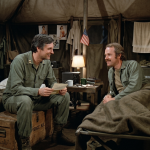
It was half-past two in the morning at the 4077th Mobile Army Surgical Hospital. Outside, the Korean night was freezing, dark, and thankfully silent. The only sound echoing across the compound was the low, steady hum of the diesel generators.
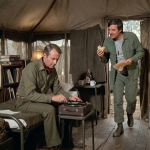
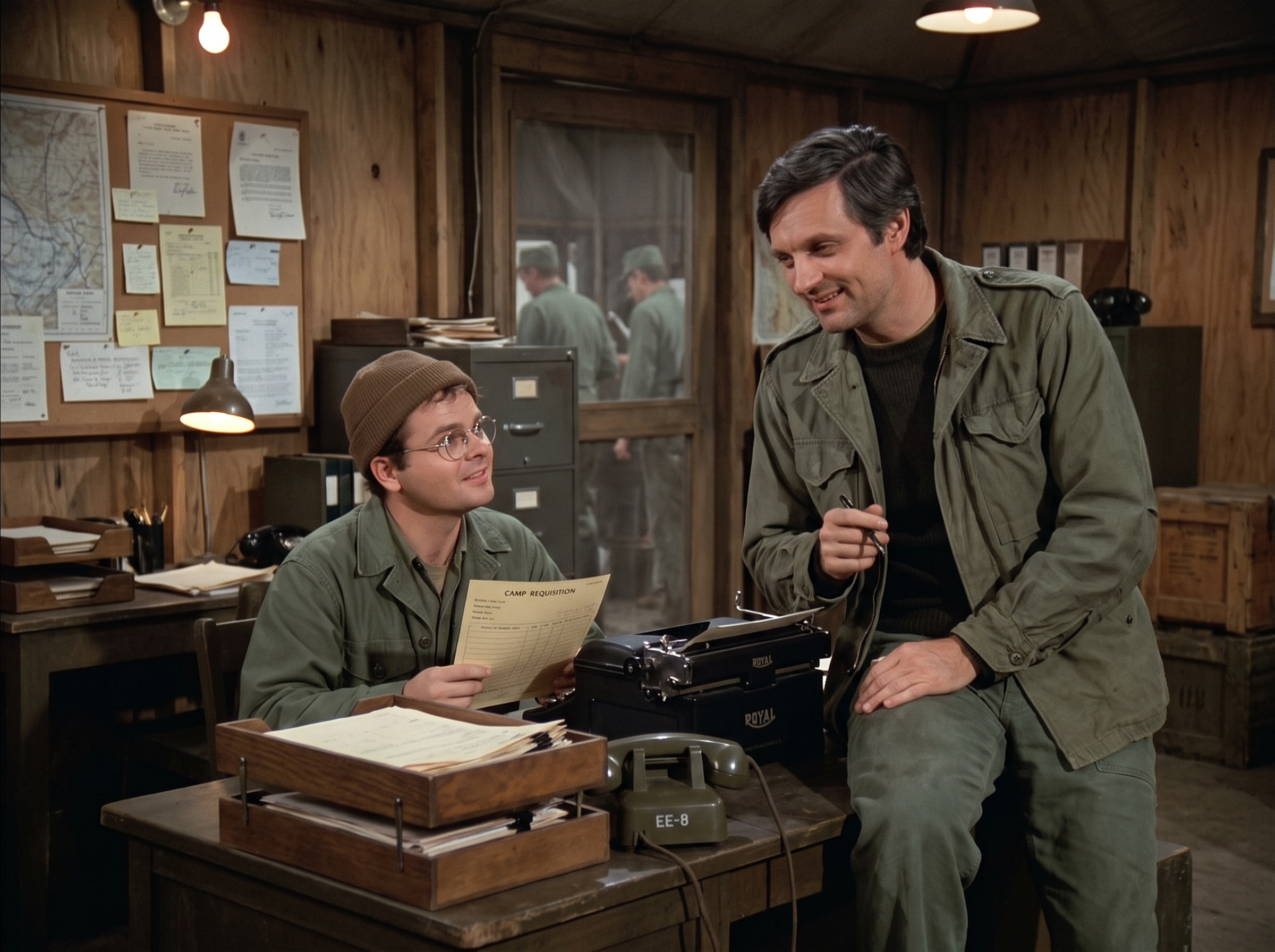
Inside the company clerk’s office, the atmosphere was entirely different. It was a small, cluttered sanctuary made of olive-drab canvas and raw wood. The lighting was soft and even, anchored by the warm, yellow glow of a practical metal desk lamp.
In the center of this organized chaos sat Corporal Walter “Radar” O’Reilly.
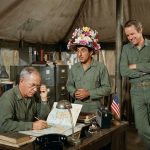
Radar was seated firmly behind his heavy wooden desk, flanked by wire file trays and a towering, messy bulletin board. Beside him sat the olive-green field phone, holding its breath for the night. Radar was dressed in his worn, lived-in fatigues, his round glasses reflecting the lamplight.
He was holding a piece of heavy beige Army stationery with an expression of earnest focus, though a shy, suppressed smile was currently fighting its way onto his face.
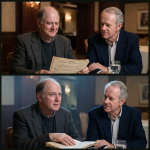
Leaning casually against the wooden furniture across from him was Captain Benjamin Franklin “Hawkeye” Pierce.
Hawkeye was in his usual state of exhausted rebellion. He wore a faded, unbuttoned uniform shirt over a rumpled undershirt, his dog tags resting against his chest. He was using every ounce of his playful deflection to navigate the latest piece of bureaucratic confusion raining down from I Corps.
His face, framed by dark, tired hair, showed a sharp, emotionally alert amusement. He was a man who used humor the way a soldier used a shield.
“I don’t understand the problem, Radar,” Hawkeye said, his voice a smooth, conspiratorial whisper. “It’s a perfectly standard medical requisition.”
Radar adjusted his glasses, looking down at the document. “Captain, you ordered three hundred yards of pink silk chiffon and twenty gallons of industrial-grade maraschino cherries.”
“For medicinal purposes,” Hawkeye replied without missing a beat. He leaned closer, resting his weight on his elbows. “We have a severe shortage of morale, Walter. The silk is for bandages. The cherries are for… internal antiseptic.”
Radar’s shy smile widened just a fraction, though he tried to maintain his professional bearing. “Supply in Seoul didn’t buy it, sir. They bounced the requisition back. And they attached a new form. Form 412-B.”
Hawkeye sighed, rolling his eyes toward the canvas ceiling. “Let me guess. ‘Declaration of Intent to Misuse Military Property’?”
“No, sir,” Radar said, his tone shifting slightly as he looked closer at the fine print on the beige paper. “It’s a mandatory ‘Psychological Resiliency and Frontline Surgeon Status’ evaluation. Apparently, when you order pink silk, the brass thinks you’re cracking up.”
Hawkeye let out a short, dry laugh. “Cracking up? I’m the sanest man in this camp. Which, admittedly, is like being the tallest leprechaun in Ireland. Read me the questions, Corporal. Let’s give the Army what they want.”
Radar picked up his pencil. He read the questions with earnest, nervous precision, while Hawkeye batted them away with lightning-fast sarcasm.
For ten minutes, the little office felt like a comedy club. Hawkeye’s sharp wit bounced off the muted gray equipment and the brown desk wood, keeping the heavy reality of the war firmly at bay.
But then, Radar reached the bottom of the page.
He read the next question silently to himself. His shy smile completely vanished. The pencil in his hand stopped moving.
“What’s the matter, Radar?” Hawkeye asked, noticing the sudden shift. “Did they ask for my hat size?”
Radar looked up from the beige paper. His young face suddenly looked incredibly tired, bearing the weight of a war he shouldn’t have been old enough to fight.
“Question 14, sir,” Radar read, his voice dropping to a quiet, hesitant whisper. “‘Has the subject experienced a significant loss of hope, humanity, or empathy in the execution of their medical duties?'”
The playful amusement drained instantly from Hawkeye’s face. The silence in the office stretched out, heavy and thick, suddenly transforming the warm, cozy room into a very cold place.
Hawkeye stood frozen for a fraction of a second. The joke he had queued up died in his throat.
He pushed himself off the furniture, the sudden movement causing a slight rustle of his worn cotton uniform. He shoved his hands deep into his pockets, looking away from Radar and staring at the faded duty rosters pinned to the bulletin board.
“Well,” Hawkeye finally said, his voice entirely stripped of its usual bravado. “That’s a hell of a question for three in the morning.”
Radar didn’t say anything. He just sat behind the typewriter, his earnest eyes fixed on the exhausted surgeon. In this muted, olive-drab world, Radar possessed an uncanny ability to see right through the armor of the people he cared about.
“Tell them no, Radar,” Hawkeye said, pacing a slow, small circle on the wooden floorboards. He tried to force a smile back onto his face, attempting to reconstruct his playful deflection. “Tell them Captain Pierce is overflowing with hope. Tell them I weep at sunrises and I love every single piece of powdered eggs the Army feeds me.”
“Hawkeye…” Radar started, his voice gentle and completely void of military rank.
“Tell them I have so much empathy I can barely stand up straight,” Hawkeye continued, his voice rising slightly, the sharp edge of combat fatigue finally showing through the cracks. “Because if you tell them the truth, Walter, they might send a psychiatrist down here. And if they do that, the shrink is going to realize that doing meatball surgery for twelve hours a day on kids who aren’t old enough to shave might actually be a depressing line of work.”
Hawkeye stopped pacing. He leaned back against the edge of the desk, looking down at his own hands. They were steady now, but they carried the ghosts of a hundred frantic hours in the O.R.
The silence returned, but this time, it wasn’t cold. It was the quiet, sacred silence of a found family holding space for one another.
Radar looked at the document. He looked at the stark black ink on the beige paper. He knew Hawkeye was running on fumes. He knew the war was taking small, invisible pieces out of all of them, every single day.
Slowly, Radar picked up his pencil.
He didn’t ask Hawkeye another question. He simply bent over the desk, his face bathed in the soft, warm desk-lamp light. He marked a neat, precise ‘X’ in the ‘No’ box beside Question 14.
Then, he rolled a fresh sheet of paper into his typewriter.
Clack. Clack. Clack.
The mechanical sound of the keys was oddly comforting in the quiet room. Hawkeye watched him, the emotionally alert tension slowly draining from his shoulders.
“What are you doing, Radar?” Hawkeye asked softly.
“Just filling out some standard administrative addendums, sir,” Radar said, never taking his eyes off the keys. His earnest focus had returned, but the shy smile was slowly creeping back onto his face.
He pulled the paper from the typewriter and attached it to the psychological form.
“I have officially informed I Corps that Captain Pierce maintains a highly stable and resilient psychological profile,” Radar said, his tone returning to its familiar, innocent cadence. “However…”
Hawkeye raised an eyebrow. “However?”
“However, I also noted that due to extreme atmospheric conditions in the surgical theater, the Captain has developed a severe case of… ‘Optical Fatigue Syndrome’.” Radar looked up, his glasses catching the light. “It’s a very serious bureaucratic condition, sir.”
Hawkeye felt a genuine, exhausted smile break through his defenses. “Is it fatal, doctor?”
“No, sir,” Radar said seriously. “But the only known cure, according to Army Regulation 416, is for the afflicted officer to be immediately prescribed a bottle of scotch from the Colonel’s private reserve, followed by a mandatory, uninterrupted eight-hour sleep cycle. I’ve already stamped it. It’s official Army policy now.”
Hawkeye looked at the young corporal. Beneath the oversized uniform and the naive demeanor, Radar was the absolute bedrock of the 4077th. He navigated the maddening, soul-crushing machinery of the military and somehow managed to squeeze out small drops of mercy for his friends.
“Radar,” Hawkeye said, his voice thick with genuine affection. “You are a beautiful, bureaucratic genius.”
“I just fill out the forms, Captain,” Radar said modestly, stacking the papers into his ‘Out’ tray.
Hawkeye reached out and gave Radar’s shoulder a brief, gentle squeeze. It was a small gesture, completely unscripted and purely human.
“Get some sleep, Walter,” Hawkeye said quietly.
“You too, Hawkeye,” Radar replied.
Hawkeye turned and walked out of the office, stepping back into the freezing Korean night. The war was still out there, waiting for the sun to rise. But as the canvas door flapped shut behind him, Hawkeye felt just a little bit lighter, knowing that someone was keeping the books in their favor.
Inside the quiet office, Radar sat alone in the warm, practical light, resting his hand briefly on the field phone, grateful that for one more hour, it remained entirely silent.
In a world gone mad, salvation didn’t always come from a scalpel; sometimes, it came from a clerk with a typewriter and a fiercely loyal heart.