Empty Crates and Full Hearts
War is a hungry machine, and at the 4077th Mobile Army Surgical Hospital, it always seemed to eat the medical supplies first.
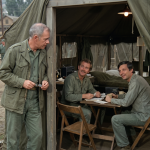
The afternoon sun beat down mercilessly on the canvas roof of the supply tent, baking the air inside until it smelled sharply of hot dust, dry pine bark, and old canvas.
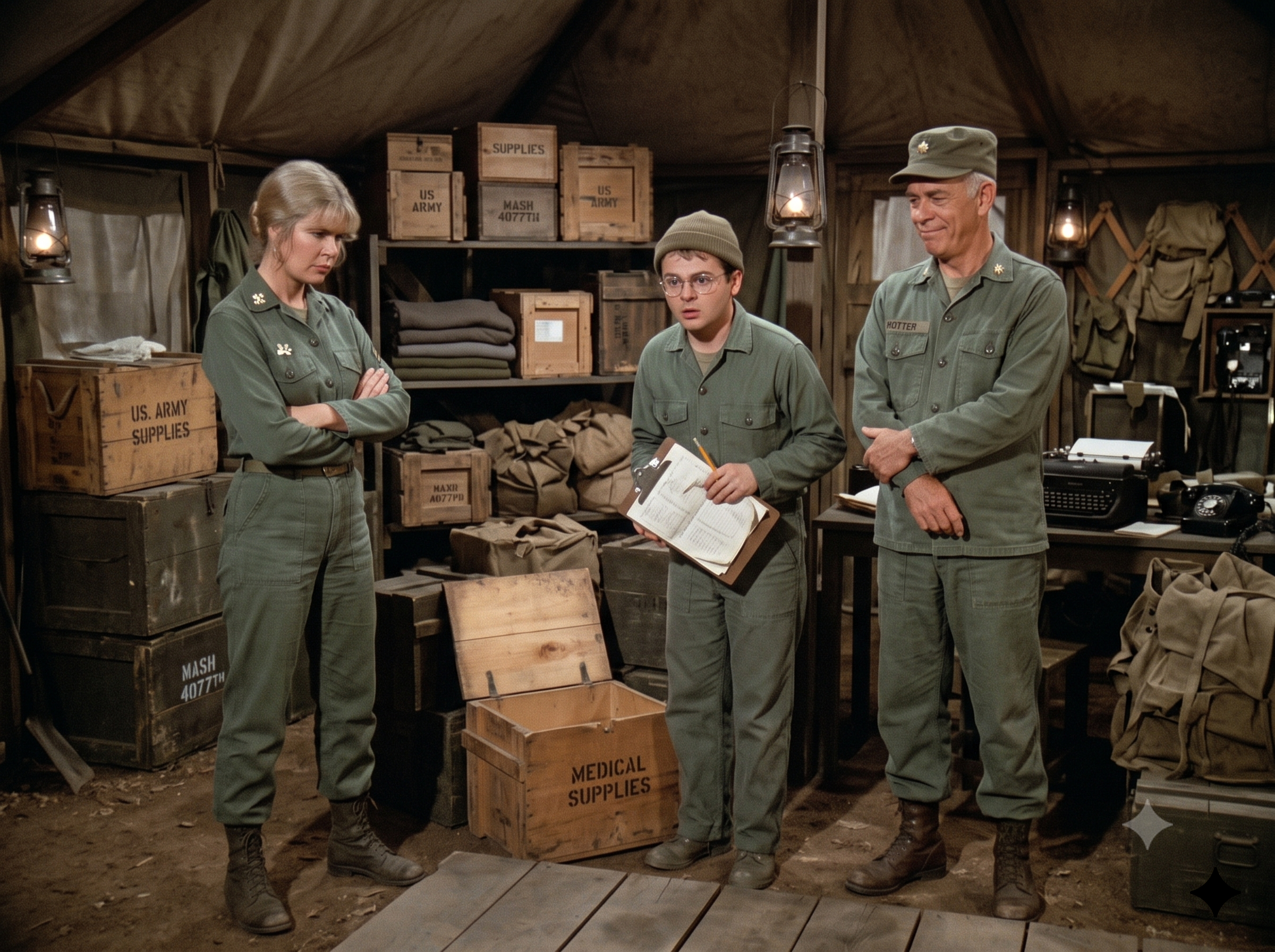
Inside, beneath the soft, yellow glow of a practical camp lantern, a silent standoff was underway.
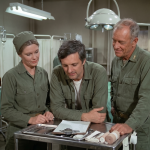
Major Margaret Houlihan stood in the center of the dusty floor, her posture a masterpiece of controlled frustration.
Her arms were folded tightly across her chest, her green fatigues perfectly crisp despite the stifling heat of the Korean summer.
She was leaning sharply into the moment, her expression one of proud, unyielding skepticism.
She wasn’t angry, not exactly.
She was simply an excellent head nurse who was bone-tired of having to perform miracles with shoestrings and good intentions.
A few feet away, standing near a freshly opened wooden crate, Corporal Walter “Radar” O’Reilly was doing his best to make himself invisible.
He cowered just slightly, his knit olive-drab cap pulled down low over his brow.
He clutched a battered wooden clipboard to his chest like a medieval shield, his round glasses magnifying a wide-eyed, earnest look of innocent apology.
“I’m telling you, Major,” Radar squeaked, his voice pitching up with anxiety. “I put the requisition in exactly like you asked. Three weeks ago. Priority A-1.”
Margaret didn’t blink.
She merely shifted her gaze from Radar to the wooden box sitting open between them on the dirt floor.
Stenciled across the side in bold, faded black letters were the words: MEDICAL SUPPLIES.
The lid had been pried off, the nails bent and discarded.
The crate was completely, unquestionably, entirely empty.
“And I am telling you, Corporal,” Margaret said, her voice dropping into a dangerously calm register. “That unless the United States Army has invented a revolutionary new form of invisible surgical gauze, there is nothing in this box.”
Standing just to Margaret’s right, Colonel Sherman T. Potter watched the exchange with the quiet, compact posture of a man who had seen it all.
His hands were clasped patiently in front of him.
He offered a dryly amused, barely perceptible sigh, the corner of his mouth twitching upward in a gesture of practical leadership.
“Now, Margaret,” Potter said, his voice a steady, gravelly rumble. “Let’s not jump to conclusions. Maybe they sent us a box of highly classified Korean air.”
“Colonel, please,” Margaret said, refusing to break her stare at Radar. “We have post-op patients who need those bandages. We are down to cutting up bedsheets.”
Radar nervously flipped a page on his clipboard, the paper crinkling loudly in the quiet tent.
His finger traced down a column of faded mimeographed type, his lips moving silently as he double-checked the labyrinth of Army bureaucracy.
Suddenly, Radar swallowed hard. The color drained from his already pale face.
He looked up at Margaret, then at Potter, his eyes looking like two giant saucers behind his spectacles.
“Uh oh,” Radar whispered.
Margaret’s posture went rigid. “What do you mean, ‘uh oh’?”
Radar licked his dry lips, pressing the clipboard tighter against his chest.
“Well, Major,” Radar stammered, “I tracked the supply code. Requisition 404-G. Surgical gauze, sterile, standard issue.”
“Yes,” Margaret prompted sharply. “And?”
“And…” Radar gulped. “It seems Quartermaster Command in Seoul cross-referenced our form with Directive 22-B.”
Potter sighed, rubbing the bridge of his nose. “Translate that into English, son.”
“They didn’t send us the gauze, Colonel,” Radar explained, his voice filled with genuine sorrow. “They sent us the regulation empty crates required to transport the gauze.”
Radar pointed a trembling finger at the box.
“We’re supposed to put the gauze we don’t have into these crates, and then ship them back to Seoul so they can properly inventory the shortage.”
For a long moment, the only sound in the supply tent was the distant, rhythmic thumping of a chopper miles away.
Margaret closed her eyes. She took a deep, shuddering breath.
The proud skepticism faded from her face, replaced by a sudden, overwhelming wave of exhaustion.
She uncrossed her arms, letting them fall heavily to her sides.
It wasn’t just about the bandages.
It was about the endless, crushing absurdity of trying to heal broken bodies in a world that insisted on making everything so incredibly difficult.
“Major?” Radar asked softly, stepping forward. He looked genuinely heartbroken.
“I’m really sorry. I’ll get on the horn right now. I’ll wake up a general if I have to. I’ll find those bandages.”
Margaret opened her eyes and looked at the young corporal.
She saw his slumping shoulders, his innocent panic, and the dark circles of fatigue under his eyes.
The strict, military discipline melted away, leaving only the quiet, tender core of a woman who cared deeply for her people.
“Never mind, Radar,” Margaret said, her voice suddenly soft and incredibly gentle. “It’s not your fault. The Army works in mysterious, idiotic ways.”
Radar blinked, surprised by the grace in her tone. “Are you sure, Major?”
“I’m sure,” she nodded, offering him a faint, tired smile. “You do your best for us. I know that.”
Colonel Potter watched the exchange, his dry amusement giving way to a look of profound, fatherly pride.
He stepped forward, placing a reassuring hand on Margaret’s shoulder.
His touch was grounded, steady, and full of unspoken understanding.
“You’re a good officer, Margaret,” Potter said quietly. “And you’re a remarkable nurse. We’ll figure this out. We always do.”
Margaret looked at the older man, drawing strength from his calm presence.
“I just hate seeing them suffer, Colonel,” she admitted, her voice thick with emotion. “They’re just boys. And we don’t even have clean cotton to put on their wounds.”
“I know,” Potter said, his eyes filled with the same bittersweet sorrow. “But we have you. And we have Hawkeye, and B.J., and Father Mulcahy.”
Potter gave her shoulder a gentle squeeze.
“We’ll boil the bedsheets again. We’ll tear up our own t-shirts if we have to.”
Potter turned his gaze to Radar, who was watching them with quiet reverence.
“Corporal,” Potter ordered gently. “Get over to the mess tent. Tell Igor to start boiling water and gathering up every clean apron he has.”
“Yes, sir,” Radar said firmly, standing a little taller.
“And Radar?” Potter added, gesturing to the empty wooden crate on the floor. “Take this box with you. Give it to Igor. Tell him to use it for firewood to heat the water.”
Radar smiled, a small, genuine grin breaking through his anxiety. “That’s a good use for it, sir.”
“The Army sent us a box,” Potter mused, his eyes crinkling at the corners. “Might as well let it save a life today.”
Radar nodded eagerly, tucking his clipboard under his arm.
He bent down, scooped up the empty crate with ease, and hurried out of the tent, the canvas flaps falling shut behind him.
Margaret and Potter stood alone in the dim, dusty supply area.
The warm light from the camp lantern cast long, soft shadows across the stacks of faded canvas bags and folded blankets.
Margaret looked around the room, taking in the makeshift reality of their lives.
It was dirty, it was tired, and it was deeply unfair.
But as she looked back at Colonel Potter, who was watching the tent flap with a fond, wistful expression, she knew there was nowhere else she’d rather be.
They weren’t just an army unit.
They were a family, bound together by blood, dirt, and the quiet, stubborn refusal to let the darkness win.
“Come on, Major,” Potter said softly, turning toward the door. “Let’s go make some bandages out of tablecloths.”
“Right behind you, Colonel,” Margaret replied, her voice steady and full of heart.
Some days the Army gave them nothing at all, but they always managed to find exactly what they needed in each other.