A Matter of Forms and Family
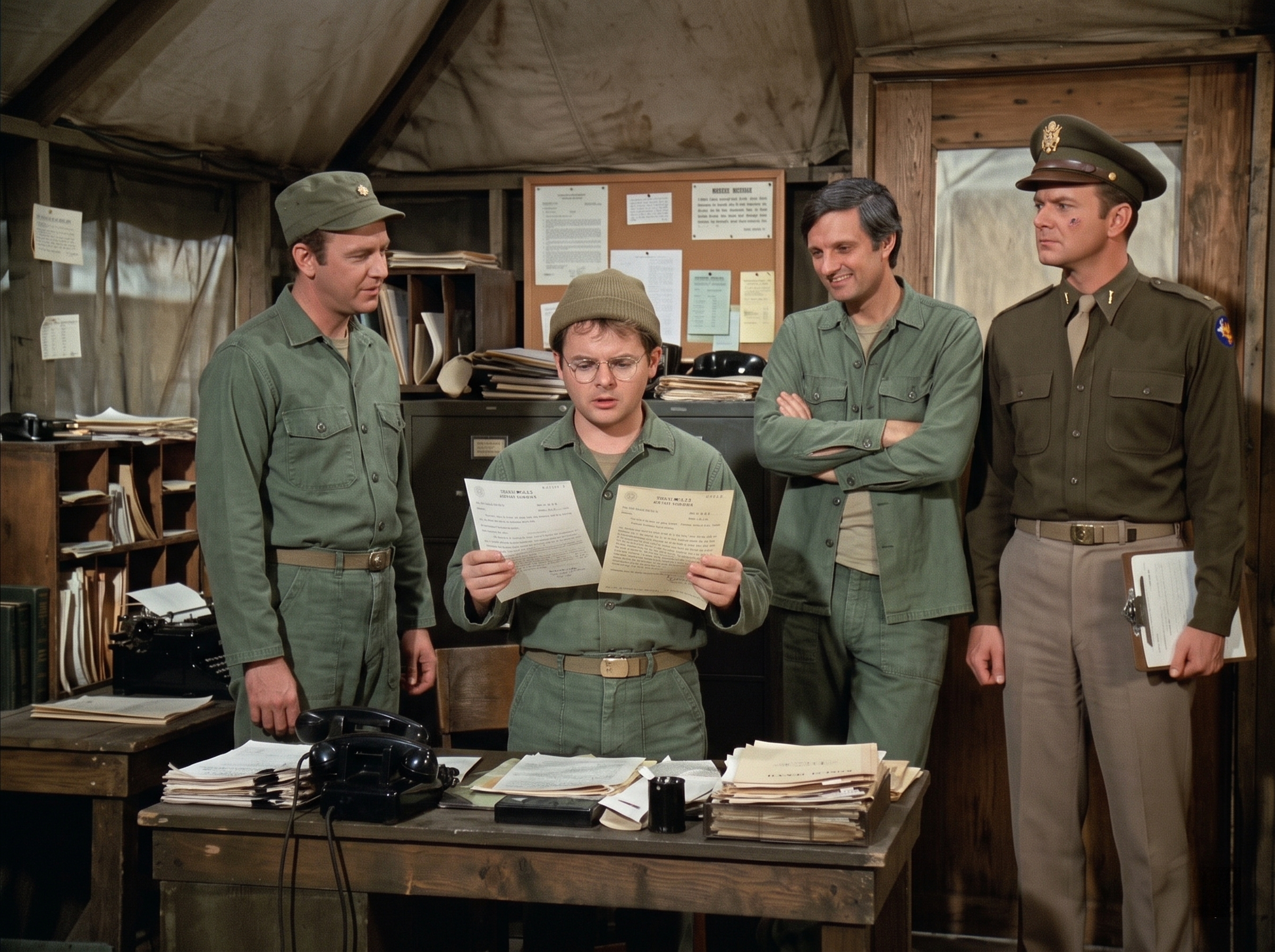
In the 4077th, there were two kinds of exhaustion.
There was the bone-deep, heavy-limbed fatigue that followed thirty straight hours in the operating room. That kind of tired was loud. It tasted like cold coffee and smelled of iodine, blood, and fear.
Then there was the quiet exhaustion. The kind that settled over the camp during the long, dusty lulls between choppers.
During the lulls, the real enemy wasn’t the war. It was the waiting. And worse, it was the paperwork.
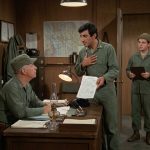
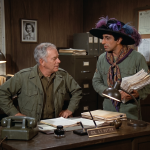
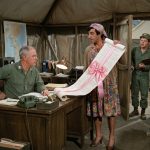
The soft, practical light of a solitary desk lamp cast a warm, golden glow over the tan canvas walls of the clerk’s office. It was a busy, slightly chaotic station. Stacks of beige carbon paper threatened to topple over at any moment. A dented typewriter sat waiting for the next barrage of military bureaucracy.
Behind the battered desk stood Corporal Walter “Radar” O’Reilly.
Right now, Radar looked like a boy who had accidentally broken a very expensive window. He was holding two mismatched military forms in his hands. His shoulders were hunched up to his ears in a posture of innocent misunderstanding and nervous confusion. He kept looking back and forth between the two pieces of paper as if hoping one of them would magically change its typed ink.
Hawkeye Pierce leaned casually against the wooden doorframe.
He was relaxed, slouching in that unmistakable, loose-limbed way of his. He wore his faded, lived-in fatigues like a second skin, entirely comfortable in his defiance of military posture. He watched Radar’s rising panic with an amused, playful deflection. A quick, clever smile played on Hawkeye’s lips. He was using his wit the way he always did: as a shield against the crushing boredom of the Korean peninsula.
Standing stiffly beside the desk was Major Charles Emerson Winchester III.
Charles was a stark contrast to Hawkeye. Even in the middle of a war zone, Charles stood with upright, rigidly controlled posture. His uniform was miraculously pressed. His face was a mask of refined irritation, and one thick eyebrow was raised in an expression of dry, aristocratic superiority. He looked at Radar the way a king might look at a peasant who had just spilled soup on the royal slippers.
Tucked away in the corner, a sleepy corporal from the motor pool leaned against a filing cabinet. He was completely indifferent to the drama, just waiting for a signature on a spark plug requisition.
“Well, Corporal?” Charles drawled, his voice dripping with cultured impatience. “I am waiting. And the Winchester patience, much like the Winchester wine cellar, has a finite bottom.”
“I’m trying, Major,” Radar stammered, his voice squeaking up half an octave. “But the forms… they don’t match.”
“What do you mean, they don’t match?” Charles sighed, pinching the bridge of his nose. “It is a simple requisition for a trans-Pacific telephone line. I booked the 1900 hours slot three weeks ago to speak with my mother in Boston.”
Hawkeye chuckled, his smile widening. “And I booked the 1900 hours slot three weeks ago to speak to my dad in Crabapple Cove. It seems the great United States Army has finally realized that Maine and Massachusetts are basically the same place.”
“Do not lump my beloved Boston in with your rustic fishing village, Pierce,” Charles snapped, though he didn’t turn around.
“Sirs,” Radar interrupted, holding the two forms up like a white flag of surrender. “I-Corps stamped both of your forms with the same routing number. The switchboard in Seoul just called. The line is open.”
Hawkeye stopped slouching. Charles dropped his hand from his face.
Radar swallowed hard. “They said there’s only one line available to the States tonight. And they need to know right now which of you is making the call.”
The heavy field phone on Radar’s desk began to ring. It was a harsh, metallic sound that cut through the quiet hum of the camp.
Radar stared at the phone. He looked at Charles. He looked at Hawkeye.
The clever smile vanished from Hawkeye’s face. Charles’s rigid posture suddenly looked a lot less like arrogance, and a lot more like desperation.
The operator was waiting. And only one of them could go home tonight.
The field phone rang a second time.
In the small, cluttered office, the sound was deafening. The sleepy corporal in the corner finally looked up, sensing the sudden shift in the room’s atmospheric pressure.
“Answer it, Corporal,” Charles ordered. His voice was entirely stripped of its usual haughty theatricality. It was tight. Controlled.
Radar picked up the heavy receiver with a trembling hand. “4077th MAS*H, Corporal O’Reilly speaking. Yes, Sparky. I know, Sparky. Just… give me thirty seconds, okay? Please?”
Radar covered the mouthpiece with his hand. He looked up at the two surgeons with wide, miserable eyes.
“He says we have one minute to connect the patch, or he gives the line to a general in Tokyo who wants to talk to his stockbroker.”
Charles stepped forward, his polished boots heavy on the wooden floorboards. He opened his mouth to speak. He had a dozen arguments ready. He could mention his seniority, his rank, the delicate nature of the Winchester family finances that required his immediate attention.
But Charles didn’t say any of that. He just looked at the black receiver in Radar’s hand, his raised eyebrow softening into something vulnerable and incredibly tired.
Hawkeye watched him.
Hawkeye was a man who lived on words. He used jokes to keep the blood off his hands and the ghosts out of his head. He had spent the last three weeks thinking about what he would say to his father. He wanted to hear about the weather in Maine. He wanted to hear about the patients at his dad’s small practice. He just wanted to hear a voice that didn’t sound like a war.
Hawkeye looked at Charles’s stiff shoulders. He saw the way the man’s hands were quietly gripping the edge of Radar’s desk.
Hawkeye let out a long, slow breath. The playful smile returned to his face, but it was smaller this time. Softer.
“Take it, Charles,” Hawkeye said quietly.
Charles blinked, turning his head slowly. The refined irritation was completely gone, replaced by genuine shock. “Pierce, I… you also have a claim to this time slot.”
“My dad is probably out delivering a baby anyway,” Hawkeye said, pushing himself off the doorframe and stuffing his hands deep into his pockets. He gave a casual, dismissive shrug. “You know how he gets. If I interrupt him while he’s tying an umbilical cord, he’ll just yell at me for wasting the taxpayer’s money. Go ahead. Tell Boston I said hello.”
Radar held the phone out.
Charles looked at Hawkeye for a long moment. There were no jokes. No sarcastic retorts. Just a quiet, unspoken understanding between two men who were drowning in the same mud.
Charles cleared his throat, adjusting the collar of his pristine uniform. He took the receiver from Radar with elegant precision.
“Operator,” Charles said, his voice regaining a fraction of its usual authority. “This is Major Winchester. You will connect me to Beacon Hill, Boston, Massachusetts.”
Hawkeye turned away, looking out the screen door into the dusty compound. He didn’t want to eavesdrop. He just watched a pair of nurses walking toward the mess tent, letting the familiar, comforting hum of the camp wash over him.
Behind him, he heard Charles speak.
“Mother? Yes, it is Charles. No, I am quite well. The conditions are… adequate.”
Charles’s voice was remarkably gentle. The pompous bluster had completely evaporated. He sounded like a son.
“Yes, Mother. I miss you as well. Please ensure Father does not neglect his health. Yes. I love you too.”
Hawkeye closed his eyes, leaning his head against the doorframe. It hurt a little to hear it, but he was glad Charles got his moment. He really was.
Then, Hawkeye heard the sound of Charles clearing his throat loudly.
“Mother, I must be brief. The military restricts our time severely. Yes. Goodbye.”
Hawkeye frowned, opening his eyes. That couldn’t have been more than ninety seconds. He turned back around.
Charles was standing tall, holding the receiver in one hand and checking his gold pocket watch with the other.
“Operator?” Charles said sharply into the phone. “I am concluding my call. You have approximately one minute and forty-five seconds remaining on this connection. You will immediately patch this line through to Crabapple Cove, Maine. The residence of Dr. Daniel Pierce.”
Hawkeye froze.
Radar’s jaw dropped, his eyes going wide. The mismatched forms on his desk were completely forgotten.
Charles held the receiver out toward Hawkeye. His face had returned to a perfect mask of dry superiority.
“Well, Pierce?” Charles said, raising his eyebrow again. “Are you going to stand there catching flies, or are you going to take the instrument? The army is charging me by the second, and I assure you, I expect full reimbursement in the form of your best smuggled scotch.”
Hawkeye stared at the phone. He stared at Charles.
For once in his life, Hawkeye Pierce didn’t have a witty comeback. He didn’t have a joke.
He just walked over, his boots scuffing the floorboards, and took the heavy black phone from Charles’s hand.
“Thanks, Charles,” Hawkeye said. His voice was thick, barely above a whisper.
“Do not make a spectacle of it, Pierce,” Charles muttered, turning his back and inspecting a random piece of carbon paper on Radar’s desk to give Hawkeye privacy. “Just speak.”
Hawkeye pulled the receiver to his ear.
Through the crackle of static, across thousands of miles of ocean, through wires and switchboards and the endless machinery of a war they all hated, Hawkeye heard a voice.
“Hello? Hawkeye? Son, is that you?”
Hawkeye let out a shaky breath, a real, genuine smile finally breaking across his exhausted face. “Hey, Dad. Yeah. It’s me.”
Radar smiled, quietly sinking down into his chair. He carefully took the two mismatched forms, folded them together, and slid them into the trash can. Some administrative mix-ups didn’t need to be fixed.
Charles remained facing the wall, his posture rigidly perfect, a small, invisible smile playing on his own lips.
The soft, practical light of the desk lamp seemed a little warmer now. The paperwork could wait. The war could wait. For the next minute and a half, the 4077th wasn’t an army hospital. It was just a room full of friends, listening to a voice from home.
In a place built to mend broken bodies, it was the quiet, shared moments of humanity that truly kept them whole.