The Light in the Supply Tent
The war wasn’t just fought in the muddy trenches or across the bloody operating tables of the 4077th.
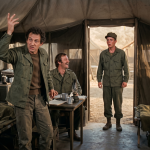
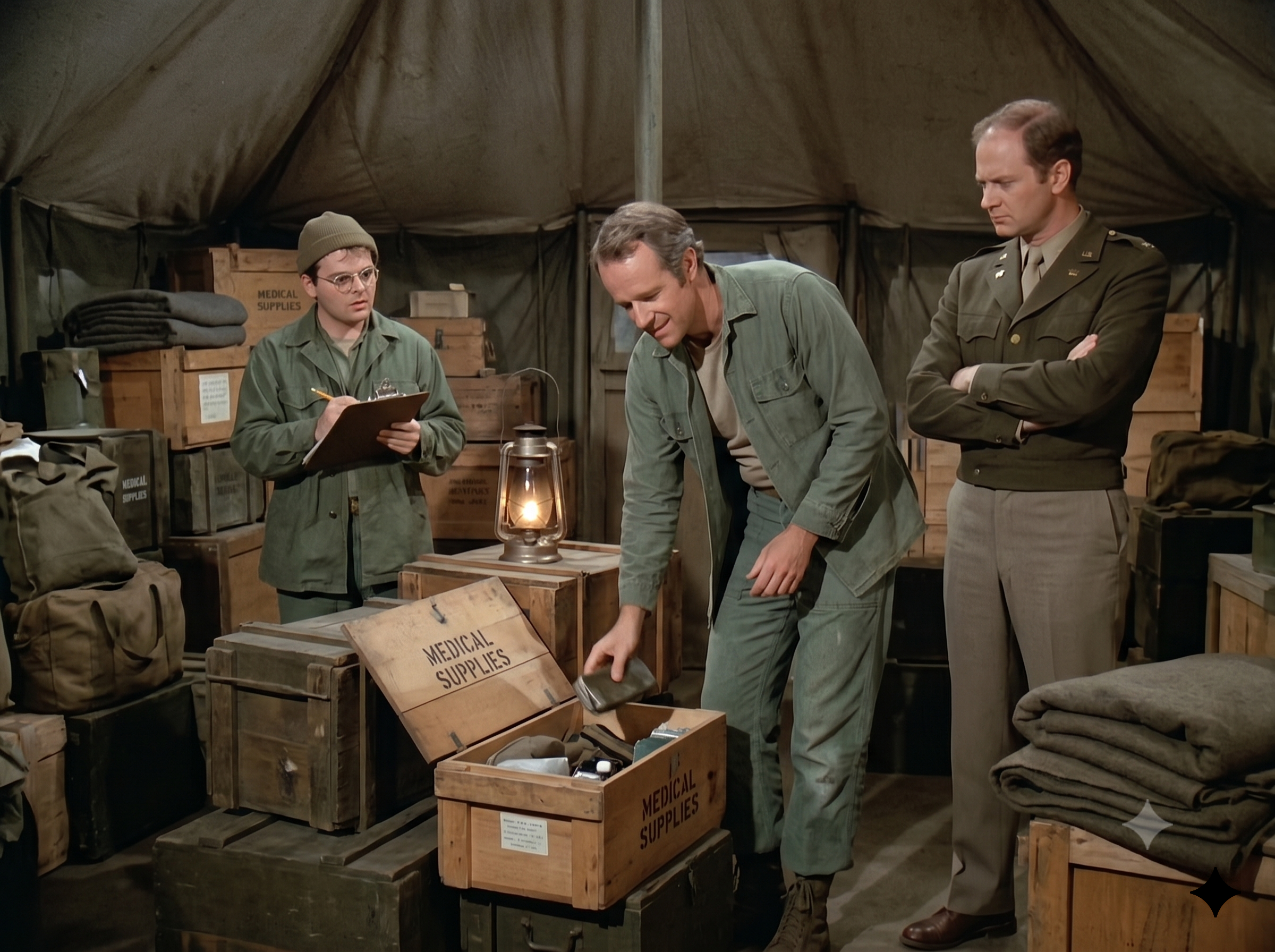
Sometimes, the most exhausting battles were fought right here in the supply tent, under the dim, flickering glow of a kerosene lantern.
It was 0200 hours, and the air inside the canvas walls was thick with the smell of damp wool, canvas, and the sharp, metallic dust that seemed to cover every inch of Korea.
A heavy silence hung over the camp, broken only by the distant, rhythmic thud of artillery that they had all long since learned to ignore.
But inside the clutter of wooden crates and stacked blankets, a different kind of tension was brewing.
Radar O’Reilly stood near the center of the tent, clutching his worn wooden clipboard to his chest like a shield.
His round face was etched with a familiar, nervous confusion, his eyes darting between the inventory sheets and the scattered boxes.
He tapped his yellow pencil against the paper, his brow furrowed so deeply it nearly touched the rim of his glasses.
“It says right here, Captain,” Radar muttered, his voice tight with anxiety. “Box 4-B. Medical supplies. Hemostats and silk sutures. I checked the manifest three times.”
He swallowed hard, looking at the open crate in front of them. “But… but it’s not in there. It’s just not.”
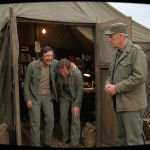
A few feet away, Major Charles Emerson Winchester III stood with his arms firmly crossed over his olive-drab jacket.
His posture was entirely rigid, an island of Bostonian refinement stranded in a sea of military incompetence.
His face was a portrait of restrained, simmering irritation.
“Fascinating,” Charles drawled, his voice dripping with icy sarcasm. “Simply fascinating. The United States Army, in its infinite and majestic wisdom, has managed to misplace the very tools required to keep men alive.”
Charles took a slow, deliberate step forward, his eyes locked on the offending crate.
“We have a chopper pad full of wounded arriving at dawn, Corporal. And you are telling me that instead of delicate surgical instruments, the quartermaster has sent us… what, exactly?”
Radar flinched slightly, pulling the clipboard closer. “I… I don’t know, Major. It looks like… canvas pouches. Maybe mess kit covers? I asked for sutures, honest I did.”
Captain B.J. Hunnicutt ignored the rising temperature in the room.
He leaned comfortably over the open wooden crate, his tall frame relaxed, a stark contrast to Winchester’s stiff indignation.
The stenciled black letters on the lid proudly proclaimed “MEDICAL SUPPLIES,” a cruel joke delivered courtesy of the military supply chain.
B.J. didn’t yell. He didn’t sigh. He simply sifted through the mislabeled contents with the quiet, methodical patience of a man who was used to fixing broken things.
The warm light of the lantern caught the gentle, thoughtful smile playing at the corners of his mouth.
“Don’t blow a gasket just yet, Charles,” B.J. said softly, his voice a soothing, grounded anchor in the drafty tent.
He reached deep into the bottom of the crate, his fingers brushing past the useless canvas covers.
Charles scoffed, his patience finally snapping. “Do not patronize me, Hunnicutt! We cannot sew up a ruptured spleen with good intentions and a mess kit!”
Radar braced himself, looking like he wanted to sink right through the dirt floor.
But B.J. just kept smiling. His hand closed around something heavy and tightly coiled at the very bottom of the box.
He slowly pulled a dark, olive-drab pouch into the light of the lantern.
“You’re absolutely right, Charles,” B.J. said quietly, turning the pouch over in his hands. “But we just might be able to use this.”
Charles uncrossed his arms, leaning in just a fraction of an inch despite himself.
“And what, pray tell, is that?” Charles asked, his tone still sharp but laced with a sudden, reluctant curiosity.
Radar leaned over, squinting through his glasses at the object in B.J.’s hands.
B.J. carefully unbuckled the small canvas pouch and pulled out a thick spool of heavy-duty, translucent line.
“It’s from a pilot’s survival kit,” B.J. explained, his voice calm and even. “Looks like heavy-gauge nylon fishing line. Someone at supply must have dumped a busted crate of survival gear into our medical boxes.”
Charles stared at the spool, his eyes widening in horror as he realized what the California doctor was suggesting.
“You cannot be serious,” Winchester breathed, genuine offense coloring his cultured voice. “You expect me, a thoracic surgeon trained at Massachusetts General, to perform delicate vascular repairs using… fishing tackle?”
“It’s not ideal, Charles,” B.J. admitted, his smile softening into a look of quiet, serious determination.
“But it’s nylon. It’s strong, it won’t break down in the body, and if we boil it for twenty minutes, it’ll be as sterile as anything else in this camp.”
B.J. looked up, meeting Winchester’s eyes directly. “It’s meatball surgery, Major. We use what we have to keep them breathing until they get to Tokyo.”
The silence in the tent stretched out, heavy and expectant.
Radar watched the two surgeons, his breath held tight in his chest. He knew that if Winchester refused, the morning’s surgical session would be a disaster, and he would carry the blame in his own heart.
For a long moment, Charles simply stared at the spool of fishing line.
He looked at the dirt on the floor, the frayed edges of his uniform, and the exhausted lines around B.J.’s eyes.
The rigid, arrogant posture slowly began to melt away, leaving behind the tired, dedicated doctor beneath the bluster.
Charles sighed, a long, defeated sound that seemed to carry the weight of the entire war.
“Very well,” Charles murmured, his voice surprisingly quiet. “But I want it on the record, Hunnicutt. If I am forced to pull a largemouth bass out of a soldier’s abdomen tomorrow, I am blaming you.”
A wave of profound relief washed over Radar. His shoulders dropped, and he let out a breath he didn’t realize he’d been holding.
“I’ll get it to sterilization right away, Major!” Radar said quickly, his voice squeaking just a little in his excitement.
“Hold your horses, Radar,” B.J. said gently. He tossed the spool to the young corporal, who caught it clumsily against his clipboard.
“You go get some sleep. Leave the line with the night duty nurse. We’ve got a long day tomorrow.”
Radar looked at the spool in his hands, then up at B.J. The deep, heavy guilt of the supply mix-up finally lifted from his young face.
“Thanks, Captain,” Radar said softly. “I really thought I messed up this time.”
“You didn’t mess up, Radar,” B.J. said, patting the wooden crate. “The Army messed up. You just happen to be the guy standing in front of the box.”
Charles gave a sharp, dismissive sniff, though there was no real venom behind it.
“Indeed, Corporal. The ineptitude of the military machine is vast and infinite. Try not to take it personally.”
Winchester turned on his heel, his posture immaculate once again. “Now, if you will excuse me, I am going to attempt to sleep before we are subjected to the horrors of whatever ‘breakfast’ the mess tent has concocted.”
As Charles disappeared through the canvas flaps into the cold night, B.J. and Radar were left alone in the warm, yellow light of the lantern.
B.J. reached out and turned the knob on the lantern, lowering the flame just a bit to save fuel.
They were thousands of miles from home, surrounded by mislabeled boxes, cold mud, and the endless stream of wounded.
But in this small, cluttered corner of the camp, they had found a way to make it work for one more night.
They weren’t just a military unit. They were a family, held together by duct tape, dry humor, and a stubborn refusal to let the madness win.
B.J. smiled at the young corporal. “Come on, Radar. Let’s get out of here.”
Radar nodded, tucking the clipboard under his arm.
Together, they walked out into the dark, leaving the supply tent behind, ready to face whatever the morning helicopters would bring.
In a place where nothing ever went according to plan, the greatest medicine they had was each other.