The Rag Doll Sermon in Post-Op
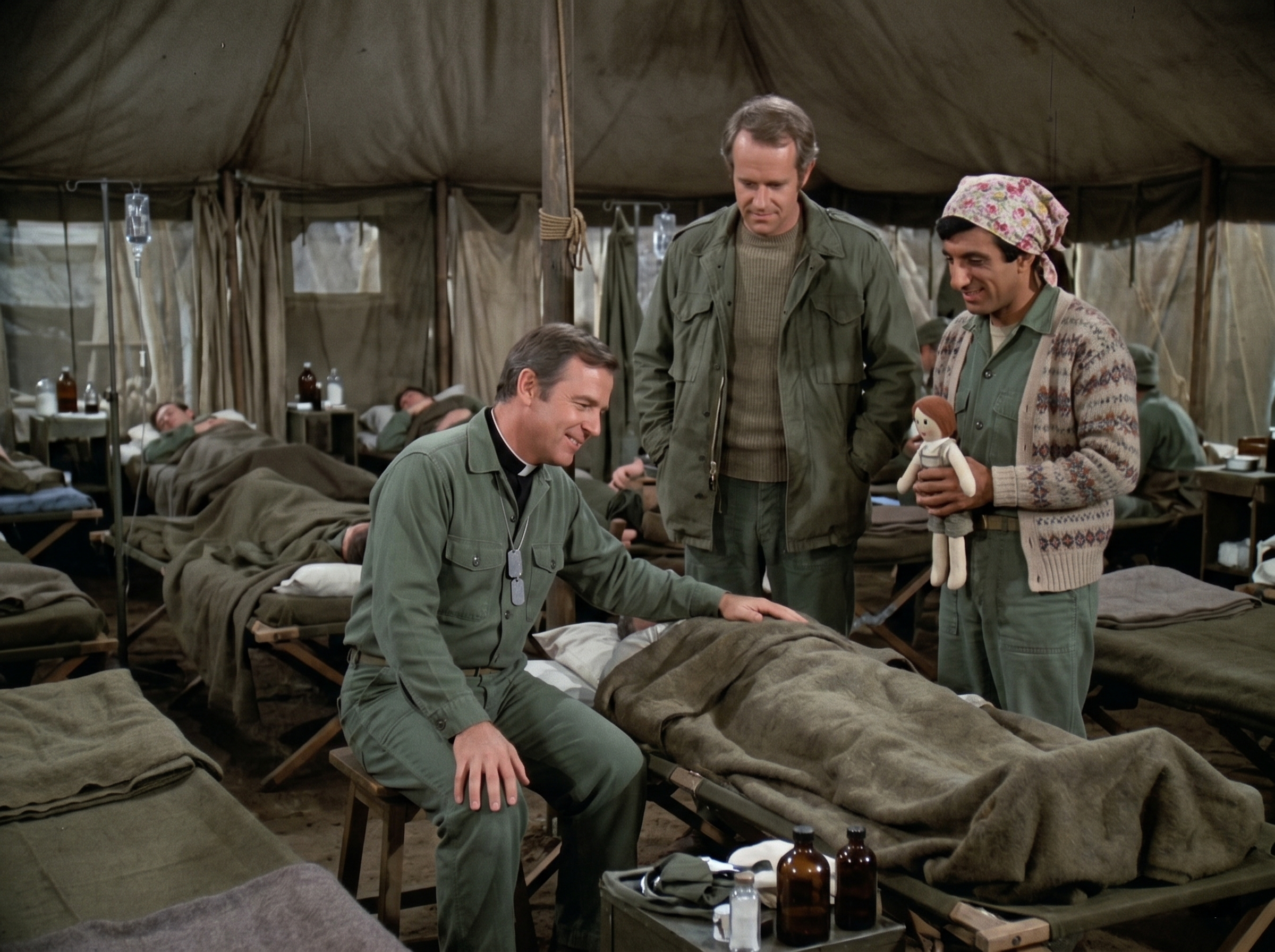
The air in the Post-Op recovery tent always smelled the same: stale coffee, old canvas, and antiseptic soap that couldn’t quite chase away the scent of fear.
It was 0300 after a twelve-hour push. The last helicopter had finally lifted off, and the silence that followed felt heavier than the screaming engines.
In the dim glow of the tent’s single overhead bulb, Father John Mulcahy sat on a small wooden stool beside Corporal Miller. Miller was a quiet boy from Kansas, barely twenty, currently deep in a restless sleep beneath a thin wool blanket.
Mulcahy, wearing his fatigued clerics and dog tags, rested his right hand gently on the boy’s chest, his fingers matching the slow, fragile rhythm of Miller’s breathing. He offered a small, weary smile, less a prayer than a comforting thought. It was his longest sermon of the night, delivered in a quiet posture of presence.
Standing behind him, a steady wall of support, was Captain B.J. Hunnicutt. B.J. still wore his M-65 field jacket over a heavy brown knit sweater, the collar pushed up. His hands were stuffed deep into his pockets, but his thoughtful expression betrayed the fatigue that weighed on his shoulders. He didn’t say a word, just watched Mulcahy watch the boy. His silence was its own form of medicine.
Then, from the shadows at the foot of the bed, a familiar figure materialized. It was Corporal Maxwell Q. Klinger.
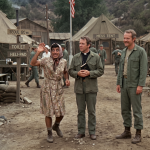
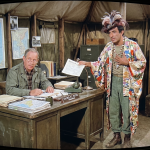
Tonight, Klinger was showing unusual restraint. There were no feather boas or hoop skirts. He wore a colorful floral headscarf tied low and a distinct patterned cardigan sweater over his OD work shirt. He looked less like a soldier trying to get out of the Army, and more like someone’s grandmother trying to stay warm.
But the most surprising thing about Klinger was what he held.
It wasn’t a section-eight petition, and it wasn’t a smuggled salami. In both hands, Klinger carefully cradled a simple, handmade rag doll.
The doll had mismatched button eyes and yellow yarn hair, wearing tiny gingham trousers. It was crude, worn, and impossibly fragile against the backdrop of a battlefield surgical unit.
Klinger, standing at the foot of the bed, offered neither drama nor comedic timing. Instead, his face held a look of sly, quiet hope, his dark eyes reflecting a tenderness he usually hid behind grand gestures.
Mulcahy sensed Klinger’s arrival and slowly looked up. He didn’t question the doll, nor Klinger’s attire. He only saw the expression on Klinger’s face.
B.J. shifted his gaze from Mulcahy to Klinger, his brow furrowing slightly as he processed the scene.
A small sigh escaped Miller under the blankets, and the patient shifted restlessly, his eyes blinking open briefly in confusion.
The silence grew thick again. Everyone waited, the small tent holding its breath, as Klinger made a slow, deliberate move toward the bed.
Klinger stepped closer, avoiding the medical supply crates stacked in the foreground.
He moved around the foot of the cot, holding the doll towards the boy on the mattress. Miller’s gaze was clouded, fighting sleep. He didn’t see the colorful cardigan or the eccentric headscarf. He just saw a kind hand extending something familiar.
“He was rambling about a sister back home,” Klinger said softly. “Kept asking if she knew he was okay. He kept calling for ‘Lily’.“
Klinger nodded toward the doll. “The local villagers made these for the orphanage kids. This one came from a little girl who wanted to say thanks after Colonel Potter gave her a chocolate bar. I thought… maybe she looked a little like Lily.“
Mulcahy’s warm smile deepened, a rare moment of genuine comfort in the dark hours. “An inspired sermon, Max,” he murmured, never lifting his hand from Miller’s chest. “Delivered right at the foot of the pulpit.“
Klinger gently touched the doll’s button eye. He didn’t speak of Section-Eight discharges. In this quiet Post-Op ward, his resilience came not from chasing escape, but from anchoring his sanity in acts of kindness. This doll wasn’t theatre; it was human dignity made of cloth.
“It works,” B.J. said quietly, shifting his weight. “My Peg sends things like this for Erin. It’s amazing how a piece of fabric can make you feel less… gone.“
He looked at Mulcahy, and the two shared a silent moment of understanding. B.J., the steady family man, and Mulcahy, the shepherd of souls, both recognizing a profound truth in the simplest of objects.
Miller’s hand slowly slipped out from beneath the blanket. It was pale and shaky. The boy looked from the doll to Klinger’s hopeful face. His eyes didn’t fill with confusion, but a slow, profound relief.
Klinger gave a small, almost imperceptible nod. He held the doll just near enough. Miller took it, his fingers curling around the gingham trousers and yarn hair. He clutched it tight to his chest, closing his eyes again. The tension in his shoulders vanished, and his breathing steadied.
“Sleep tight, kid,” Klinger whispered. “Lily knows you’re okay.“
Mulcahy watched the boy drift off, the quiet grace of Klinger’s gesture hovering in the stale air. “May you find the comfort you gave him, Max,” the Father said softly.
B.J. smiled, a genuine crack in the armor of fatigue. “Come on, Father. The coffee must be close to drinking temperature. Klinger, you look like you need it, too. If that sweater gets any heavier, you’re going to fall over.“
Klinger didn’t answer with a witty comeback. He just smiled, a look that wasn’t trying to hide anything. He glanced once more at the sleeping boy, then turned and followed B.J. and Mulcahy into the deeper shadows of the unit.
The light in Post-Op remained dim, but in that small corner, a little less cold.
In the heart of the 4077th, hope wasn’t always a grand prayer, but sometimes just a handmade doll holding onto a boy.