The Unspoken Burden
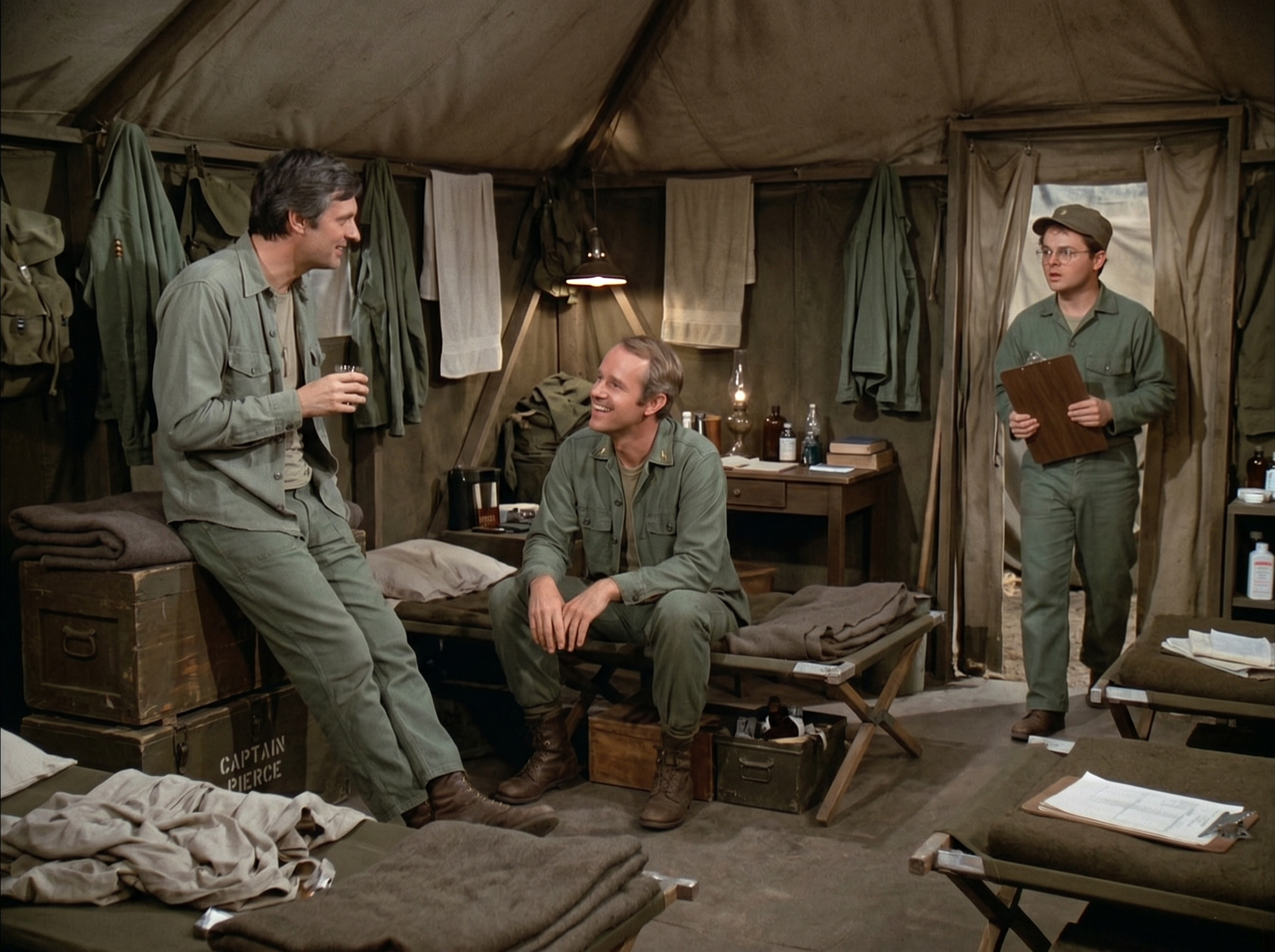
In the sprawling absurdity of the 4077th MASH, quiet moments were rarer than decent coffee. The Swamp, with its tangle of olive drab cots, clotheslines, and half-empty bottles, was a sanctuary. Hawkeye Pierce and B.J. Hunnicutt had carved out a temporary truce with the war. The Operating Room had finally emptied out, leaving them only the exhaustion in their bones.
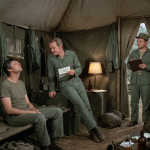
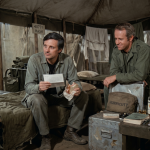
Hawkeye was in peak form, leaning against a stack of crates that served as his personal footlocker. A chipped tumbler of something clear was in one hand, his posture as casual as his wit. His shirt was rumpled, his face etched with fatigue, but his eyes danced with a familiar spark. He was in the middle of a story, weaving defensive humor like an invisible shield against the surrounding chaos.
B.J., seated on the edge of his cot, was watching him with a genuine, open smile. He wore the relaxed comfort that always grounded him, his warm gaze reflecting Hawkeye’s narrative. The messy reality of their life—towels drying on lines, gear scattered everywhere—didn’t touch this small bubble of friendship. For a brief second, they were just two guys sharing a moment of shared humanity and simple joy.
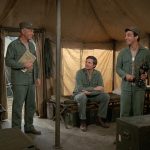
The heavy canvas flap of the tent was pulled back with a decisive, familiar rustle. The light from a small lamp, struggling against the encroaching evening shadows, illuminated the entrance. Their shared joke, the ease, the comfort… all of it instantly dissolved. Walter “Radar” O’Reilly stood in the doorway.
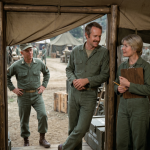
Radar wasn’t standardly frantic; this was different. His green fatigue cap was slightly askew, his large, nervous eyes darting from Hawkeye to B.J. His entire demeanor was tense, his usual unassuming efficiency entirely gone. A clunky wooden clipboard was clenched tightly in his hands, held like a precious and terrifying object.
He didn’t just walk in; he almost vibrated. A worried frown creased his young forehead, and he bit his lip as he looked at the two surgeons. He seemed poised to speak, to drop some catastrophic news that could only wait until the moment it was utterly unavoidable. His expression, frozen in the doorway, held a volume of unspoken distress.
Hawkeye’s smile faltered, replaced instantly by the guarded, slightly mocking look he used for crises. B.J. shifted on his cot, his warm smile giving way to a concerned, attentive focus. Even the inanimate objects in the Swamp seemed to lean in, mirroring their sudden attention. The warm quiet was shattered, and they were all suspended in the silence before the storm he was about to break. Radar stood there, holding a clipboard that felt heavier than the world, and they all waited for the words that would change everything in their small, imperfect sanctuary.
Hawkeye was the first to speak, the sarcasm already a comforting reflex. “Well, look who it is. Walter. The herald of bad tidings and administrative chaos.” He paused, watching Radar’s intense gaze. “What is it, Radar? Another order of size eight gloves when we needed ten? Or did you finally manage to procure a whole crate of something decent?“
Radar didn’t immediately reply; he just continued to stare, gripping the clipboard. “No, Captain,” he finally said, his voice unusually strained, a small catch in it. B.J. stood up, moving over to the small table littered with books and bottles, putting a gentle hand near Radar’s arm. “You look like you’ve seen a ghost, Radar. Sit down. Tell us.“
Instead of sitting, Radar just handed the clipboard to B.J., refusing to let go of the message it held. It wasn’t a standard military order; it was a simple, handwritten letter, folded awkwardly. “It’s… it’s a letter. From Ottumwa. For my mom.” His eyes were brimming, and he looked around the cluttered Swamp as if searching for something familiar. “She says… she says she’s fine, but she’s sick, Captains. An infection. And she was worried about me, and she told the doctor to write…“
Hawkeye’s mocking edge softened completely. “An infection? What kind, Radar?” “She doesn’t say! Just… sick. And she was in the hospital.” Radar looked desperate. “But then she got out. And she wanted the doctor to tell me, so I wouldn’t worry. So why did he write that?” His logic, usually so sound in matters of forms and supply chains, was failing him with the uncertainty of human emotion and distance.
“She told the doctor to write that so you wouldn’t worry, Walter,” Hawkeye said, his voice unexpectedly quiet. “Because she knew that if she didn’t tell you, you’d sense it anyway. That’s how families work. You two are connected, remember?” Hawkeye put his tumbler down on the footlocker with a definitive clatter, all trace of sarcasm gone. “The fact that the doctor wrote that she got out is actually good news, Radar. It means the crisis passed.“
“But I was already sensing something!” Radar protested, his face a complex map of worry. “Last week, I had that dream about the mailbox. And now this. She’s alone, Captains.” His small frame seemed even smaller amidst the chaos of their tent, highlighted against the dark entrance. The image of his mother alone in Ottumwa, with only the distant promise of a letter, was too vivid.
“She’s not alone, Radar. She has friends, and neighbors, and a community that cares about her,” B.J. added, offering the steady reassurance he excelled at. “And she has you, here, doing work that is incredibly important. You help keep this place running, and that helps the soldiers she sends her prayers to.” B.J. was speaking with a conviction that made Radar look down at his boots, a faint blush creeping up his neck. “Think about all the letters you’ve facilitated, the orders you’ve filled. Your mother knows that.“
“But what if it’s bad?” Radar asked, looking from B.J. to Hawkeye. “What if the doctor is just… not saying?” His standard paranoia about bureaucracy was manifesting as a fear for his mother. Hawkeye took the clipboard from B.J., scanning the simple handwritten text. “It’s a genuine note, Radar. Written with care, not deception.” He handed it back, his eyes steady on the young clerk. “Your mother was well enough to direct this. Trust that. Trust her.“
“But…” Radar paused, searching for words. “But I need to check. I need to call.” “You cannot call, Radar. You know the protocols for personal calls during combat,” Hawkeye replied, with unusual strictness for him. “It’s not just a rule, it’s a security measure. And it’s a line we can’t all use.” Radar’s shoulders slumped, defeated by the massive systems he was a small part of managing.
B.J. saw the visible defeat. “But Radar, you can do something else.” “We could write her a letter,” B.J. said gently. “A detailed letter. We can write about how essential you are here. About how we appreciate you. About how much we know you love her.” Radar’s eyes widened, looking between them. “You would do that? But you’re busy officers, and… the OR… and… “
“Consider it our official medical opinion on your well-being, Walter,” Hawkeye said, the wry smile returning to his face. “Written by two slightly questionable surgeons with a flair for the dramatic.” “We can also add some medical advice for her doctor,” Hawkeye teased, his tone defensive once more. “Something like, ‘We highly recommend immediate administration of extra letters from her son.’”
For a second, Radar almost smiled. The tension in his shoulders was easing, just a little. “Okay,” he said, holding the clipboard with both hands again, but this time it looked less like a weight and more like an action plan. “I can start on that. I’ll get some fresh stationery and a decent pen.” He looked at the two captains, really seeing them in their worn fatigues and tired humanity. “Thank you,” he whispered, his voice cracking slightly.
“Get out of here, Walter,” Hawkeye told him, waving him away. “You’re disrupting our deeply important therapeutic session.” Radar nodded once, then quickly turned around and left the Swamp, the canvas flap closing behind him with a comforting rustle. Silence returned to the small, messy space. Hawkeye retrieved his glass, looking at B.J. with a profound, unspoken sigh.
“Tired, Hawkeye?” B.J. asked, his own face mirroring the sentiment. “Tired of it all, Beej. Tired of the forms, the bodies, and the letters.” Hawkeye took a sip, but it didn’t seem to bring the usual comfort. “And tired of seeing that kid’s face crumble when we can’t do anything that matters.” “He’s stronger than he looks,” B.J. said, looking at the spot where Radar had stood. “And we just did do something that matters.“
“The letters from home are the hardest, aren’t they?” Hawkeye murmured, staring at the dimly lit canvas walls. “More than the supply orders or the surgical reports.” B.J. nodded in agreement. “They’re the reminders that this isn’t normal. That there is a life waiting. A whole, beautiful, messy life.” “A life with mothers who get sick, and kids who worry,” Hawkeye added, his voice low. “The simplest things… the most precious things.“
They returned to their initial positions: Hawkeye leaning, B.J. seated. The Swamp was still a cathedral of shared misery, but the unexpected grace that always found its way in was now stronger. The visual scene was the same as before, but changed, deepened by the shared moment of simple human connection. Outside, the war continued with its relentless, tragic noise, but inside, for that fleeting moment, the most important thing had just been getting a scared kid to breathe again.
The simple listening, the validation of a shared burden, was the sanctuary. The three of them—a cynical surgeon, a steady friend, and a gentle clerk—were tied by a world that made no sense, but in moments like this, their friendship was the only logic that held. The messy reality of the Swamp wasn’t just chaos; it was the visible proof of their shared life, their found family, their collective will to survive. They had weathered another small storm, together, anchored by simple acts of care that were far more important than any official military form or medical procedure.
Some human connections are simply too important to be contained by a clipboard.