The Weight of the Paper, the Shade of the Parasol
The hardest thing to fight in a war isn’t always the enemy, the cold, or even the sheer exhaustion. Sometimes, it’s the paper.
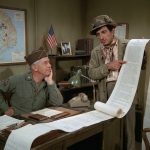
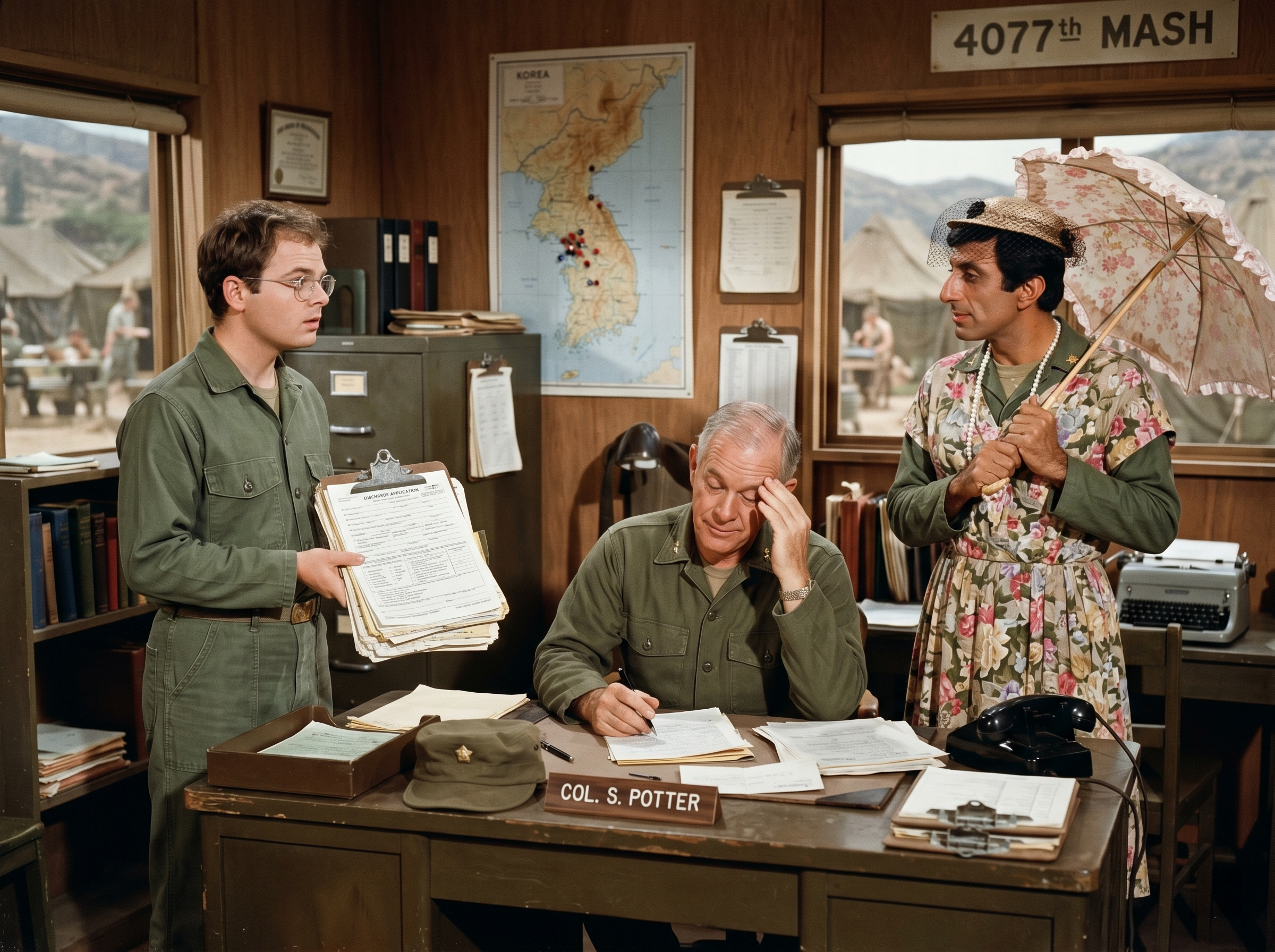
Colonel Sherman T. Potter sat behind his wooden desk, the morning sun already baking the office into a dusty, olive-drab oven. He had been signing forms since 0600 hours. Requisitions, daily reports, inventory manifests, and forms that simply confirmed he had signed other forms.
His hand ached. His eyes burned from the lack of sleep following a brutal forty-eight-hour session in the O.R.
Standing to his left was Corporal Walter “Radar” O’Reilly. Radar was clutching a clipboard so thickly stacked with army red tape that it looked heavy enough to anchor a battleship.
Radar stood at attention, his face a picture of earnest, nervous dedication. He had his thumb wedged into the stack, keeping his place among the endless paragraphs of military jargon.
“And this one, sir,” Radar said, his voice carrying that familiar, youthful squeak. “This is form 4-J. It’s an application for the requisition of new applications. They changed the old forms, so we need to fill out this form to get the new forms to replace the forms we already filled out.”
Potter didn’t look up. He just kept scratching his pen across the paper in front of him.
To Potter’s right stood Corporal Maxwell Q. Klinger. He was waiting patiently for his commanding officer’s attention.
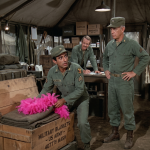
Klinger was entirely wrapped up in his latest bid for a Section 8 discharge. Today’s ensemble was a vibrant, floor-length floral print dress, accented by a perfectly draped pearl necklace.
Perched on Klinger’s head was a woven straw hat adorned with a delicate black veil. To complete the look, he was holding a frilly pink parasol over his shoulder, shielding himself from the non-existent indoor rain.
“Colonel, sir,” Klinger chimed in, his deep, gravelly voice contrasting wildly with the lace and pearls. “If you have just a moment to review my latest psychiatric evaluation. I believe you’ll find I am entirely unfit for military service. I am currently experiencing a severe delusion that I am a southern belle at a garden party, and the artillery fire is just the sound of aggressive croquet.”
Potter stopped writing.
The scratch of the fountain pen ceased. The silence in the small office suddenly felt heavier than the stifling Korean heat.
Potter slowly placed the pen down on the desk. He didn’t yell. He didn’t snap.
Instead, he brought his left hand up to his forehead, pressing his fingers deeply into his temple. He closed his eyes, squeezing them shut as a dull, throbbing headache blossomed behind his eyes.
Radar froze, his knuckles turning white as he gripped the massive stack of paperwork. He knew the signs. The old man was running on empty.
Klinger stopped twirling his parasol. The theatrical smile faded from his face, replaced by a sudden, very real look of concern.
The camp outside the open door seemed to quiet down. The war was thousands of miles from home, the paperwork was endless, and Colonel Potter looked like a man who was finally about to break under the sheer, absurd weight of it all.
The silence stretched out. It lasted for five seconds, then ten.
In the 4077th, a ten-second silence was usually the warning siren right before an explosion. Radar instinctively took a half-step back, pulling the giant clipboard closer to his chest like a canvas shield.
He was mentally preparing for a classic Potter eruption. He expected a bellow about horse hockey, buffalo bagels, and the sheer, unadulterated lunacy of the United States Army.
But the eruption never came.
Instead, Potter let out a long, slow exhale. It was the tired sigh of a man who had seen too many wars, too many wounded boys, and entirely too many forms in triplicate.
He lowered his hand from his forehead and opened his eyes. He looked at the map of Korea on the wall behind Radar, then shifted his gaze back to his desk.
“Radar,” Potter said, his voice quiet, worn down to a soft rasp. “Tell me exactly what would happen if I took that entire stack of paper you’re holding, walked outside, and threw it directly into the incinerator.”
Radar swallowed hard. “Well, sir. Technically, under Army Regulation 40-50, the willful destruction of official documents is a court-martial offense. But…” Radar paused, his eyes darting to the side. “But I suppose I could just say the jeep hit a bump and they flew into a puddle. Then I’d have to fill out the forms for lost forms, sir.”
Potter managed a very small, very tired half-smile.
“Let’s split the difference, Son,” Potter said gently. “Give me the top three that actually matter. The ones that get us plasma, penicillin, and fresh socks. The rest of that novel you’re holding? Bury it at the bottom of the filing cabinet. If General MacArthur himself rises from the grave to ask for them, tell him I used them to patch a hole in the mess tent.”
Radar’s shoulders dropped in immediate relief. “Yes, sir. Plasma, penicillin, socks. The rest go into the dark drawer.”
Radar expertly flipped open the clipboard, extracted three single sheets of paper, laid them on the desk, and quietly stepped back, hugging the now-condemned stack of bureaucracy.
Potter signed the three forms with quick, practiced strokes. Then, he turned his chair slightly to face the right side of the room.
He looked Klinger up and down. He took in the floral pattern, the tasteful pearls, the black netting on the hat, and the pink ruffled parasol.
Klinger stood a little straighter, gripping the handle of the parasol. He was ready for the rejection. He was ready for the Colonel to shout him out of the office and threaten him with a court-martial for the uniform violation.
Potter just leaned back in his chair and crossed his arms.
“Klinger,” Potter said, his tone entirely conversational.
“Yes, Colonel?” Klinger replied, his voice slipping out of its theatrical pitch and returning to its normal, nervous register.
“You know, my wife Mildred has a dress almost exactly like that one,” Potter said, his eyes crinkling just a bit at the corners. “Wore it to our nephew’s wedding back in ’46. Except hers was a shade lighter. Periwinkle, I think she called it.”
Klinger blinked, completely caught off guard. “Periwinkle, sir? A fine color. Very… summery.”
“It is,” Potter agreed. “But Mildred always knew better than to wear an outdoor hat indoors. And she certainly wouldn’t open a parasol inside a canvas tent. It’s bad luck, Son.”
Klinger looked up at the pink canopy above his head. Slowly, with an almost apologetic shrug, he reached up and clicked the parasol shut.
“You make a fair point, Colonel,” Klinger said softly. “Wouldn’t want to bring any bad luck down on the camp.”
“Appreciate that, Klinger,” Potter said. He reached out and tapped the pile of signed forms on his desk. “Your discharge is denied, by the way. But the outfit is a solid B-plus. It brings a little color to this drab little corner of the world. Dismissed.”
Klinger offered a sharp, crisp salute, entirely incongruous with the lace trim on his sleeves. “Thank you, sir. I’ll try for an A-minus next week.”
As Klinger spun around and marched out the door, his floral skirt swishing around his boots, Radar stepped forward to collect the signed paperwork.
“Will that be all, Colonel?” Radar asked quietly.
“That’ll be all, Radar,” Potter said, picking up his pen once more. The headache was still there, but it wasn’t quite as sharp.
He watched Radar scurry out of the office, hauling his mountain of discarded forms.
Potter sat alone in the quiet office for a moment. He looked at the empty chairs, the dust motes dancing in the sunlight, and the “4077th MASH” sign hanging over the door. They were a band of lunatics, dreamers, and exhausted children, all playing dress-up and pushing paper to hide from the reality of the war just over the hills.
But they were his lunatics. And as long as they were here, he supposed he could find the strength to sign his name a few more times.
He pulled the next blank form toward him, uncapped his pen, and went back to work.
In a place where the world has gone entirely mad, sometimes the only thing that keeps you sane is the quiet, stubborn love of your strangest friends.