The Inventory of the Heart
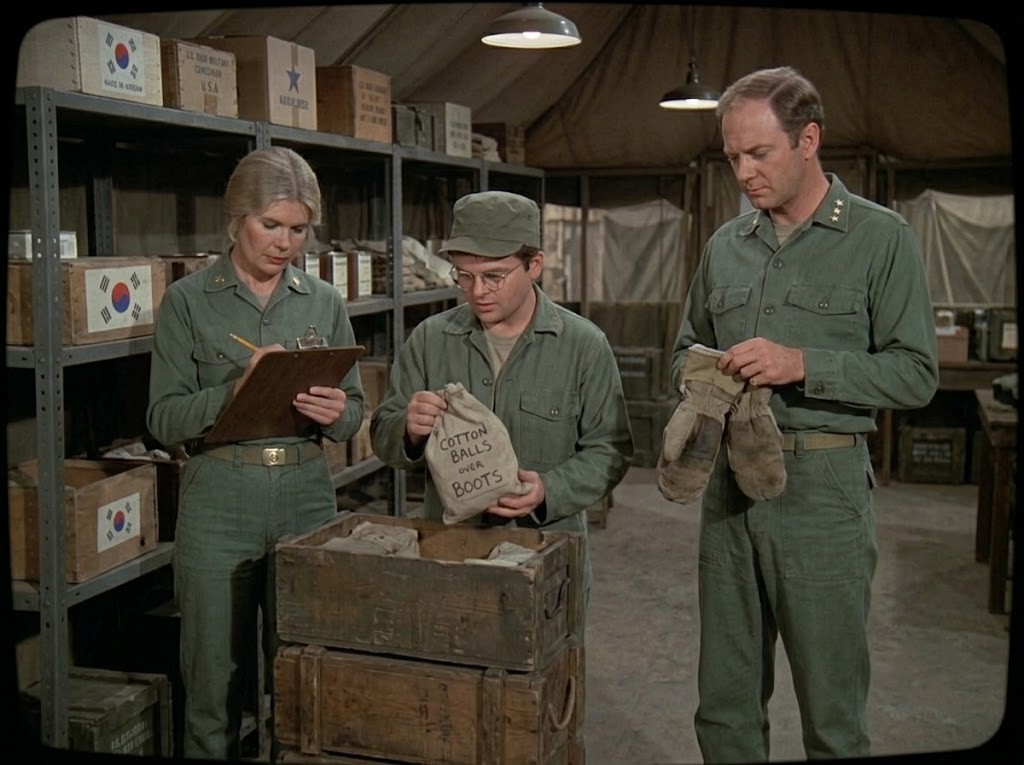
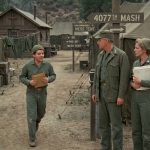
The supply tent of the 4077th was always three degrees colder than the rest of the camp, and twice as confusing.
If you asked the army for a dozen fresh blankets to survive the biting wind coming off the mountains, you were guaranteed to receive two crates of standard-issue typewriter ribbons and a single, baffling left-handed glove.
It was late afternoon, the kind of quiet day where the lack of incoming choppers left everyone with too much time to think, and too much time to feel the ache in their bones.
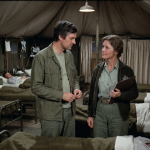
Major Margaret Houlihan stood by the metal supply shelves, her pen poised over a wooden clipboard with absolute military precision.
Her brow was furrowed, her lips pressed into a tight line as she tried to make sense of the chaotic manifest sent down from Seoul.
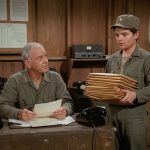
Next to her, Corporal Radar O’Reilly reached into an open wooden crate, his small hands pulling out a heavy canvas sack that defied all logic.
He blinked through his thick glasses, turning the small bag over as if waiting for it to make sense in the dim light of the overhead bulb.
“Major,” Radar said, his voice cracking slightly with that familiar, earnest innocence. “I think the supply clerks in Tokyo have been drinking the medicinal alcohol again.”
Margaret sighed, not looking up from her clipboard. “What is it now, Corporal? If it’s another box of dehydrated water, I’m going to personally march to Seoul.”
“Not exactly, ma’am,” Radar mumbled, lifting the sack so she could see it. “It’s a bag. And it says… ‘COTTON BALLS OVER BOOTS.’ But it’s small. Really small.”
Major Charles Winchester stood just to Radar’s left, looking as thoroughly displaced and aristocratic as a man could look while surrounded by moldering army surplus.
He was holding a pair of heavy, stained winter mittens, turning them over with two fingers as if they were a pair of contaminated specimen.
“An extraordinary specimen of military efficiency,” Charles drawled, his Boston accent cutting through the chilly air like a silver butter knife. “They send us mittens that appear to have been previously worn by a prehistoric caveman, paired with a bag of cotton balls apparently intended for a giant who wears combat boots. Or perhaps, conversely, boots made entirely of cotton. The mind reels at the sheer genius of the Pentagon.”
Margaret finally lowered her clipboard, her eyes narrowing as she looked at the canvas bag in Radar’s hands.
“Let me see that,” she ordered, stepping closer.
Radar held it up defensively. “It’s heavy, Major. It doesn’t feel like cotton balls. And it definitely doesn’t feel like boots.”
The room grew quiet for a second, save for the distant, rhythmic hum of the generator outside.
In a camp like the 4077th, a mislabeled crate was usually a joke—a source of brief entertainment for Hawkeye and B.J. to exploit over a glass of swamp gin.
But there was something about the weight of this particular box, sitting beneath crates marked with the South Korean flag, that made Margaret pause.
She looked at Charles, whose sarcastic smirk faded just a fraction into a look of genuine curiosity.
“Open it, Corporal,” Margaret said softly, her professional armor slipping just enough to reveal the protective, maternal spirit underneath.
Radar untied the coarse twine keeping the sack closed, his fingers trembling slightly from the draft in the tent.
He reached inside, his hand disappearing into the canvas, and pulled something out.
It wasn’t medical supplies. It wasn’t standard military gear.
As Radar held the item out in the light, the three of them stared in absolute silence, the sudden weight of the discovery hanging heavily in the cold air.
—
It was a collection of handmade woolen socks, knit with thick, mismatched yarn, and tucked inside one of them was a crumpled piece of loose-leaf paper.
Radar carefully unfolded the note, his eyes tracking the neat, trembling cursive handwriting.
“It’s from a church group,” Radar whispered, his voice dropping an octave as he read. “In Ohio. A ladies’ knitting circle. It says… ‘For the boys keeping the peace. To keep your feet warm when the winter comes. We are praying for you every Tuesday.'”
The sarcasm completely drained from Charles’s face.
He looked down at the old, stained mittens he was holding, suddenly looking very self-conscious of his own complaints.
Margaret took the note from Radar’s hands, her fingers tracing the faded ink.
For all her talk of regulations and the army way, Margaret felt the profound loneliness of the camp deeper than most.
She knew what it was like to crave a touch of home, a reminder that they weren’t just a dot on a map surrounded by mud and misery.
“They must have mislabeled the bag at the shipping depot,” Margaret said, her voice unusually gentle. “Some clerk saw ‘Socks’ and wrote ‘Boots,’ and then someone else tried to correct it, and… well.”
“And instead of ending up at a warm supply depot in Tokyo, it found its way to the three most freezing people in the northern hemisphere,” Charles murmured, his voice lacking its usual booming theatricality.
He reached into the crate, his long, refined fingers pulling out another pair of the thick, colorful socks.
They were utterly devoid of military utility—bright blues, warm maroons, and a pair that looked suspiciously like a failed attempt at a Christmas pattern.
“They’re completely non-regulation,” Margaret noted, but there was no bite in her words.
“The Colonel’s feet have been bothering him,” Radar said quietly, looking up at Margaret. “He says the dampness gets into his old cavalry wounds. And Father Mulcahy… his boots have a hole in the left sole. He wouldn’t ask for a new pair because he said the local kids needed the leather more.”
Charles looked at the socks, then at his own pristine, custom-ordered leather boots.
He thought of his comfortable home in Boston, the crackling fireplaces, the hot cider, and the sheer abundance of his former life.
Then he looked at Radar, a kid from Iowa who looked like he belonged in a high school classroom instead of a olive-drab supply tent in a combat zone.
“Corporal,” Charles said, clearing his throat and adjusting his collar to hide a sudden wave of emotion. “It appears to me that the manifest is completely inaccurate. Therefore, as a matter of strict administrative accuracy, these items do not exist.”
Radar blinked. “Sir?”
“If they do not exist,” Charles continued, turning the bright maroon socks over in his hands, “they cannot be audited. And if they cannot be audited, they cannot be confined to this dreadful tent.”
Margaret looked at Charles, a soft, knowing smile breaking through her serious expression.
“The Major is right, Radar,” Margaret said, capping her pen with a decisive click. “Mark the crate as ‘Mislabeled/Disposed.’ We can’t have non-regulation wool clogging up our inventory.”
“Yes, ma’am!” Radar smiled, his face lighting up with that genuine, pure joy that kept the camp’s heart beating.
Within an hour, the contents of the little canvas bag had vanished from the supply tent.
A pair of bright blue woolen socks found their way onto Colonel Potter’s desk, tucked discreetly beneath a stack of personnel reports.
Another pair, the thickest of the bunch, was left silently on Father Mulcahy’s cot while he was out visiting the wards.
Even Klinger received a pair of vibrant green ones, which he immediately claimed perfectly matched his winter liberty skirt.
Later that evening, as the night chill truly set in, Hawkeye and B.J. walked into the Swamp, shivering and complaining bitterly about the cold.
Charles was sitting on his cot, a classical record spinning softly on his phonograph, a book in his lap.
He didn’t say a word as the two younger doctors poured themselves a drink, but as he shifted his legs, the hem of his pristine trousers pulled up just enough.
There, sticking out of his immaculate leather shoes, were a pair of thick, hand-knit, wildly mismatched woolen socks.
Hawkeye opened his mouth to make a joke, but B.J. caught his arm, shaking his head with a quiet smile.
Charles caught them looking, cleared his throat loudly, and turned the page of his book.
“The acoustics in this tent are dreadful,” Charles muttered to his book, though the corner of his mouth twitched upward. “Goodnight, gentlemen.”
Outside, the wind howled against the canvas, but inside the tents of the 4077th, the world felt just a little bit warmer.
In the middle of nowhere, it was the things that didn’t officially exist that kept them all alive.