The Letter and the Leatherneck
If there was one thing you could count on at the 4077th, besides a steady stream of incoming wounded and Winchester complaining about the plumbing, it was the bizarre, theatrical, and sometimes strangely moving persistence of Corporal Maxwell Klinger. But even for Klinger, what happened that Tuesday afternoon in Colonel Potter’s office was something else entirely. It started subtly, a vibration felt only by Radar’s preternatural senses, the sound of a very specific, slightly frantic set of footsteps approaching before any of us even knew he’d left the motor pool.
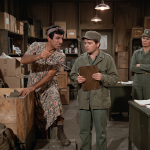
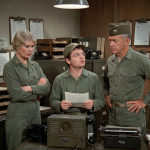
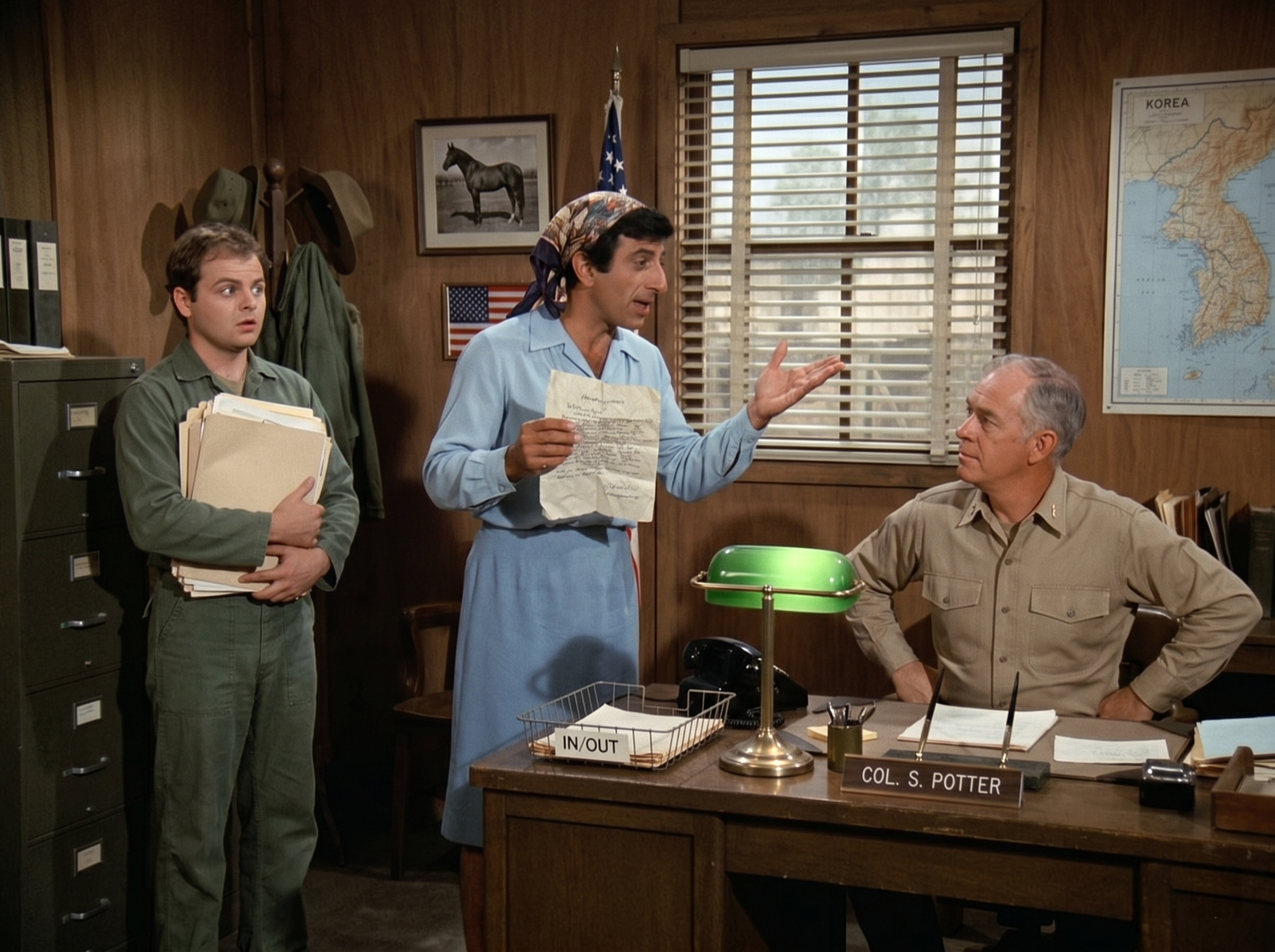
I was standing there, watching Radar clutch a stack of folders as thick as a Sears catalog. He was already looking nervous, and that was saying something. Radar nervous was a low-level static electricity you could practically smell. When Klinger burst through the door, though, even Radar’s antenna-like ears seemed to twitch in surprise. Klinger wasn’t in his usual tailored chiffon. He was wearing something slightly more utilitarian, but no less dramatic—a kind of fetching, light blue skirt suit and a patterned headscarf that whispered of a Mediterranean spring afternoon, if you squinted hard enough. He was holding up a single, crumpled piece of paper as if it was a sacred scroll, his other hand outstretched in an eloquent gesture of desperate persuasion, his face a canvas of pure, bewildered emotion.
“Colonel! You won’t believe it! The most *miraculous* thing just arrived!” Klinger’s voice was pitched high, trembling with the kind of energy that could jumpstart a dead battery. Colonel Potter, bless his steady old heart, just sighed. He was sitting behind that massive desk, hands planted, looking like a man who’d seen it all and survived. The green banker’s lamp cast a sickly glow on his expression, which was less ‘tell me more’ and more ‘how much is this going to cost me?’ Behind him, the U.S. flag and a photo of a very sturdy-looking horse (Colonel’s favorite, naturally) completed the picture of quiet authority waiting for the storm to break. “Klinger,” Potter said, “I have paperwork for two full weeks that needs processing, including *your* transfer requests.” He massaged his temples. “Whatever this miracle is, make it quick. And make it not involve another discharge scheme.”
But it *wasn’t* a discharge scheme. This time, Klinger’s face wasn’t theatrical desperation, it was genuine, raw disbelief mixed with something that looked suspiciously like hope. He waved the letter frantically. “A letter, Colonel! A *real* letter! From my grandmother!” Radar let out a small gasp. “Grandma Klinger? But…she can’t read or write!” Klinger turned to Radar with wild eyes. “That’s it, Radar! That’s the miracle! The postmark, the handwriting… it’s all here! It’s *her*!” He turned back to the Colonel, his arm still extended, holding the letter aloft like a holy relic. For the first time, Potter leaned forward. The look on Klinger’s face wasn’t a fabrication; it was a mix of awe and a vulnerability we rarely saw beneath the dresses. “She didn’t write it,” Klinger said, his voice dropping to a near-whisper. “She dictated it. To Father Mulcahy, in an email… I mean, a message from God. No, not email! That’s decades away. What’s the thing they use? Telepathy! No, *prayer*! Radar, what do they call that newfangled thing in the papers? A… a *telegram*?” No, it wasn’t a telegram. It was something entirely different, something almost as impossible. He just stopped, staring at the letter, leaving us all hanging.
Klinger just froze, his arm still in the air, a small tear escaping down his cheek. He swallowed hard. “Colonel… my grandmother… she’s always told me about the ‘old country’ and how important it is to remember where you come from. She doesn’t know I dress up like this.” He gestured vaguely at his outfit. “But I told Father Mulcahy about this special dream I keep having. A dream about seeing her again, healthy and young, just for one day. And somehow… somehow he managed to send a message *to* her, through some incredible kind of long-range… something!” We all stared at him. The idea was absurd, but the conviction in his voice made us all hesitate. “Klinger, what are you talking about?” Potter asked, his voice softening just a fraction.
Klinger un-crumpled the letter slowly. “It says… it says she knows I’m a brave boy, doing my duty. She says she’s proud of me. And then… and then it says: ‘I may not be able to write these words, but I see your face when I pray. Your face is full of joy, Maxwell, like the summer sun over the village.’“ He stopped, choked up. “Joy, Colonel! She doesn’t see a dress. She sees *joy*. And then she says: ‘I know you worry, but please remember the story of the lost button.’” He paused again, looking completely bewildered. “The lost button? I have no idea what that means! My family doesn’t lose buttons. We lose our tempers, but never buttons!”
We all waited, the silence in the office heavy with confusion and something else, something tender and almost fragile. Potter was watching Klinger with a look I’d rarely seen him give the Corporal—a kind of quiet understanding. “A lost button,” Potter repeated, more to himself than anyone. Radar took a timid step forward. “Klinger,” he said, his voice very small, “remember when we first met, in that bar, before I even joined the Army? You told me your grandmother gave you a special button when you were a little boy, said it was from her wedding dress.” Klinger blinked, his memory struggling. “The… the pearl button? The tiny one?” Radar nodded. “Yeah, that one. You said you used to keep it in your shoe, because she told you it would make you walk towards happiness.”
The realization hit Klinger like a tidal wave. His hand went to his chest. “Yes! The pearl button! She told me if I ever felt lost, if I ever wondered if I was doing the right thing, to remember the button, and it would guide me!” He looked at the letter, then at Colonel Potter, his eyes wide with a different kind of tears now. “Colonel, it’s about finding my way. My grandmother… she knew. She *knew* what I was really searching for, even before I did.” A quiet chuckle erupted from Klinger, a wet, genuine sound that was half sob, half laugh. “Even when she can’t even read the words, she’s still teaching me.”
Colonel Potter slowly took off his glasses and set them on the desk. He looked at Klinger, then at the horse on the wall, then back to Klinger. “Klinger,” he said, his voice strangely rough, “I may have a mountain of paperwork from every lunatic and loon in this Army, but it’s letters like that that remind me why I bother to file any of it.” He gestured to a corner of his desk. “Put the letter on top of the pile. I’ll make sure it gets put in your personal file. Properly.” He looked Klinger right in the eyes. “And Corporal… maybe you should wear that suit more often. Blue is definitely your color.” Klinger stood a little straighter, a small, proud smile touching his lips. “Yes, Colonel. Thank you.” As he walked out, he didn’t bounce; he just walked. And you could tell he was walking towards happiness, one pearl-button-guided step at a time, reminding us all that sometimes, the true miracle wasn’t the postmark, but the quiet echo of home that could find us, even on the furthest battlefront.
In the end, it was a simple button that tied the 4077th together, proving that even a world away, family is never truly out of reach.